Core HR encompasses the fundamental processes, data, and software that underpin an organization’s HR operations.
Imagine the foundation of a thriving company, where every person feels supported, engaged, and aligned with the organization’s goals. At the heart lies core HR, the essential processes and data that keep everything running smoothly.
Core HR is an umbrella term used to refer to three distinct things:
- The primary functions of a human resources department
- Basic HR data captured about team members
- The HR software used to enable the first two
Effective core HR management optimizes organizational efficiency and creates a positive, thriving company culture. And when core HR processes prioritize team member experience, the subsequent engagement boost can increase productivity by 14 percent and profitability by 23 percent.
This article reviews core HR functions, types of core HR data, and how core HR software streamlines an HR team’s workflow and drives business success.
<< Optimize your workflows with a free core HR processes checklist >>

Key insights
- Core HR encompasses the fundamental processes, data, and software that underpin an organization’s HR operations
- It includes essential functions like recruitment, onboarding, time and attendance management, performance management, and compliance
- Core HR software streamlines administrative tasks, enhancing efficiency and allowing HR professionals to focus on strategic initiatives
- Efficient core HR systems improve internal communication, data privacy, and the ability to access actionable insights
- Investing in robust core HR software supports a positive company culture, engagement, and organizational growth
Why is core HR important?
Core HR is central to compliance and risk management. Because it underpins everything from hiring and contracts to paid time off (PTO) rules and pay changes, a strong core HR foundation helps teams apply policies consistently across locations and departments. Standardized workflows replace scattered docs and guesswork with clear checkpoints and reliable records. This ensures that compliance steps happen in the correct order, potential risks are flagged early, and teams have a traceable record to reference during audits, policy reviews, or internal questions.
An automated and streamlined core HR system improves internal workflows, privacy and security, and a team’s ability to access quality data for actionable insights. With clear HR strategies, HR professionals effectively manage team members’ journeys to help improve engagement, retention, and productivity. The payoff extends beyond HR outcomes: Companies with strategy-minded HR teams are 1.4 times more likely to report outperforming competitors.
<< Build a high-performing workforce with our strategic talent management template >>
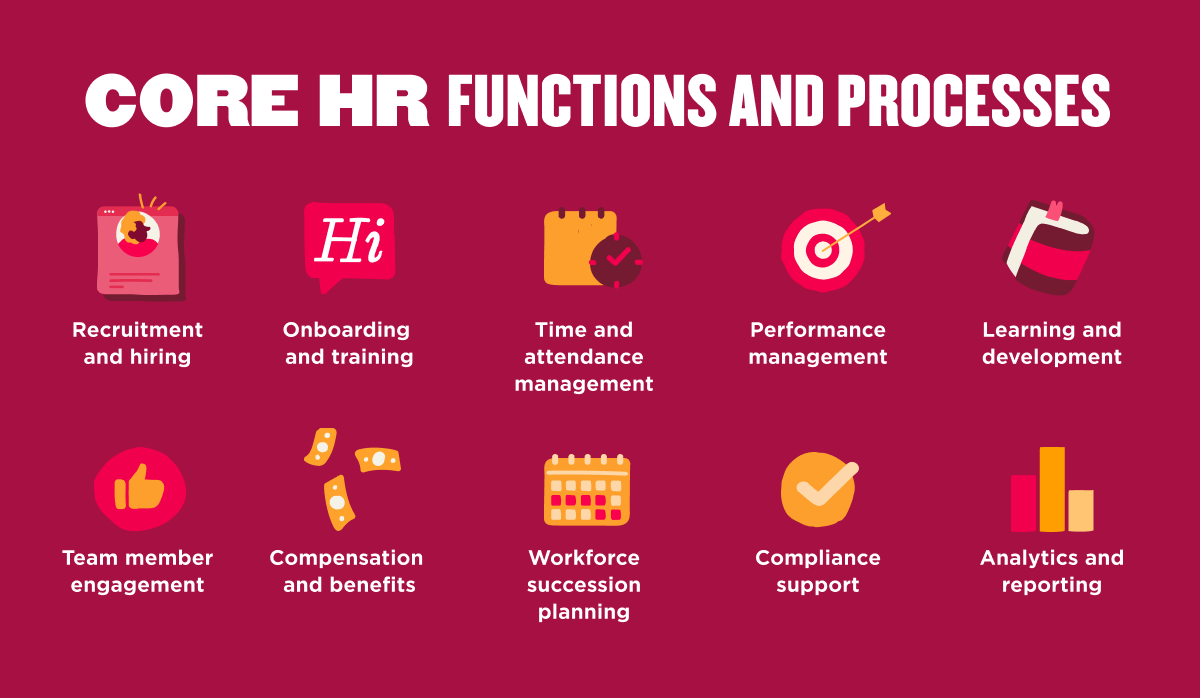
Core HR functions and processes
Human resources teams perform several core functions across the employee lifecycle. The following processes make up the day-to-day backbone of people operations:

Recruitment and hiring
With the right approach to recruitment and hiring, HR teams can find candidates with the right skills and culture fit. An effective hiring process helps HR teams and hiring managers determine how well applicants will align with the company’s goals and work environment.
This process includes:
- Preparation: HR teams gather information from hiring managers to write a job description for the open position. A clear, concise job description attracts relevant candidates to apply for the role and provides a reference point for evaluating a new joiner’s performance.
- Candidate sourcing: HR teams find candidates through job boards, social media, team member referrals, and internal recruiting. In-house recruitment speeds up onboarding processes and provides career progression opportunities for your people.
- Resume screening: The next step is to screen and shortlist applicants. Determine screening criteria based on the job requirements and role qualifications. Applicant tracking systems (ATS) can help identify candidates with the required skills and experience.
- Interviews: HR teams and hiring managers use interviews to get a feel for each of the candidates and their fit for the company. HR facilitates this process by scheduling interviews, consolidating insights, and providing interview feedback to candidates at the end of the process.
- Hiring: After reference checks, background checks, and internal discussions, it’s time to make the final hiring decision. This involves finalizing the employment terms, discussing salary and benefits, and presenting an exciting job offer to the candidate.
The average time-to-fill role is about 44 days, but core HR software can speed things up by helping HR teams “predict hiring trends and make proactive decisions that better serve candidates and the organization,” says recruitment advertising expert Michael Ang. When requisitions, approvals, and offers are centralized, the process runs with fewer hiccups, from the initial headcount ask through to the signed offer.
If the candidate accepts, the onboarding process begins.
<< Speed up hiring handoffs with a free job offer letter template >>
Core HR process example: Building a smoother hiring pipeline
Lunar was growing fast and hiring across multiple teams, but a clunky handoff between their ATS and HR records slowed things down. HR had to re-enter new-hire details manually, creating delays and occasional data issues right when speed and accuracy mattered most.
They solved this by linking the ATS directly to core HR records, so candidate information flowed automatically into team member profiles as soon as the team hired someone. The result was less repetitive admin, fewer errors, and a single, dependable view of hiring progress and headcount needs for both recruiters and HR.
Onboarding and training
HR handles the onboarding process, which starts as soon as a hiring manager makes an offer to a candidate. Companies with a standard onboarding process see about 50% higher new-joiner productivity than companies without standardized processes, and those new joiners are 58% more likely to still be with the company three years later.
The onboarding process typically includes:
- Preparing onboarding materials like tax forms, company handbooks, and a welcome letter for the joiner
- Assigning existing team members specific onboarding or training responsibilities
- Training the joiner on company systems and software
- Introducing the new person to their team and overall company culture
- Creating opportunities for social interaction with the team to build relationships
- Scheduling regular check-ins to track the onboarding progress and discuss questions or concerns
Many HR teams use onboarding software to automate and manage the tasks of welcoming new joiners and ensuring a smooth transition.
Core HR process example: Replacing manual onboarding workflows
Payapps’ onboarding used to run through email chains: HR manually sent contracts and policies, scheduled meetings, and tracked progress by hand. They redesigned onboarding into a repeatable workflow with automatically triggered tasks, role-based documents sent at the right time, and clear ownership across HR and managers. This saved the team hours every month and helped new joiners feel welcomed and connected earlier.
<< Streamline your onboarding process with these essential onboarding checklists >>
Time and attendance management
Transparent time-tracking and attendance policies can reduce stress for your people and nurture a positive and respectful work environment. Make it easy for team members to request PTO, log work hours, and track absence requests.
Automated time-tracking tools and team member self-service options can alleviate the administrative burden on HR, saving time for strategic initiatives.
Core HR process example: Standardizing time off globally
With team members across 12 countries, Australian Wool Innovation faced complex leave of absence rules and inconsistent tracking. HR standardized time-off policies globally, introduced a single request-and-approval flow, and automated leave data updates for payroll readiness. This reduced errors and saved roughly 1.5 admin days per month.
Performance management
Performance management involves tracking your people’s work performance and creating development opportunities. A strong performance management strategy helps organizations identify high-performing team members, streamline succession planning, and drive productivity.
HR teams can facilitate performance management efforts by scheduling reviews, creating development plans, and encouraging a culture of continuous learning. Help your people improve their performance by providing access to mentorship programs, HR courses and certifications, and leadership training. Maria Miletic, chief people officer ActiveViam, put it best: “Education, patience, and iteration are key to delivering an engaging experience for all.”
<< Guide growth conversations with a free professional development plan template >>
Core HR process example: Modernizing performance conversations
Save the Children Italia had been running performance reviews in spreadsheets and manual follow-ups, which led to inconsistent cycles and made development conversations challenging to sustain.
As they scaled, they moved to a structured performance approach centered on shared goals and OKRs, adding 360-degree feedback so managers, peers, and partners could all contribute. The shift gave leaders a clearer, more rounded view of performance, helped people get timely direction instead of waiting for annual reviews, and made the cycle far easier to run across both HQ and field teams.
<< Improve your review process with performance management review templates >>
Recommended For Further Reading
- Best HR software for small business
- What is HRMS?
- Best HR software for startups
- Rippling vs. Gusto vs. HiBob: Features, pricing, benefits
- How to choose an HR software for your small business
- How to integrate HR data for better decision-making
- How Save the Children Italia modernized performance management and saved hours on core HR with Bob
Learning and development
HR teams implement learning and development (L&D) initiatives to level up their people’s competencies and improve organizational performance. Team members can learn new skill sets and upgrade their existing knowledge, helping them advance their careers, earn pay raises, and take on new challenges.
To facilitate learning and development, HR teams can:
- Perform skills gap analysis by sending out surveys, conducting performance reviews, researching industry-standard skills, and offering assessments
- Offer a variety of programs to accommodate different learning styles
- Implement a learning management system (LMS) to optimize learning processes
- Assess and measure the improvement in team member performance using L&D metrics
- Stick to repeatable and effective learning practices to deliver consistent results and encourage a culture of lifelong learning
Core HR process example: Aligning development to actual needs
VaynerMedia wanted L&D to stay relevant for a fast-moving, growing workforce. Instead of rolling out one-size-fits-all training, their People team used signals from across the team member lifecycle—especially engagement survey insights and goal-setting data—to spot skills gaps and emerging needs in real time. Those insights informed targeted development opportunities, keeping learning aligned with team needs and the company’s evolving direction.
<< Shape learning goals faster with a free professional development plan template >>
Team member engagement
Strong employee engagement is an essential part of any successful organization, with highly engaged teams seeing 51 percent lower turnover, according to Gallup.
Engaged people can also lead to:
- Increased productivity
- Stronger performance reviews
- Greater presenteeism
- Higher-quality work
- Better work relationships
Several factors impact team member engagement, including company culture, career growth and learning opportunities, and work-life balance. With so many levers at play, tracking engagement early on gives you a baseline and makes changes easier to see over time. Use lifecycle feedback tools, frequent surveys, and performance reviews to gather insights, then keep refining your approach based on the data.
Core HR process example: Reducing admin time to increase engagement
At Hipages, siloed communication and manual processes were getting in the way of meaningful team engagement. The team automated routine admin tasks and standardized lifecycle workflows to create more consistency and reduce manual effort. This shift cut HR admin time by 30 percent and gave the team more capacity to focus on engagement, leading to clearer communication, stronger connections, and a better experience for team members.
Compensation and benefits
Strong compensation management helps companies attract and retain talent and maintain strong engagement. HR teams work with company leadership, managers, and benefits specialists to create comprehensive compensation strategies that offer competitive compensation packages to new joiners.
In addition to salaries, compensation packages can include benefits, bonuses, pensions, equity, and professional or lifestyle benefits. “Many businesses think that compensation is a salary and that’s it,” says business advisor Emilie Poirer. “Meanwhile, you may be offering other advantages but not communicating them effectively.”
Core HR process example: Rolling out pay transparency
GoCardless introduced pay transparency by first defining salary bands and sharing them with managers, then expanding visibility company-wide once the approach was proven. With centralized, accurate role and compensation data, the team rolled out transparency consistently, built trust, and advanced their goal of closing the gender pay gap.
Workforce and succession planning
Workforce planning is the strategic process of analyzing your current workforce, forecasting future talent needs, and creating a plan to close any gaps. HR teams work with their organization’s leadership to avoid under or overstaffing, keep pace with economic and technological trends, and maintain a healthy and functioning staff and successful organization.
Connected to workforce planning, HR uses succession planning to prepare internal talent for future roles. Proper succession planning supports operational continuity and team morale throughout transitions. It also aims to avoid workforce disruptions due to role changes or sudden vacancies.
Core HR process example: Planning roles ahead of demand
Games Global grew quickly after a major merger, scaling from about 700 to 1,200 people in a year across 21 sites worldwide. Spreadsheets couldn’t keep up with forecasting future roles or aligning headcount with growth plans. To address this issue, the HR team put a structured workforce-planning approach in place with centralized headcount forecasting and clearer visibility into roles and staffing needs. Leaders could spot gaps earlier, plan pipeline hiring ahead of demand, and build talent pools for critical roles.
<< Build a clearer headcount roadmap with a free workforce planning template >>
HR compliance
HR compliance helps organizations adhere to labor laws, regulations, and industry standards. Maintaining compliance is critical for:
- Avoiding legal penalties
- Enhancing company reputation
- Protecting your people’s rights
- Improving operational efficiency by limiting legal errors and standardizing HR processes
A proactive HR team helps companies avoid legal mishaps and fosters a safe positive workplace culture.
Core HR process example: Stabilizing compliance during acquisitions
As Nuvei rapidly expanded through multiple acquisitions, the HR team needed a way to unify processes, eliminate manual admin, and ensure accurate reporting across global offices. Bob became their single source of truth, housing all HR documentation including contracts, performance reviews, and equity agreements in one secure platform.
With workflows and automation, Nuvei streamlined onboarding and performance management, reduced paperwork, and improved visibility into people data. As a publicly traded company, they now rely on Bob’s analytics and reporting features to meet strict compliance and disclosure requirements with speed and confidence.
<< Stay up-to-date with this complete HR compliance checklist >>
Analytics and reporting
HR analytics involves collecting and interpreting HR data, including:
- Time-to-hire
- Time-to-fill
- Offer acceptance rate
- Revenue per person
- Absenteeism rates
- Training expense per person
- Voluntary turnover rate
- Human capital risk
The best HR software gives teams access to richer people data, making it easier to evaluate process efficiency, productivity, diversity, and attrition clearly. With that foundation, HR can produce comprehensive reports for leaders and stakeholders, who then use the insights to guide key business decisions.
From altering compensation strategies to implementing changes to reduce costs and increase profits, companies that excel at HR analytics are nearly five times more likely to turn insights into constructive changes that strengthen their people programs.
Core HR process example: Shifting from spreadsheets to precise KPIs
Ualá’s people data lived in sprawling spreadsheets, which made reporting slow and unreliable. HR centralized team member records and turned key metrics into real-time dashboards for monthly leadership meetings. Leaders could finally spot patterns and trends quickly and use that view to plan ahead instead of reacting after the fact. The shift made analytics faster, more accurate, and genuinely useful for decisions.
Culture and change management
Culture and change management is the core HR process of shaping how work feels and evolves inside your company. It shows up in moments like growth spurts, leadership transitions, or workflow adjustments. It’s about making sure your values show up in everyday behaviors, and that when change happens, your people understand why, know what’s expected, and feel supported through the transition.
In practice, the process combines clear direction with consistent feedback loops:
- Partner with leaders to define or refresh company values, behaviors, or ways of working
- Embed those priorities across the team member lifecycle
- Map the people impact of changes and build a clear rollout plan
- Equip managers to lead the transition with confidence
- Track sentiment in real time through surveys, listening sessions, and lifecycle feedback
- Use the insights collected to fine-tune messaging, resources, or timing so the changes actually stick
Core HR process example: Guiding a new work model across regions
Auror introduced a four-and-a-half-day workweek with full pay across teams in Auckland, Melbourne, and Denver. HR treated it as a culture and change initiative, setting clear expectations, preparing managers, and running a company-wide trial with structured feedback loops. The shift landed well: 77 percent of team members felt more productive working shorter hours and 60 percent said it improved their weekends, so Auror embedded the model as a long-term way of working.
Core HR processes checklist
Core HR works best when it’s documented, mapped, and easy for people to follow. Here’s a practical checklist you can use to tighten your processes:
<< Download free checklist and map out a more efficient, people-first core HR system >>
What is core HR data?
One of the most critical functions of a core HR platform is to store important information. HR professionals use HR data to complete tasks, including talent management, workforce planning, learning management, and more.
“Core HR” data includes:
- Individual team member information, such as job title, job description, birth date, social security number, and more
- Payroll information, such as tax withholding and salary
- Enrollment data for benefits
- Documentation for training
- Sick days and vacation days
- Team demographics
- Compliance information
- Work hours and absences
This core HR information gives teams a clear, up-to-date view of their workforce so they can support people effectively, spot patterns early, and make decisions with context instead of chasing data across systems. “If you get questions that are important for you to answer with the data….you can answer those in seconds or minutes instead of hours or days,” says Ben Keefe, People Operations Lead at HiMama. That level of responsiveness helps HR keep pace with the business as needs shift.
How to manage core HR data
Core HR data can provide essential insights into an organization’s people, processes, and potential. Teams can analyze this data to measure specific HR metrics, like time to hire or growth rate, to determine the effectiveness of HR initiatives and company processes.
Maintaining HR data quality helps HR leaders and executives make informed decisions and ensures accurate reporting. Regular data audits and validation processes keep information updated and reliable.
It also helps to actively organize your data around the areas you rely on most, like tagging roles, requisitions, and pipeline status in talent acquisition; structuring compensation and enrollment data for benefits management; and keeping job architecture, headcount, and org changes current for workforce and succession planning. When you set up your core HR data this way, it’s easier to spot gaps early, track progress over time, and pull insights without starting from scratch.
Data security is equally critical to protect sensitive team member information and maintain compliance with privacy regulations. To protect core HR data, teams store all data and analytics in a secure, centralized location and implement data encryption, access controls, and audit trails.
What is core HR software?
HR leaders and teams can use core HR software to automate their work and streamline essential administrative tasks. The term “core HR software” covers a range of platforms, like:
- Human resource information systems (HRIS): Store and organize core people data, including pay, benefits, roles, and performance records
- Human resources management systems (HRMS): Enhance the functions of an HRIS with stronger workflow support, management tools, and deeper analytics
- Human capital management (HCM) software: Add higher-level, strategic capabilities like succession planning, compensation management, and industry benchmarking
<< Learn more about HRIS vs HRMS vs HCM >>
Core HR software functions
Although every core HR software is different, some functions the platforms typically include are:
- People data storage
- Team member directory and organization chart
- Team member self-service for updating details, requesting time off, enrolling in benefits, etc.
- Document sending and signing
- Storage of HR documents such as contracts, handbooks, and policies
- Dashboards for visualizing data
Specialized HR software can also integrate with or enhance these core functions, offering more targeted solutions for specific HR needs:
- Employee management software: Handles a variety of administrative tasks like onboarding, payroll, performance review, and team recognition
- Applicant tracking systems: Simplifies recruitment by helping HR teams source and screen candidates, manage applications, schedule interviews, and more
- Workforce planning software: Helps HR teams create hiring plans and timelines, streamline the recruitment and hiring process, and build headcount plans for acquisition, new sites, or reorganization
- Employee onboarding software: Optimizes preboarding and onboarding tasks like document distribution, equipment setup, and access provisioning
- Compensation management software: Streamlines compensation strategies and supports compliance
- Payroll automation platforms: Calculates compensation, generates payroll reports, and ensures team members receive their salaries
- Employee recognition software: Makes it easier to celebrate wins, reinforce a supportive culture, and boost retention
- Learning management systems: Automates training delivery, tracks progress, and reports on learning outcomes
Advantages of using core HR software
Core HR software offers organizations many benefits, including:
- Serving as a centralized location for storing and viewing essential data related to people, payroll, enrollment, compliance, and more
- Streamlining and automating core HR processes
- Saving time with digitized paperwork
- Improving internal communication
- Increasing productivity with self-service
- Maintaining the organization of important documents and information
- Offering privacy and security
- Gathering valuable insights through data analytics
HR teams often have a lot on their plate as they manage team member lifecycles, regular training, company compliance, and much more. Modern HR tech automates where possible to help HR professionals save time and optimize their processes.
Why core HR should be incorporated into modern HR strategy
As HR departments evolve and take on a more strategic role in the modern organization, it becomes increasingly important to streamline and automate the more basic, repetitive HR tasks and processes to free up HR professionals’ time and bandwidth.
Core HR software helps teams stay on top of foundational work, such as payroll and compliance, more efficiently and with less manual effort. With tools for easy automation, you can lessen your team’s administrative burden and improve productivity.
Core HR FAQs
Do I need core HR software?
If your team could benefit from less time on manual admin, core HR software is a natural next step. It brings people data into one trusted place and supports smoother processes for hiring, onboarding, time off, and updates.
The right core HR platform simplifies the essentials and scales with you. Look for a solution with:
- An easy-to-use, user-friendly interface
- Implementation support
- Helpful, available customer service
- High security standards
- The ability to scale as your company grows
- Features to streamline all the core HR functions you need, such as people or payroll data, compliance, and analytics
How can I develop and implement a core HR strategy?
A strong core HR strategy starts with defining how you want your team member lifecycle to operate, then building the processes and data to support your vision. To make it happen:
- Map your current core processes across the lifecycle
- Identify the biggest pain points and priorities, such as admin or data gaps
- Set clear outcomes for what you want to improve
- Standardize policies, workflows, and data fields so the basics run the same everywhere
- Use core HR software to automate and centralize repeatable work and records
- Roll out in phases, train, and iterate based on feedback and data
What is mapping HR processes?
Mapping HR processes means visually documenting every step in a process, from trigger to completion, so it’s clear who does what, when, and how. It helps spot inefficiencies and improve operations.
To create an HR process map:
- Pick one process (like onboarding or performance reviews)
- List every step from start to finish
- Assign owners (HR, manager, finance, IT, or team members)
- Identify inputs/outputs (documents, approvals, or data updates)
- Mark decision points (e.g., “Offer accepted?”)
- Spot what you can automate in core HR software
- Publish and iterate with feedback from stakeholders
Once you’ve mapped your processes, you can build a clean, scalable core HR engine that grows with you.

From The HiBob Team
The HiBob Team includes HR, payroll, people operations, and workforce management specialists who create and review practical, trustworthy content for modern HR teams. Drawing on real-world HR expertise and workplace insights, we help people leaders navigate today’s most important workforce challenges.