Attrition is the steady churn that happens in any organization as people retire, relocate, change careers, or simply find a better fit elsewhere.
Employee attrition measures the natural shrinkage of a workforce over time. It’s typically the metric companies use to understand long-term workforce stability rather than short-term staffing gaps.
Most attrition is voluntary. Some of it has little to do with the company itself: relocation, retirement, a career change, or family circumstances. But a meaningful share traces back to the company—Work Institute found career development is the single biggest driver of resignations, cited in 22 percent of departures, ahead of work-life balance, management, and pay.
What separates attrition from a layoff isn’t simply who ends the relationship—it’s whether the departure is part of a planned, company-wide reduction. Most of the time, people choose to leave, even when the underlying cause, like poor culture or limited growth, is something the company could have addressed. But attrition can also be involuntary on a case-by-case basis, like a performance-related termination that isn’t part of a broader strategy. A layoff is different: It’s a deliberate, planned reduction, usually tied to budget or strategy, that eliminates roles rather than responding to one person.
The real work is understanding what’s driving attrition and building a workforce plan flexible enough to absorb it. We’ll explore common causes of attrition, how to calculate it, and how to manage it.
Key insights
- Attrition is the natural, often voluntary loss of team members through resignation, retirement, or relocation, and it differs from turnover because organizations don’t always backfill the role
- Attrition can be an asset, not just a loss: a clear offboarding process protects institutional knowledge, preserves goodwill, and keeps the door open for boomerang team members, turning departures into part of the workforce plan rather than a gap to react to
- Calculating attrition by department, tenure, and reason reveals whether a company is losing the right people for the right reasons, or losing the people it can least afford to lose
Why should HR leaders care about employee attrition?
Unmanaged attrition carries a real cost. Unplanned departures mean unbudgeted hiring, coverage gaps while roles sit open, ramp-up time for new hires, and the loss of institutional knowledge that took years to build. The people who stay absorb the extra work in the meantime, which can quietly wear down morale and performance across the team.
But not all attrition is a problem. A healthy amount keeps a workforce from becoming stagnant, creating room for new skills, fresh perspectives, and internal promotions. The risk shows up when attrition climbs higher than a company can plan for, or when it concentrates in roles and teams the business can least afford to lose.
Tracking attrition by department, tenure, and reason for leaving turns that risk into something manageable. It shows which teams are losing people fastest, whether departures cluster around a specific tenure milestone, and how much of the churn is genuinely unavoidable versus preventable. This is a distinction between a number reported after the fact and a signal HR can act on before the next departure.
Common causes of employee attrition
Pay matters, but it’s rarely the whole story. Gallup found that 42 percent of voluntary departures were preventable. Among those, compensation was the single biggest factor employees cited (30 percent), while the remaining 70 percent traced back to management relationships, career advancement, and unresolved friction at work.
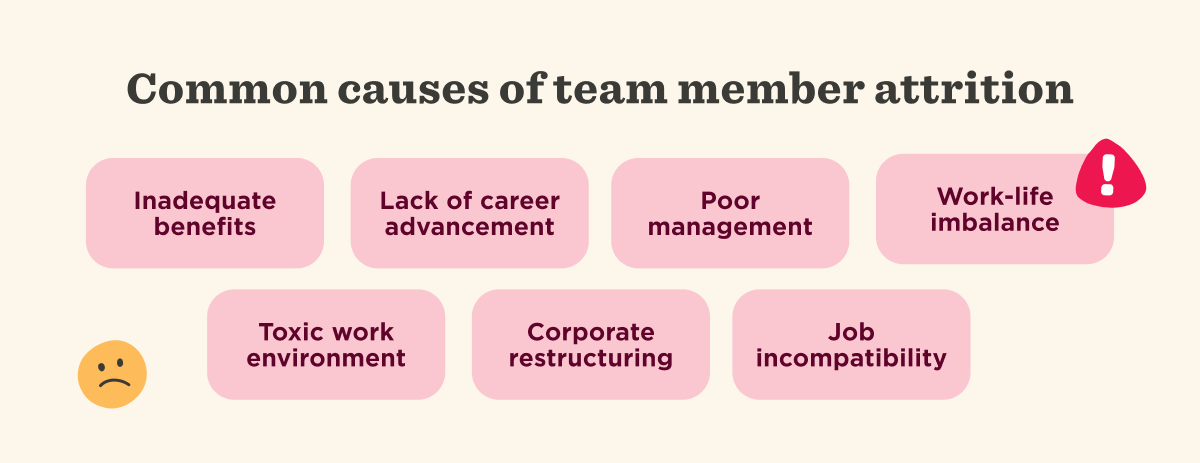
Here are a few common factors associated with attrition:
- Inadequate benefits: People increasingly expect comprehensive benefits that extend beyond salary, including healthcare, retirement plans, paid time off (PTO), and flexible work arrangements.
- Lack of career advancement: When your people don’t see a clear path for growth, they’re more likely to seek opportunities elsewhere.
- Poor management: The relationship between team members and their direct manager can be a strong predictor of attrition.
- Work-life imbalance: Excessive workloads, burnout, and poor work-life balance often push people to leave.
- Toxic work culture: People are more likely to leave when they experience poor communication, lack of trust, or a negative work environment.
- Corporate restructuring: Organizational changes such as mergers, acquisitions, and layoffs can create uncertainty about job security and future opportunities. This uncertainty often increases turnover as people seek greater stability elsewhere.
- Job incompatibility: Team members may leave when their role doesn’t align with their expectations, skills, or long-term interests. Regularly reassessing job responsibilities can help identify and address fit issues before they lead to turnover.
Types of employee attrition
Not all attrition behaves the same way, and the right response depends on which type a company is dealing with.
- Voluntary attrition: A person chooses to leave for a new opportunity, retirement, relocation, or personal reasons. Example: A marketing manager resigns to take a director role at another company.
- Internal attrition: Someone leaves one team or department for another role within the same company. The company doesn’t lose the person, but the original team loses the headcount. Example: A sales rep moves into a customer success role on a different team.
- Retirement attrition: Departures tied to retirement age or eligibility, generally the most predictable category. Example: A 30-year finance veteran retires after becoming eligible for a pension.
- Involuntary attrition: The company ends the employment relationship due to performance issues, conduct, or role elimination and doesn’t immediately fill the position. Example: The company eliminates a support role after a department reorganization.
- Demographic-specific attrition: Disproportionate attrition within a specific group, such as a particular age range, tenure band, or job level, can signal a deeper retention issue worth investigating. Example: A company notices most of its attrition is concentrated among team members with one to two years of tenure.
- Unavoidable attrition: Departures with no clear connection to the workplace itself, like relocation or family circumstances. Example: A team member moves overseas to be closer to family.
- Dysfunctional attrition: The loss of high-performing or hard-to-replace team members, the costliest and most preventable category. Example: A top engineer leaves because of a stalled promotion timeline.
How to calculate the attrition rate
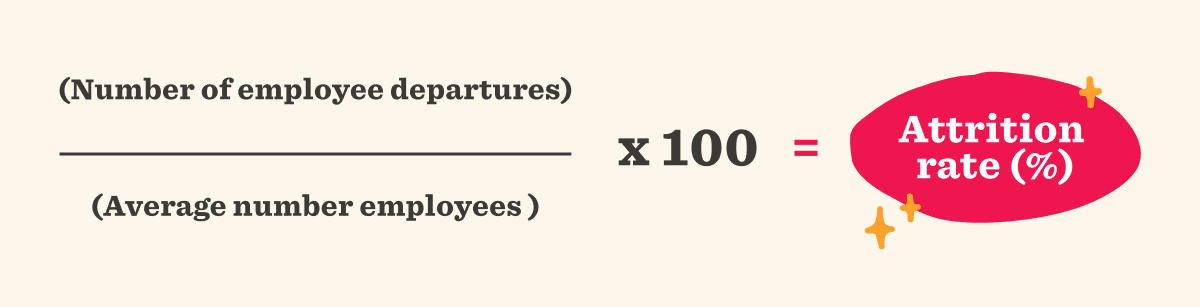
Attrition rate measures the percentage of people who left a company during a set period, relative to the average number of people employed during that same period. Most companies calculate it quarterly for early signals and annually for workforce planning and benchmarking.
Attrition rate = (Number of departures ÷ Average number of team members during the period) × 100
For example, a 200-person company that loses 18 people over a year, with average headcount holding steady at 200, calculates its attrition rate as (18 ÷ 200) × 100 = 9 percent. That figure sits close to the above-noted voluntary turnover average of 13 percent, giving the company a useful benchmark to judge whether nine percent reflects healthy, expected churn or signals an area to dig into further.
Employee attrition vs. employee turnover vs. layoffs
These three terms get used interchangeably, but they describe different kinds of workforce change, with different implications for planning and budget.
The distinction matters more than it might seem: 68 percent of US HR leaders say they can’t make truly fair, confident workforce decisions without a unified view of people and financial data. This gap becomes especially visible when leaders try to parse attrition, turnover, and layoffs in their own reporting.
| Term | Definition | Employer intent |
| Attrition | Natural reduction in headcount through resignation, retirement, or non-renewal | Passive; the company isn’t actively driving the departure |
| Turnover | The rate at which people leave and are replaced | Can be voluntary or involuntary |
| Layoffs | A planned, employer-initiated reduction in headcount, usually tied to budget or strategy | Active and deliberate |
| Voluntary turnover | A subset of turnover where the person chooses to leave | Passive |
| Involuntary turnover | A subset of turnover where the company ends the relationship | Active |
| Regrettable attrition | High performers or hard-to-replace people leaving | Passive, but often preventable |
| Retirement attrition | Departures tied to retirement eligibility | Passive |
What can HR do to manage attrition?
Even healthy, well-run companies see attrition. Rather than treating every departure as a loss to absorb quietly, HR leaders can use the moment to reassess. They can ask questions like: Does the team’s current skill mix match where the business is headed? Should they rehire the role exactly as it was, or does it need to evolve?
That reassessment is also an opportunity: A departure opens a seat for someone whose skills better match where the team is headed next or for an internal promotion. Companies that treat attrition as a planning input tend to build cultures that feel more dynamic and less stagnant over time, where growth and movement are expected rather than feared.
Companies can plan for attrition and, in many cases, turn it into an advantage. A few practices help:
- Plan for a mix of employment types: Use workforce data to identify which roles genuinely need full-time, permanent coverage and which can flex with contingent workers or contractors as headcount shifts. This keeps the business resilient without overcommitting budget to roles likely to see natural turnover.
- Retain team members crucial to company success: Not every departure carries equal weight. Pinpointing the team members most critical to performance, and investing deliberately in their compensation, growth, and connection to the company, protects against the costliest kind of attrition.
- Incorporate a warm offboarding program: A consistent offboarding experience, exit interviews included, helps departing team members leave on good terms and gives the company a clear, repeatable view into why people go. It also protects the company’s reputation with future candidates and clients.
- Leave the door open for former team members to return: People who return bring back their institutional knowledge plus new experience from elsewhere. A culture that welcomes boomerang employees back, rather than treating a resignation as a one-way door, expands the future talent pool at lower acquisition cost than an external hire.
- Track attrition risk before someone resigns: Engagement signals, manager feedback, and tenure trends can surface attrition risk early. This may give companies enough time to act, rather than learning about issues in the resignation letter.
Recommended For Further Reading
Turn employee attrition into a planning advantage
Attrition is a permanent feature of workforce planning. The companies that handle it well are the ones with the clearest picture of why people leave, which departures matter most, and how quickly the business can adapt.
That clarity depends on connected data. HiBob brings HR and Finance data together in one people-first platform, so headcount, budgets, and salary benchmarks live in one place instead of scattered across spreadsheets. From there, Bob Companion helps HR teams and managers ask questions in natural language and surface attrition trends by department or tenure, so leaders can act on patterns before they turn into a budget surprise.
Employee attrition FAQs
What does 80 percent attrition mean?
An 80 percent attrition rate means a company lost the equivalent of 80 percent of its average headcount over the measurement period (typically a year). A percentage that high may signal a problem with pay, management, role design, or working conditions. It can also reflect industry-specific volatility, since seasonal or high-turnover sectors like retail and hospitality post far higher rates than the cross-industry average.
Why is employee attrition bad?
Attrition is not necessarily bad as long as it remains at an appropriate level, generally consistent with company or industry averages. On the other hand, high attrition drives up recruiting and onboarding costs, slows productivity while roles sit open or new hires ramp up, and risks losing institutional knowledge that’s hard to rebuild quickly. It may also point to a deeper issue, like inconsistent management, stagnant pay, or limited growth opportunities, that will keep producing departures until the organization addresses it directly.
What are the consequences of a high attrition rate?
Beyond the direct cost of rehiring, sustained high attrition can strain the people who stay, as remaining team members absorb extra work during each vacancy. It can also damage a company’s reputation with candidates and clients, disrupt institutional knowledge and continuity, and make workforce planning far less predictable for both HR and Finance.