
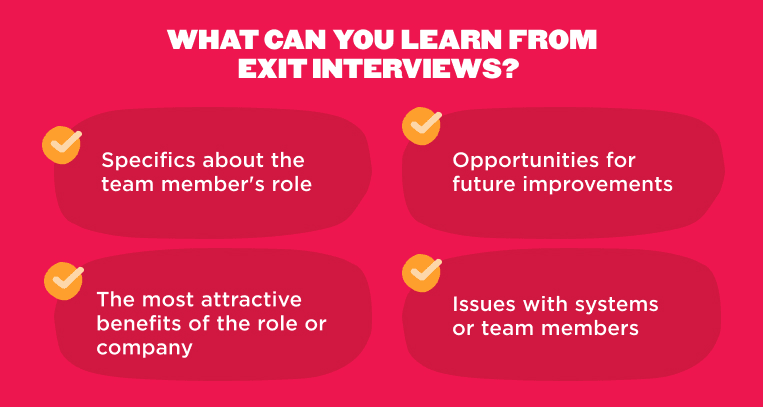
Every departure gives HR leaders a chance to learn. Exit interviews help you understand what shaped someone’s experience and what changes could strengthen retention going forward. For example, 68 percent of people who leave their jobs cite better work-life balance and personal wellbeing as their main reason, while 21 percent cite unsatisfactory pay as their reason for leaving.
An exit conversation lets you explore what that means in practice, whether workload expectations feel unsustainable, flexibility falls short, or growth conversations lack clarity.
This guide covers the benefits of exit interviews, common pitfalls to avoid, and a practical exit interview questions template to help you gather meaningful insights.
<<Download our free employee interview template.>>
Key insights
- Thoughtful exit interview templates ensure consistency and help you gain insights into why people leave, strengthening your company’s retention strategy
- Tailoring each interview supports deeper conversations, reveals opportunities for improvement, and helps reinforce a positive, growth-oriented company culture
- Segmenting feedback by role, tenure, team, and location turns individual comments into actionable workforce insights
- Handling sensitive feedback correctly reduces legal risk tied to retaliation, discrimination concerns, and whistleblower protections
What is an exit interview?
An exit interview is a structured conversation with a team member who plans to leave your organization. It helps you understand how their experience unfolded, what influenced their decision to move on, and what adjustments could strengthen retention.
Exit interviews create a rare moment for candid feedback. Professor of Leadership and Management at the Harvard Business School, Amy Edmondson, emphasizes that psychological safety encourages people to share hard truths and contribute to meaningful discussions. This still applies even when those conversations feel uncomfortable.
When leaders prepare thoughtfully, exit interviews reveal patterns, highlight policy gaps, and preserve positive relationships with alumni who may return later in their careers.
Why do exit interviews matter?
Exit interviews play an important role in building an effective HR process and improving the overall employee experience. They help HR leaders:
Maintain positive relationships with alumni and boomerang employees: A respectful offboarding experience protects employer reputation and strengthens long-term talent networks. Organizations that part on positive terms often improve the likelihood that high performers return with new skills and perspectives.
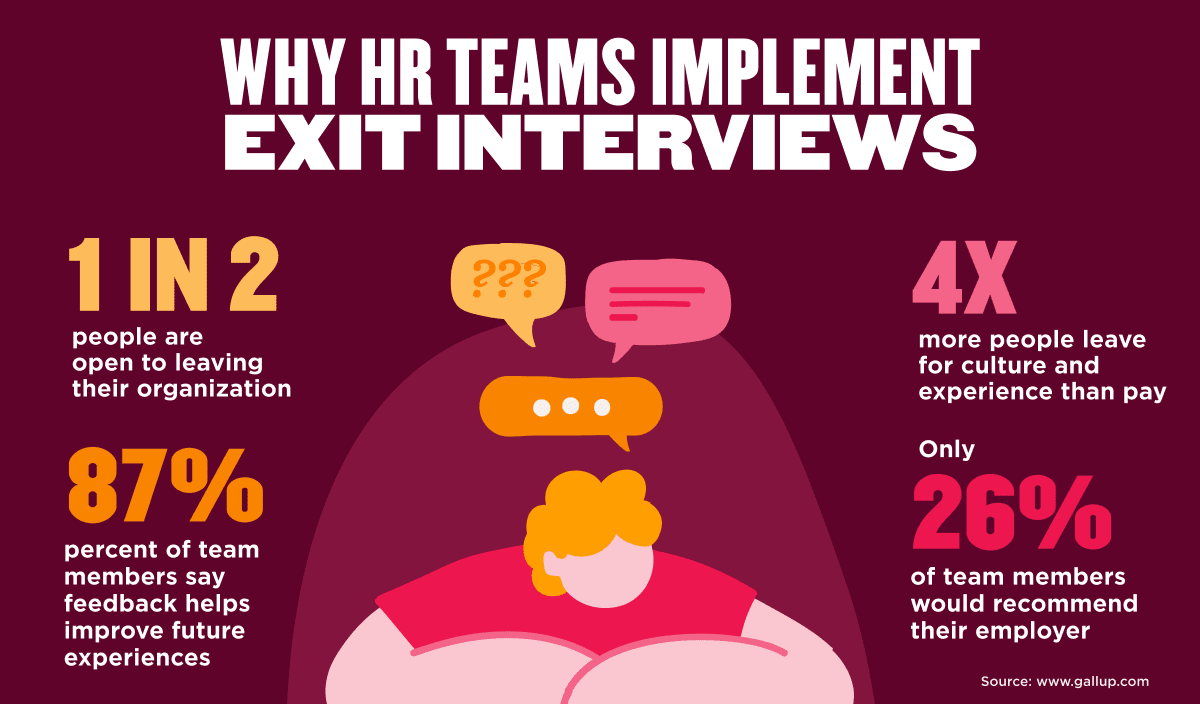
Identify improvement opportunities: Exit interviews can reveal patterns in workload expectations, manager support, company culture, and internal processes. These insights carry real urgency in a workforce where one in two United States team members report feeling open to leaving their organization, making this feedback loop essential for retention planning.
Support a positive offboarding experience: A structured exit conversation gives departing team members space to share honest reflections while reinforcing respect and professionalism. Exit feedback matters to 93 percent of team members, and 87 percent believe their insights can help improve the experience for others. At the same time, only 64 percent of people feel comfortable communicating frustrations at work, making exit interviews one of the final opportunities to surface concerns in a constructive way.
Strengthen company culture and trust: Consistent exit interviews signal that leadership values transparency and continuous improvement. This commitment becomes increasingly important given that only 26 percent of US team members say they feel likely to recommend their employer, highlighting opportunities to strengthen that sense of advocacy and confidence in leadership.
Inform smarter policy updates: Exit feedback often surfaces deeper experience drivers behind turnover, such as flexibility, development support, or communication gaps. Research shows four times as many people leave roles due to engagement, culture, or work-life balance challenges compared with those who primarily leave for better pay or benefits, helping HR leaders prioritize meaningful changes.
Improve retention strategies: Early attrition comprises roughly 40 percent of all turnover. Aggregated exit data helps HR teams move from reactive fixes to proactive workforce planning. Leaders can identify recurring friction points, strengthen manager enablement, and align retention initiatives with real team needs.
What is an exit interview template?
An exit interview template gives HR leaders a clear structure for asking open-ended questions and gathering continuous feedback from departing team members. It typically covers reasons for leaving, job experience, company culture, and work environment, while leaving space for role-specific insights. Organizations might also include targeted questions about tools, processes, and management.
Exit interview questions to ask departing team members
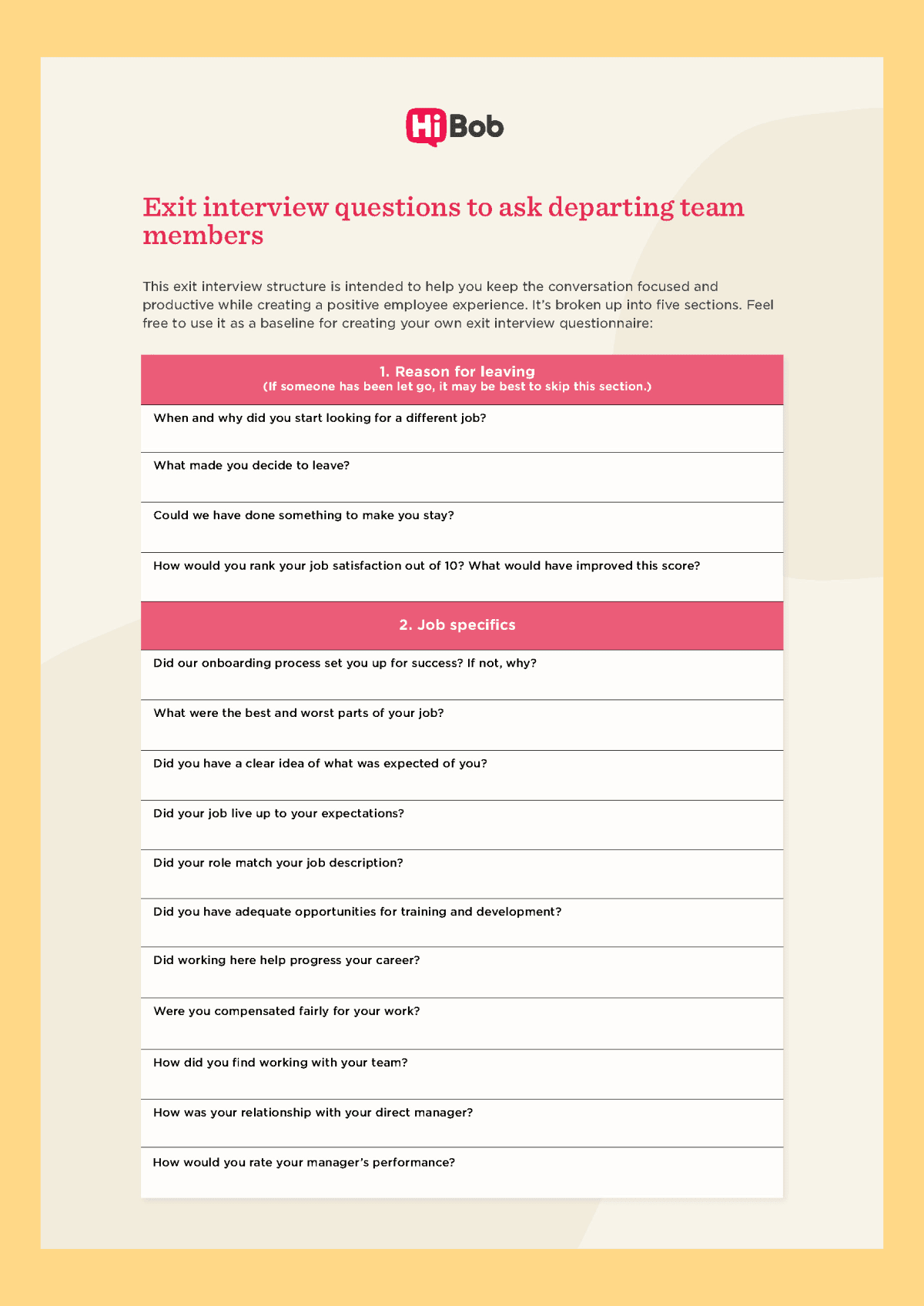
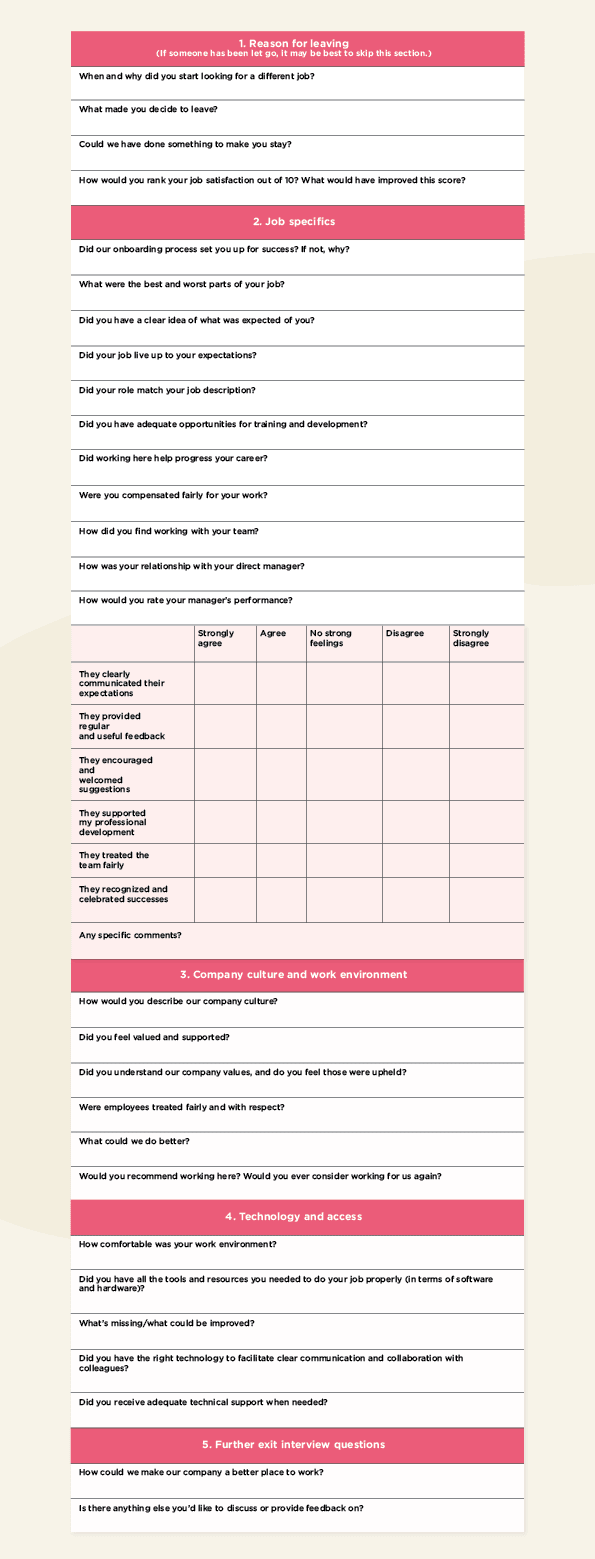
This exit interview structure is intended to help you keep the conversation focused and productive while creating a positive employee experience. You can use it as a baseline for creating your own exit interview questionnaire:
- Reason for leaving:
- When and why did you start looking for a different job?
- What made you decide to leave?
- Could we have done something to make you stay?
- How would you rank your job satisfaction out of 10? What would have improved this score?
- Job specifics:
- Did our onboarding process set you up for success? If not, why?
- What were the best and worst parts of your job?
- Did you have a clear idea of what was expected of you?
- Did your job live up to your expectations?
- Did your role match your job description?
- Did you have adequate opportunities for training and development?
- Did working here help progress your career?
- Were you compensated fairly for your work?
- How did you find working with your team?
- How was your relationship with your direct manager?
- How would you rate your manager’s performance?
- Company culture and work environment:
- How would you describe our company culture?
- Did you feel valued and supported?
- Did you understand our company values, and do you feel those were upheld?
- Were employees treated fairly and with respect?
- What could we do better?
- Would you recommend working here? Would you ever consider working for us again?
- Technology and access:
- How comfortable was your work environment?
- Did you have all the tools and resources you needed to do your job properly (software and hardware)?
- What’s missing or what could be improved?
- Did you have the right technology to facilitate clear communication and collaboration with colleagues?
- Did you receive adequate technical support when needed?
- Further exit interview questions:
- How can we make our company a better place to work?
- Is there anything else you’d like to discuss or provide feedback on?
What should the ideal exit interview cover?
A structured exit interview should cover enough for HR leaders to gather consistent insights while still leaving room for honest, role-specific feedback. Focus on:
Reasons for leaving
From time to time, people might come to exit interviews with a clear issue they’d like to discuss with you. While that’s helpful to learn, it can quickly railroad your planned conversation and take time away from other issues.
Guide the conversation across multiple topics and avoid missing broader themes tied to role clarity, team experience, or workplace processes.
Explore both long-term drivers—such as career progression, compensation structure, or work environment—and short-term triggers like project pressure, manager changes, or team dynamics.
Perks, benefits, and opportunities they feel are missing
Understand which benefits your team members wish you had to stay competitive in attracting and retaining talent. Modern professionals value perks like:
- Regular learning and development opportunities
- Performance bonuses
- Comprehensive healthcare coverage
- Insurance plans
- Wellness programs
- Childcare support
- Flexible work arrangements
- Retirement plans
Recommended For Further Reading
Relationship dynamics
Departing team members bring first-hand perspective on collaboration, manager effectiveness, and internal systems. To uncover these insights, HR leaders can ask questions such as:
- How would you describe communication within your team and with your manager?
- Were expectations and priorities clear in your role?
- Did any internal processes slow down your work or make collaboration difficult?
- How effective were the tools and systems you used to complete your responsibilities?
- What could have improved your day-to-day experience working with your team?
Further actions
If serious concerns emerge, confirm whether follow-up conversations remain possible after departure. This signals accountability and helps organizations resolve issues that may affect current team members.
Pro tip: Use a consistent exit interview format across teams and regions. Standardization protects anonymity, supports fair treatment, and makes it easier to identify patterns over time.
How to conduct a successful exit interview
Try some of these helpful tips the next time you conduct an exit interview.
1. Clearly communicate the purpose of the interview
Start the conversation by explaining why the organization conducts exit interviews and how feedback gets interpreted. Let the departing team member know that their insights help improve manager practices, policies, and the overall experience—not influence references, final pay, or offboarding processes.
Clear communication directly shapes retention and trust. Over 60 percent of people who consider leaving their job say poor internal communication played a role in that decision, highlighting why transparency matters from the very first moment of the exit conversation.
Set expectations upfront. Clarify who will see the feedback, whether responses will be anonymized, and what happens next. This transparency builds psychological safety and increases the likelihood of candid, useful input.
2. Offer different exit interview formats
Give departing team members options such as a live conversation, written forms, phone call, or video interview. Different formats support different comfort levels, especially when feedback involves sensitive topics.
Written responses may lead to more thoughtful, detailed reflections, while live conversations help interviewers ask follow-up questions and explore nuance. Some organizations also offer a follow-up conversation after the employee’s final day to encourage even more openness.
3. Send exit interview questions in advance
Sharing questions ahead of time helps people prepare and often leads to more structured, reflective feedback, especially for complex topics like career path progression or compensation. This approach works well for senior roles or long-tenured team members who may need time to organize their thoughts.
However, some organizations intentionally choose not to share questions in advance. Asking broader questions live can surface more spontaneous reactions and emotional signals that reveal day-to-day friction points. This approach may suit shorter-tenured team members or situations where you want to avoid overly rehearsed responses.
4. Choose the right date, time, and interviewer
Schedule the exit interview close to the end of the notice period while the experience still feels fresh. Offer time during working hours and avoid cramming the conversation into the final handover rush.
Select an interviewer who can remain neutral and build psychological safety. HR partners often lead these conversations because departing team members may hesitate to share candid feedback with their direct manager. In some cases, a joint HR–manager format works best when the goal includes role transition clarity or knowledge transfer.
5. Encourage transparency and listen carefully
Create space for honest feedback by explaining how the organization will handle sensitive input. Avoid interrupting, defending past decisions, or trying to “solve” issues during the conversation. Focus instead on clarifying questions like, “What would have improved your experience?” or “When did this challenge start?”
Watch for tone shifts, hesitation, or vague answers that signal deeper friction. Follow up gently to uncover practical examples that help identify patterns across teams or processes.
Exit interviews should never feel like a debate. The goal is to understand the departing person’s experience, not to correct their version of events or defend company decisions.
Even when the feedback feels unfair, incomplete, or difficult to hear, interviewers should stay neutral, curious, and professional. Defensive reactions shut down candor and can turn a useful conversation into a negative final experience.
6. End the interview positively
End the interview by summarizing key themes and thanking the departing team member for their input. Confirm next steps, such as how feedback will be documented or whether follow-up contact remains possible.
A respectful close strengthens organizational reputation and keeps future collaboration channels open. Offer practical support where appropriate, such as references, transition assistance, or alumni network connections.
7. Document and analyze the feedback
Collecting feedback is only valuable if you can turn it into patterns and priorities. Create a simple, repeatable structure for documenting exit interview insights so trends become visible over time.
Start by tagging feedback using standardized themes such as compensation, manager effectiveness, workload, career growth, flexibility, culture, tools, role clarity, burnout, or relocation. This makes it easier to compare responses across different exits.
Next, separate the primary reason for leaving from other contributing factors. For example, someone may resign due to relocation but still highlight workload or lack of development opportunities as underlying concerns.
Then, segment results to uncover meaningful differences. Analyze themes by:
- Team or department
- Manager
- Tenure band
- Role family
- Location
- Remote vs. hybrid working vs. onsite
Track leading indicators over time, such as an increase in exits citing workload or limited growth opportunities. Even small shifts can signal deeper organizational risks.
8. Create an action plan
Once patterns emerge, translate exit interview findings into specific HR initiatives with owners and timelines. Prioritize actions based on impact and frequency. For example, updating career frameworks, improving manager training, or revisiting workload distribution.
Define how progress will be tracked and reviewed. This might include setting quarterly checkpoints, monitoring retention metrics, or revisiting the same themes in future engagement surveys.
Overarchingly, make sure to focus on improvement. Treat exit interview results as part of a larger commitment to improve the workplace. That means using feedback to strengthen manager training, refine policies, and improve satisfaction.
<<Download, print, and use these exit interview templates for a proper farewell.>>
Legal and ethical considerations for exit interviews
Exit interviews themselves rarely fall under a single specific law. However, the feedback shared can trigger obligations tied to anti-retaliation protections, discrimination laws enforced by the EEOC, whistleblower regulations, and state employment rules.
When departing team members raise concerns about harassment, pay equity, safety, or unfair treatment, HR teams may need to follow established investigation or escalation processes. Laws such as Title VII of the Civil Rights Act and the Americans with Disabilities Act shape how organizations must respond once these issues surface.
Voluntary participation
Exit interviews should generally remain optional. While employers can invite departing team members to participate, pressuring them can undermine trust, reduce candor, and create legal or cultural risk, especially if sensitive topics arise.
Make expectations clear from the start. Let people know they can skip questions, choose not to participate, or request a different format.
Data protection and privacy
Exit interviews often generate personal or highly sensitive information. Notes may include allegations of misconduct, compensation concerns, wellbeing challenges, or feedback about specific managers or teams. HR teams can handle this data with the same care as other confidential people records by:
- Storing responses securely
- Limiting access to authorized stakeholders only
- Avoiding informal note-sharing with leaders who do not need the information to act
- Anonymizing feedback for trend analysis
- Setting expectations early around comments that may trigger a formal investigation
Retaliation risks
Retaliation occurs when an employer takes negative action against someone because they raised a concern or exercised a protected workplace right. It’s the most common workplace legal claim in the United States, which makes exit interviews a sensitive moment for both team members and employers. If a departing team member raises concerns about discrimination, harassment, pay practices, safety, or compliance issues, the organization must respond carefully and lawfully.
Avoid punitive reactions, defensive follow-ups, or actions that could appear retaliatory, such as withholding earned compensation, delaying references, or restricting benefit access. Even subtle responses can damage trust and create legal exposure.
Train interviewers to recognize when feedback moves beyond general sentiment into formal complaint territory. At that point, shift the conversation into the company’s established investigation process. Exit interviews support listening and learning, but they should never replace proper case management.
Confidentiality
Confidentiality is essential, but it should never be overstated. Do not promise absolute secrecy if the information shared may require investigation or formal follow-up. Instead, explain that feedback will be handled as confidentially as possible and shared only with the people who need it to respond appropriately.
When reporting insights to leadership, focus on themes and patterns rather than naming individuals unless there is a legitimate business or legal reason to do so. This protects the departing person while still helping the organization learn and improve.
Achieve better employee insights with an exit interview template
Exit interviews give HR leaders a final opportunity to understand what shaped someone’s experience and what improvements can support future retention. A consistent template helps teams run focused conversations, capture comparable feedback, and turn insights into meaningful action.
Handled thoughtfully, exit interviews strengthen employer reputation and help maintain positive relationships with alumni who may return with new skills and perspectives.
<<Capture employee insights with a free employee exit interview template.>>
Exit interview template FAQs
What is an exit interview vs exit survey vs stay interview?
An exit interview happens when someone leaves and typically involves a live conversation with HR to understand their experience and reasons for departure. An exit survey collects similar feedback in a written or digital format, which can increase participation or anonymity but often limits deeper follow-up. A stay interview takes place while someone still works at the company and focuses on what keeps them engaged and what might cause them to leave in the future.
Together, these tools give HR leaders a more complete view of retention risks and opportunities across the employee lifecycle.
Who conducts exit interviews?
Because exit interviews entail asking departing team members strategic (and sometimes, sensitive) questions, a neutral third party, like an HR representative, typically conducts them. However, managers and HR personnel may conduct the interview together depending on the company and the circumstances behind a team member’s departure.
You can conduct exit interviews in person or online and they typically take about 30 minutes to an hour.
What should you not say in an exit interview?
Treat departing team members with respect and professionalism, regardless of why they’re leaving. During the interview, try to avoid:
- Gossip or hearsay about the individual
- Criticisms about their performance
- Issues that have already been addressed in the past
- Words that make the person feel guilty about resigning
- Asking the individual to reconsider
Should you use the same exit interview questions each time?
Using the same exit interview questions for each departing team member can provide consistency, which allows for better comparison and analysis of data over time. It also ensures that everyone is given an equal opportunity to provide feedback on similar aspects of their experience.
However, it’s important to recognize that not all roles, relationships, or experiences within a company are the same. You can add customized questions relevant to specific departments, levels of seniority, or the circumstances surrounding the person’s departure. Include some open-ended questions to provide people with an opportunity to share their unique insights.
<<Access all the right questions with this free exit interview template.>>
Can a departing employee decline an exit interview?
Yes, it’s okay for people to decline their exit interview. Participation in exit interviews is typically voluntary and leavers aren’t obligated to take part if they’re uncomfortable with the process.
Is an exit interview good or bad?
An exit interview gives businesses the opportunity to collect honest feedback from departing team members. Exit interviews provide teams and businesses with a richer understanding of which internal processes (i.e., training, promotions, communication) are effective and which policies they may need to scrap or update to retain and attract new quality talent.
For individual contributors, a constructive exit interview provides the opportunity to leave the company with a clean slate. People can provide feedback about their work experiences, voice concerns, and suggest improvements.
Does your company need to host exit interviews?
Exit interviews aren’t required, but they’re a great way to gain insights into people’s satisfaction with your organization.
Where should an exit interview occur?
Host exit interviews in a private area where the interviewer and departing team member feel comfortable. You can hold the meeting remotely or in person.