
When HR is busy in all the best ways (growing teams, rolling out new programs, supporting managers), you want that momentum to add up to something bigger. An HR strategic plan is one of the most effective ways to make it happen. That’s the discipline Dora Kocur, VP of Operations and Total Rewards at GoCardless, points to when she shares how their people strategy evolves every year.
Taking that kind of intentional, data-informed approach is exactly how modern people teams can move from reacting to day-to-day demands to shaping the business’ direction. This guide takes you through the entire process of building out your own strategic HR plan, complete with an HR strategy checklist and examples you can adapt to your organization. You’ll walk away with a clear, step-by-step approach to translate business goals into hiring, development, and retention priorities, including owners, timelines, and metrics to track progress.
<< Plan smarter, not harder with a free HR strategy checklist. >>

What is a strategic HR plan?
A strategic HR plan is your roadmap for how people decisions support business decisions. It brings together everything HR owns—company culture, tools and tech, internal communication, hybrid or remote work practices, performance, and benefits—into one cohesive framework. The introduction of an HR strategic plan helps modern businesses build a healthy pipeline of talent and consistently match people with roles where they can do their best work.
A strong HR strategy “creates value for all the humans who interact with an organization—team members, executives, customers, investors, and communities,” says Dave Ulrich, HR thought leader and author of HR from the Outside In. It looks at the people you have today and where the business is heading, so you can forecast future needs, identify critical skills and roles, and decide how to hire, develop, and support people to reach your goals.
With that clarity, companies stay more productive and profitable by building a steady pipeline of skilled people and a clear approach to growing them.
Why do you need a strategic HR plan?
The value of a strategic HR plan isn’t that it adds more—it’s that it helps you focus on what matters most. “We can’t just react anymore,” says Sofia Moll, Head of Global Talent Management at HiBob. “We have to plan carefully and be much more accurate about what we’ll need next.” A clear plan makes it easier to prioritize initiatives, explain why they matter, and show how they support business results.
Key benefits include:
- Positioning HR as a strategic partner: A strategic HR plan shows exactly how people initiatives support business goals, making it easier for HR to join (and lead) big-picture conversations
- Supporting broad organizational initiatives: It keeps hiring, development, engagement, and culture aligned with the company’s direction, so HR is always moving in step with wider priorities
- Enabling proactive HR management: Instead of scrambling to fill gaps, you can anticipate workforce needs and plan for the skills and roles you’ll need in advance
- Improving HR policies: Regular, strategic planning creates space to refresh policies so they better match how your people work and what they need
- Increasing productivity: Clear people priorities, the right roles, and focused development help teams work more efficiently and stay aligned on what matters most
- Promoting professional growth: A thoughtful HR strategy plan puts career paths, learning, and internal mobility front and center, providing more opportunities to develop over time
McKinsey’s HR Monitor 2025 found that about 73 percent of organizations do some form of operational workforce planning, but only 12 percent of US HR leaders look three or more years ahead. Gartner similarly estimates that just 15 percent of organizations practice true strategic workforce planning. That gap matters because workforce planning is a core element of strategic planning, translating business direction into the roles, skills, capacity, and timing you’ll need to execute.
Together, these numbers show a clear opportunity: HR teams that invest in strategic planning now can stand out as leaders in navigating shifting skills, AI-driven change, and talent gaps.
HR strategic plan template
This free HR strategy checklist includes sections to assess current workforce capabilities, identify future needs, and align your HR goals with business goals. Use it to streamline your planning process and confidently prioritize initiatives will the greatest impact.

How to develop a strategic HR plan
Want to get HR a seat at the table? Taking a strategic approach helps. Set aside time (say, a few focused hours) to plan out your biggest goals for the year. That way, you can hit the ground running with all the facts, figures, and strategies you need to succeed.
HR professionals can use this strategic HR plan template to ensure their business is well-staffed and well-served:
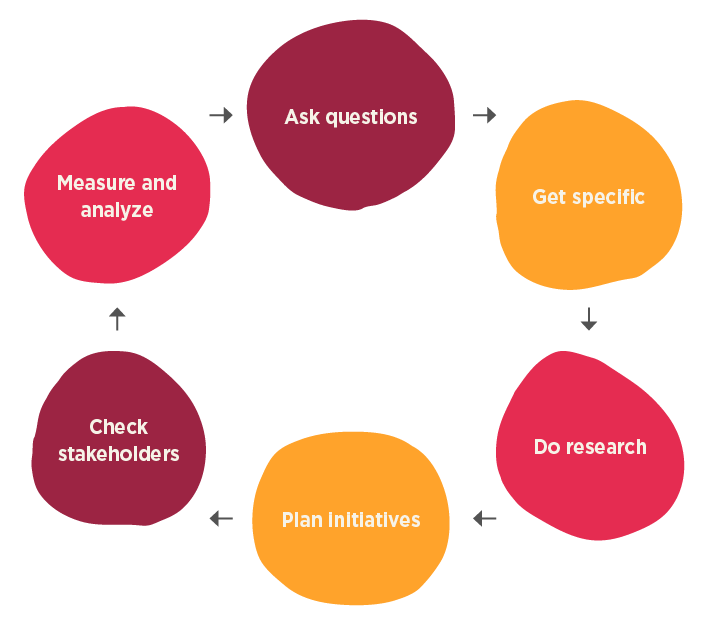
1. Look at your business and identify what you want to achieve
Start by clarifying your company’s direction and the HR support needed to drive it. That means identifying top business priorities, the challenges ahead, and the people capabilities required to get there. Ask strategic questions to uncover where HR can drive the most impact:
- What are the organization’s primary goals this year?
- Which people capabilities need to improve—and how?
- Are those needs best met through hiring, development, or restructuring?
- What cultural shifts or mindset changes are required to support success?
- What tools, programs, or communications will help teams stay aligned?
Pro tip: Keep your mission and vision statements close at hand. They help ensure your HR strategy stays anchored to your company’s purpose and future direction.
2. Gather external and internal insights
Strategic planning doesn’t happen in a vacuum. Pull in both internal voices and external research to ensure your strategy reflects real-world context.
Look outward:
- Legal and regulatory changes
- Market salary data
- Labor market trends
- Tech innovations (like AI adoption)
- Demographic shifts
Look inward:
- Skills gap analyses on workforce dynamics
- Department and exec input
- Feedback from managers
- Historical hiring and retention data
- Engagement surveys and pulse checks
3. Plan and prioritize your initiatives
Now that you know where you are and where you want to go, define how you’ll close the gap. Your initiatives might include hiring for new roles, launching a reskilling program, adjusting compensation strategy, or introducing new engagement tools.
Focus on:
- What each initiative solves
- The resources it needs
- Who owns it
- When to measure success
Prioritize based on business impact, urgency, and feasibility. Fewer, focused initiatives are often more effective than trying to do it all at once.
4. Align with stakeholders
Strategic HR plans don’t succeed in isolation. Once your plan is drafted, share it with senior leaders, managers, and cross-functional partners. These conversations are your chance to pressure-test assumptions, confirm alignment, and surface any blockers early.
As you get feedback, refine the plan to reflect what you’ve learned. Be clear about next steps, who’s responsible, and how decisions will be made. Bringing stakeholders into the process early builds buy-in—and turns strategy into shared action.
Recommended For Further Reading
5. Measure and analyze
Organizations that use strong HR analytics to guide their decisions can see a three year average profit that is up to 82 percent higher than businesses with basic analytics, underscoring how a strategic, data-driven HR approach directly supports business results.
It can also help to bring in a little outside context, like relevant benchmarks or case studies, so you’re not evaluating progress in a vacuum. A simple measurement approach usually involves:
- Identifying and measuring KPIs: Choose a small set of metrics that connect directly to your HR priorities and business goals, such as compensation trends, engagement scores, and turnover by team, then track them consistently over time
- Determining what data to gather: Decide which inputs will give you the full picture, like quantitative metrics, qualitative feedback, and team member or manager input
- Establishing how you’ll measure and report: Agree on where the data will come from, how it will be calculated, and how often you’ll review and share it with stakeholders
HR tech can help by centralizing data and revealing trends that aren’t obvious from one-off metrics. Look for patterns across dimensions like team, manager, or tenure. For example, pair engagement with turnover to evaluate leadership effectiveness, or compare promotion rates with training participation to assess development ROI.
And when it’s time to share results with stakeholders, “Meet them where they’re at and make it digestible in a way they can understand,” says McFarland. Finance usually wants dollars and timing, sales looks for capacity and ramp, and product or engineering focuses on role-level hiring and skills coverage. Keep it tight with a clear headline, the few metrics that matter to them, and the one decision or support you need.
Where to implement strategic HR
Once your HR strategy is in place, the next step is making it tangible. Below are three key areas where HR can turn strategy into impact by leveraging real data, clear goals, and people-first thinking.
Investigating and managing turnover
Turnover data is one of the clearest signals in your HR strategy and one of the most useful when you look beyond the headline number. When people leave, they’re often telling you something important about workload, management, growth opportunities, or alignment.
Start by breaking turnover down into meaningful slices, such as voluntary versus involuntary, early exits versus long-tenured departures, and differences across teams, roles, or locations. Then layer in qualitative insight. Exit interviews, stay interviews, engagement feedback, and manager conversations can all help you understand what’s really driving decisions to leave.
Helpful questions to explore include:
- Are people leaving for similar reasons?
- Are high performers exiting at higher rates?
- Are departures tied to specific moments, like after performance cycles or organizational changes?
From there, you can focus on addressing root causes, whether that’s manager support, clearer career paths, compensation adjustments, or workload balance.
Growing and developing talent
Strategic workforce planning isn’t just about filling roles–it’s about building your internal pipeline. Identify high-potential team members and match them with development opportunities that align with future business needs. Whether through upskilling, mentoring, stretch assignments, or coaching, tailor your approach to team needs and individual motivation.
This is also where succession planning comes in. Highlight critical roles at risk of vacancy or growth and ensure capable people are ready to step in.
Designing a smarter compensation strategy
Compensation is one of HR’s most visible and influential levers and a critical part of any strategic plan. A data-informed approach helps you stay competitive, equitable, and aligned with business needs.
Use benchmarking to assess where your pay structure sits in the market. Then segment compensation data by team, tenure, location, and performance to identify gaps or inconsistencies. If high-performing team members are leaving due to pay equity issues, or if certain roles consistently fall below market rates, those signals point to the need for action.
Strategic adjustments may include revising pay bands, rethinking bonus structures, or linking compensation more closely to performance and development goals.
Great HR strategy examples
While a business strategy outlines how a business will achieve its goals and growth, a good HR strategy creates the internal structures needed to activate people and processes to reach those goals. Here are a few examples of what that can look like in practice:
VaynerMedia
VaynerMedia is a mid-size marketing and advertising agency based in New York City, with additional offices in Los Angeles, London, Singapore, and Mexico City. The company’s HR strategy is all about people, putting human beings at the forefront of everything it does so its ideas and plans are culturally rich and consumer-led.
Instead of treating HR as a set of separate processes, VaynerMedia maps everything back to a bigger people story. Their HR strategy focuses on creating clear, repeatable frameworks for performance, feedback, and growth so people always know what’s expected and how they can progress. Structured review cycles, transparent expectations, and regular check-ins turn performance management into a continuous conversation that supports development and keeps teams aligned with the company’s goals.
Onboarding and culture-building are equally intentional. New joiners move through a well-defined journey that introduces them to VaynerMedia’s values, ways of working, and community, helping them feel included and productive quickly. The People and Experience team also uses surveys and ongoing feedback to understand how people are feeling and where they can improve the team member experience over time. VaynerMedia’s people aren’t just its greatest asset—they’re a community.
Fiverr
Fiverr’s culture is built around its people-first perspective. The company’s mission is to change how the world works together, and it has fundamentally changed the way businesses and freelancers work with each other.
Fiverr prioritizes the individual members of its community and continuously strives to build an atmosphere of connection and inclusivity. The ‘people company’ loves its team members for who they are and celebrates their diverse backgrounds.
Fiverr’s HR strategy and mindset focus on the personal touch. With an HR team made up of 25 professionals, the company is dedicated to supporting its people. It sought a powerful HRIS to enhance the entire team member lifecycle and provide a friendly and engaging way to communicate with its people worldwide.
Save the Children Italia
For over 100 years, Save the Children has been improving the lives of children and providing emergency aid during times of natural disaster, war, and other conflicts. Save the Children Italia, the organization’s Italian branch, has sites in Rome and Milan and employs 219 permanent team members and 84 temporary people with fixed-term contracts.
Following a period of growth in headcount and projects, Save the Children Italia set an HR strategy to better engage with its people. It involved implementing a modern HR platform to replace their spreadsheets and manual processes, revamping their performance management process, and creating a sense of community for their people working remotely and in the field. They also moved from annual performance reviews to a continuous feedback model and replaced their top-down approach with 360-degree feedback for a more holistic and engaging experience.
Best practices for planning and documenting your strategy
Build a plan that’s easy to use, share, and evolve over time. These best practices help ensure your HR strategy stays clear, actionable, and aligned:
- Keep it simple and focused: Use plain language. Highlight key goals, initiatives, timelines, and owners. Avoid long blocks of text.
- Define what success looks like: Establish metrics and track them regularly. Share progress updates with business leaders to keep engagement high.
- Use visuals and summaries: Charts, graphs, and visual timelines make it easier to communicate insights and get buy-in across the org.
- Revisit often: Treat your plan as a living document. Update it as priorities shift or new insights emerge.
- Communicate consistently: Use team meetings, dashboards, or internal comms to keep everyone aligned and engaged.
Improve workforce planning with a strategic HR plan template
A well-crafted HR strategy plan gives you the clarity, structure, and momentum to support company goals. When you map where your people are today, get clear on the skills and capabilities you’ll need tomorrow, and outline how HR will close the gap, you create a shared direction leaders can plan around and teams can feel in their day-to-day work.
Whether you’re refining an existing plan or starting from scratch, using an HR strategy checklist can make the planning process feel manageable and repeatable. It turns big ideas into practical next steps and helps you track progress in a way that’s easy to share across the business.
<< Download the free HR strategy checklist and improve your people ops today >>
FAQs on HR strategic plan
What should an HR strategy include?
An effective HR strategy takes the company’s goals and lays out the people plan behind achieving them: the roles and skills the business needs, how you’ll hire or develop those needs, and the metrics that matter to track progress. It also includes clear ownership and precise timelines so that initiatives stay on track and teams can celebrate milestones along the way.
What are the 5 P’s of HR strategy?
The 5 P’s of HR strategy are a simple way to remember the core building blocks of a strong plan: Purpose (HR’s role and goals), People (who you hire and how you support them), Processes (how HR work runs day to day), Platforms (tools and systems for HR and managers), and Performance (how you track results). Together, they help you design an HR strategic plan that feels both people-centered and business-focused.
What is an example of a HR strategy?
One example of an HR strategy is strengthening work-life balance so people are happier and more productive. For instance, a company might introduce two fixed work from home (WFH) days per week, one company-wide wellness day per quarter, and a rule that managers avoid booking meetings over lunch. HR then checks in through short pulse surveys and tracks sick days and turnover to see if the changes are working.
Meet Bob
At HiBob, we’ve built a modern HR platform designed for modern business needs—today and beyond.
An HR platform such as Bob offers a one-stop shop for all things HR. It sits at the center of your HR ecosystem, is fully customizable, and grows with your organization.
For HR, it delivers automation of many common processes, allows greater oversight and visibility of the business, and centralizes all people data in a secure, user-friendly environment.
For managers, it provides access to data and insights to help them lead more effectively and streamline processes.
For team members, it’s the tools and information they need to connect, develop, and grow throughout their journey.
In a short time, Bob can be deployed to enable communication, collaboration, and connectivity that drives stronger engagement, productivity, and business outcomes.