
Pay transparency is a growing marker of trust and credibility in today’s market, with 84 percent of professionals supporting legislation requiring salary ranges in job postings. It starts with a simple principle: people deserve to understand how their pay is determined and how it compares to market benchmarks. But for employers, the real challenge lies in communicating that clarity consistently.
“Companies need a strategy to think about how best to communicate their value proposition regarding equitable pay to team members and other key stakeholders,” says Kelly Voss, head of rewards and career for North America at Aon. That strategy is what turns pay transparency from a statement into a daily practice that supports a people-first company culture and pay philosophy.
There’s no one-size-fits-all model. The right level of openness depends on your culture, strategy, and locations, and it can grow with you. With clear goals, solid change management, reliable market and internal data, and managers trained to explain compensation confidently, pay transparency becomes a practical way to build equity into how you work. This guide will show you what that looks like and exactly how to do it.

Key insights
- Reliable market and internal data, regular pay audits, and location-specific compliance keep the program accurate, fair, and durable over time
- Pay transparency gives people a clear view of how companies set compensation, how it compares to the market, and how it can grow
- Posting pay ranges helps, but the impact comes from explaining the thinking behind the range and keeping that message consistent across the company
- A strong compensation philosophy and role-based pay bands create a shared foundation for offers, raises, and internal moves
- The moments that shape how people experience transparency most are recruiting, performance reviews, and promotions
What is pay transparency?
Pay transparency is the practice of openly sharing compensation information with current and prospective team members in the pursuit of pay equity and greater trust in the workplace. “Transparency is the new normal,” says Sarah Reynolds, Chief Marketing Officer at Benifex. “With tighter talent competition, higher expectations, and easier access to pay data, it’s now the baseline for how people expect companies to operate.”
And it isn’t limited to base salary. Transparency can also apply to things like:
- Bonuses and commissions
- Equity or stock options
- Benefits and perks
- Salary bands and leveling criteria
- Raise and promotion criteria
There are many approaches an organization can take to embrace pay transparency. It looks different for every business and depends on factors like company strategy and local regulatory requirements. For some, pay transparency means advertising salaries (or salary ranges) in job descriptions. For others, it means breaking the taboo against talking openly about salaries and encouraging conversations about pay between team members.
Spending a little time upfront mapping out your transparency approach helps you decide what level of openness fits your organization. Whatever you choose, giving managers and people leaders practical training on the policy sets everyone up for success and keeps messages consistent. With that shared fluency, they’ll feel confident talking through pay questions and supporting their teams with clarity.
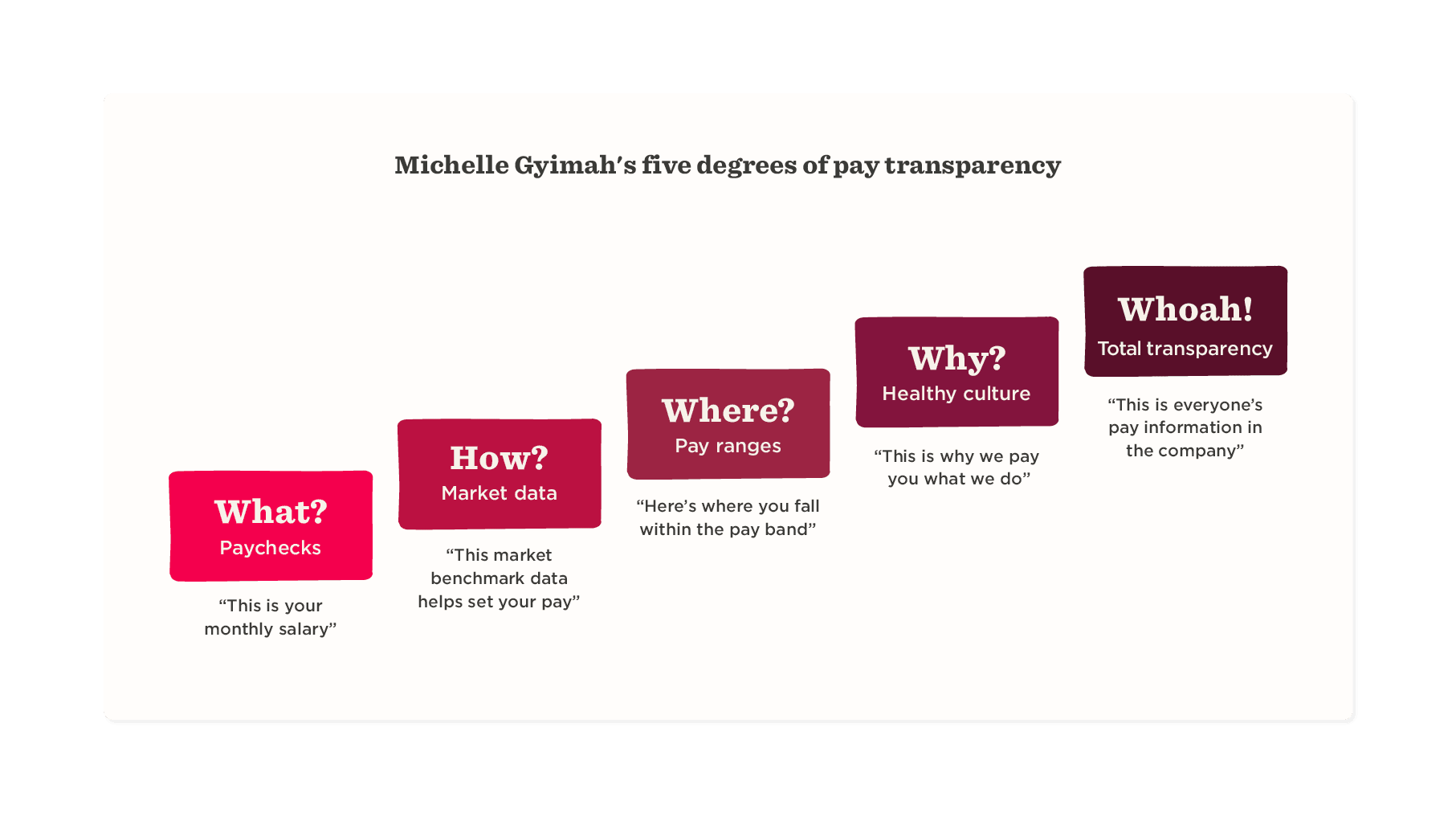
To keep things simple, pay gap analyst Michelle Gyimah proposes the following categories to explain the five different degrees of pay transparency to consider for your business:
- What: Give team members a clear breakdown of their monthly salaries
- How: Share external salary benchmarking data openly so your people can compare their pay to current market rates
- Where: Provide a thorough compensation plan that includes a breakdown of salary, benefits, and a clear pay range for each role
- Why: Establish clear processes for calculating pay, and train managers to communicate about compensation regularly
- Who: Implement a fully open pay system, where everyone can access information about each other’s salary or salary range
Of course, the degree of pay transparency that’s right for your organization will depend on what’s best for your people and the business. But one thing is for sure: Clear pay transparency, paired with a fair pay framework, is strongly associated with higher team member trust in rewards and greater confidence in pay decisions.
Why is pay transparency important?
Pay transparency policies demonstrate that your company is committed to addressing the gender pay gap and eliminating pay inequality in the workplace.
“When compensation data becomes public, it levels the playing field and creates accountability across the organization,” says Yaro Fong-Olivares, executive director of Bentley’s Center for Women and Business. “It forces companies to take a closer look at how inequities emerge in the first place and take steps to eliminate both conscious and unconscious hiring biases.” Research suggests that reducing these pay disparities strengthens perceptions of fairness, which in turn shapes motivation and workplace ethics.
And that fairness signal doesn’t stay internal. “Companies that openly share compensation data are often seen as more ethical and socially responsible, strengthening both culture and reputation,” says Hannah Weiser, assistant professor of law at Bentley University.
There’s no set formula to follow, so ultimately, it’s up to company leadership, spearheaded by HR, to decide how open you want to be. But the effort is worth it: People who feel they’re paid fairly are 85 percent more engaged and 62 percent more committed to their role. “Strengthening trust, equity, and accountability positions companies better for long-term success,” says Weiser. “That’s not just good ethics—it’s good business.”
<< Use these templates to conduct your own salary analysis >>
The evolution of pay transparency
People’s views on and approaches to pay transparency are evolving. Not too long ago, talking openly about pay, let alone compensation transparency, was considered completely taboo. Companies openly discouraged their people from discussing their salaries with one another. Now, pay secrecy policies that prohibit people from discussing what they earn may infringe on their legal right to discuss their wages.
In addition to legislation, people’s demand for transparency in pay is high, and greater openness around pay can benefit modern companies. Wage transparency (especially by posting salary ranges on job ads) saves time and helps attract the right candidates with realistic expectations that align with the company’s needs. It also serves as a pillar of healthy company culture and helps support trust between your people and the organization, spurring higher levels of loyalty, engagement, and appreciation.
Today’s push for more pay transparency plays a key role in combating pay inequality. It often takes the form of people self-reporting their wages on public databases, companies including salary ranges in job ads, and people speaking more openly about their pay with their colleagues.

One of the biggest challenges HR and line managers face is explaining the nuances of pay transparency to their people. Many professionals understand “pay transparency” to mean that a company is completely open about everyone’s compensation. They may also believe that everyone in the same or similar roles should receive the same compensation and benefits packages.
In reality, this is not the case. Paying people in the same or similar roles competitively means that their salaries fall within set pay bands. Meeting modern professionals’ expectations means clearly explaining how compensation decisions are made. Some people will fall at the lower end of the range, and some will fall at the higher end. Where an individual’s compensation sits within the salary range depends on their particular level of experience, performance over time, and other factors, including location, remote vs. on-site mandates, etc.
A growing percentage of today’s workforce is committed to fighting pay inequality and championing pay parity. In response, pay transparency laws are also on the rise worldwide.
Important places to implement pay transparency
Pay transparency is an ongoing practice, but certain moments in the team member lifecycle shape trust and fairness most. Here are the key places to put transparency into action.
Recruitment
Sharing pay ranges up front builds credibility, accelerates alignment, and helps candidates assess fit with clarity. This works especially well when you pair the range with context on what influences it (skills, experience, location, scope) and how pay grows over time. Candidates who understand both the number and the logic behind it come into interviews better prepared, and they may accept offers faster, with fewer rounds of back-and-forth.
Performance reviews
Performance reviews put your pay philosophy into motion. They connect what someone delivered this cycle to changes in their compensation.
Clear performance ratings tied to defined outcomes create consistency across teams. When you show the pay band for each level and clarify how review outcomes affect pay (like what typically leads to a larger increase, a smaller increase, a bonus, or a promotion), team members can see what their rating means in real terms.
Managers can point to shared criteria rather than personal judgment, and your people leave reviews with a clearer picture of what to strengthen next cycle to move up a level or increase pay within their current band.
Promotions
Promotions are distinct pay moments that change someone’s level, scope, and long-term trajectory, not just their annual increase. They focus on readiness for the next role and what that role requires.
Transparency here means you define the skills, scope, and responsibilities required for the next level and share the pay band for that level. You also explain how you set pay for internal moves and what factors determine where someone lands within the new band.
When team members can see the standard for the role and how you set pay within the new band, they know what it takes to earn the promotion and what pay change to expect.
How pay transparency laws are changing in the United States
In the United States, the National Labor Relations Act (1935) protects most private-sector team members’ right to talk about pay and helps promote fair and equitable compensation practices in the workplace. Similarly, the Office of Federal Contractor Compliance Programs (OFCCP) protects public sector workers.
To date, about 15 US states currently have pay transparency laws. In addition, several cities, including New York City, NY, Cincinnati, OH, and Jersey City, NJ, have municipal legislation. As of May 2025, approximately 60 million (or 40 percent) of U.S. workers were covered under transparency legislation.
The specifics of the laws vary in each jurisdiction but can obligate employers to disclose salary ranges:
- In their job postings
- When someone asks
- To job applicants at specific stages of the hiring process
As you fine-tune your compliance approach, keep the following states’ laws in mind:
Recommended For Further Reading
California
Law(s): Pay Transparency for Pay Equity Act
Effective date: January 1, 2023 (with updates taking effect January 1, 2026)
Applies to: Employers with 15+ team members hiring for roles performed in California (including many remote roles tied to California)
Key rules:
- Job postings must include a good-faith salary/hourly pay scale
- Employers must provide the pay scale to current team members on request
Colorado
Law(s): Equal Pay for Equal Work Act
Effective date: January 1, 2021 (amended January 1, 2024)
Applies to: Employers with at least one Colorado team member hiring for roles performed in Colorado (including remote)
Key rules:
- Job postings must include a good-faith pay range
- Job postings must include a general description of benefits and other compensation
- Promotional opportunities must include pay information when you post and share them internally
Connecticut
Law(s): Salary Range Disclosure Law
Effective date: October 1, 2021
Applies to: All employers hiring for roles performed in Connecticut
Key rules:
- Employers must provide a wage range to team members at hire, on role change, or upon request
Hawaii
Law(s): Hawaii Pay Transparency Law
Effective date: January 1, 2024
Applies to: Employers with 50+ team members hiring for roles performed in Hawaii
Key rules:
- Job postings must include an hourly rate or salary range
Illinois
Law(s): Illinois Equal Pay Act
Effective date: 2003 (amended January, 1, 2025)
Applies to: Employers with 15+ team members hiring for roles performed in Illinois or reporting to an Illinois worksite (including many remote roles tied to Illinois)
Key rules:
- Job postings must include a pay range
- Job postings must include a general description of benefits and other compensation
- Employers must give team members their pay scale and benefits info upon hire
- Internal promotional-opportunity postings must include pay scale info when advertised
Maryland
Law(s): Maryland Wage Range Transparency Law
Effective date: October 1, 2024
Applies to: All employers hiring for roles performed in Maryland
Key rules:
- Job postings must include a good-faith wage range
- Job postings must include a general description of benefits/other compensation
- Employers must share the wage range with applicants before discussing pay if no posting exists, and on request
Massachusetts
Law(s): Massachusetts Salary Range Transparency Law
Effective date: October 29, 2025
Applies to: Employers with 25+ Massachusetts-based team members
Key rules:
- Job postings must include a good-faith wage range
- Employers must provide the range to applicants and team members on request
- Promotional opportunities must include a range when offered/posted
Minnesota
Law(s): Minnesota Salary Ranges in Job Postings Law
Effective date: January 1, 2025
Applies to: Employers with 30+ team members hiring for roles performed in Minnesota
Key rules:
- Job postings must include a starting pay range or fixed rate
- Job postings must include a general description of benefits and other compensation
Nevada
Law(s): Nevada Wage Range Disclosure Law
Effective date: October 1, 2021
Applies to: All employers hiring for roles performed in Nevada
Key rules:
- Employers must not ask for or rely on salary history
- Employers must provide a wage range to applicants after an interview and on request
- Promotional opportunities must include a wage range for team members seeking promotion or transfer
New Jersey
Law(s): New Jersey Pay and Benefits Transparency Law
Effective date: June 1, 2025
Applies to: Employers with 10+ team members hiring for roles performed in New Jersey (including many remote roles tied to New Jersey)
Employers with at least one team member must follow these rules when hiring for roles that people can perform in Colorado (including remote)
Key rules:
- Job postings must include a good-faith pay range
- Job postings must include a general description of benefits and other compensation
- Employers must communicate promotional opportunities internally with reasonable effort
Jersey City, NJ
Law(s): Jersey City Pay Transparency Ordinance
Effective date: April 13, 2022
Applies to: Employers with a principal place of business in Jersey City and 5+ team members that advertise jobs in print or digital media circulating in the city
Key rules:
- Job postings must include a minimum and maximum salary or hourly wage
- Job postings must include benefits offered for the role
- Employers must list ranges in ads for jobs, promotions, and transfers advertised in Jersey City
- Employers must not screen applicants based on salary history or require salary history to meet minimums or maximums
New York
Law(s): New York State Pay Transparency Law
Effective date: September 17, 2023
Applies to: Employers with 4+ team members hiring for roles performed in New York or reporting to a New York worksite (including many remote roles tied to New York)
Key rules:
- Job postings must include a good-faith minimum and maximum pay range
- Job postings must clearly label commission-only roles as such
- Job postings must include a job description if one exists
- Employers must include the range in ads for jobs, promotions, and transfers
- Promotional opportunities must include a range when advertised
- Employers must not retaliate against applicants or team members for requesting a pay range
New York City, NY
Law(s): NYC Salary Transparency in Job Advertisements Law
Effective date: November 1, 2022
Applies to: Employers with 4+ team members (at least one working in NYC) advertising jobs performed in NYC, in whole or in part (including many remote roles tied to NYC)
Key rules:
- Job postings must include a good-faith minimum and maximum salary or hourly range
- Employers must include ranges in ads for jobs, promotions, and transfers that are posted
- Employers must share promotion opportunities internally when they advertise a role
Ohio
Cincinnati, OH
Law(s): Cincinnati Salary Equity Ordinance/Pay Transparency Ordinance
Effective date: March 2020
Applies to: Employers with 15+ team members located in Cincinnati
Key rules:
- Employers must provide a pay range to applicants after a conditional offer if requested
- Employers must not ask about or rely on an applicant’s salary history during hiring
Cleveland, OH
Law(s): Cleveland Pay Transparency & Salary History Ban Ordinance
Effective date: October 27, 2025
Applies to: Employers with 15+ team members located in Cleveland
Key rules:
- Job postings must include a good-faith pay range
- Employers must not ask about or rely on salary history during hiring
- Employers must share promotion opportunities internally when they post job ads
Columbus, OH
Law(s): Columbus Pay Transparency Ordinance
Effective date: December 3, 2025
Applies to: Employers with 15+ team members located in Columbus
Key rules:
- Job postings must include a good-faith pay range (enforced starting 2027)
- Employers must not ask about or rely on salary history during hiring
- Employers must share promotion opportunities internally when they post job ads
Toledo, OH
Law(s): Toledo Pay Equity Act/Salary History Ban & Pay Transparency Ordinance
Effective date: June 25, 2020
Applies to: Employers with 15+ team members located in Toledo
Key rules:
- Employers must provide a pay range to applicants after a conditional offer if requested
- Employers must not ask about, screen for, or rely on an applicant’s salary history, even if they share it voluntarily
Rhode Island
Law(s): Rhode Island Pay Equity Act
Effective date: January 1, 2023
Applies to: All employers hiring for roles performed in Rhode Island
Key rules:
- Employers must not seek or rely on salary history
- Employers must provide a wage range to applicants on request and before discussing pay
- Employers must provide a wage range to team members at hire, on promotion or transfer, or upon request
Vermont
Law(s): Vermont Pay Transparency in Job Advertisements Law
Effective date: July 1, 2025
Applies to: Employers with 5+ team members hiring for roles performed in Vermont (including many remote roles tied to Vermont)
Key rules:
- Job postings must include a good-faith compensation range or fixed rate
Virginia
Law(s): Virginia Wage Discussion Protection/Pay Transparency Law
Effective date: July 1, 2020
Applies to: All employers and team members in Virginia
Key rules:
- Employers must not retaliate against team members for discussing, asking about, or sharing wage information
Washington
Law(s): Washington Equal Pay and Opportunities Act
Effective date: January 1, 2023 (amended July 27, 2025)
Applies to: Employers with 15+ team members hiring for roles performed in Washington (including remote)
Key rules:
- Job postings must include a good-faith wage scale/salary range or fixed rate
- Job postings must include a general description of benefits and other compensation
- Promotional opportunities must include a range when advertised or offered internally
West Virginia
Law(s): Wage Payment and Collection Act
Effective date: June 6, 1975
Applies to: All employers hiring for roles performed in West Virginia
Key rules:
- Employers must notify team members in writing at hire of their rate of pay and pay schedule
- Employers must give advance notice (at least one full pay period) before any change to pay rate or terms takes effect
Pay transparency laws around the world
Pay transparency is quickly becoming a global standard for fair pay. From salary-range requirements in job ads to mandatory gender pay gap reporting and bans on pay secrecy, governments are using transparency to make compensation practices clearer—and outcomes more equitable—for workers everywhere.

The information on pay transparency laws below is here to give you an overview of legislation you may need to be aware of, depending on where your company operates. To ensure your organization maintains compliance with pay transparency laws in the jurisdictions in which it operates, always consult a local legal advisor.
United Kingdom pay transparency laws
Similar to the US, national legislation in the UK protects private and public sector team members from discrimination in pay under The Equality Act 2010 (Gender Pay Gap Information) Regulations 2017, which applies to organizations with a workforce of 250 or more in the private and voluntary sectors. In parallel, The Equality Act 2010 (Specific Duties and Public Authorities) Regulations 2017 applies to public organizations with a workforce of 250 or more team members.
Both laws compel organizations to publicly report on gender-based pay and bonuses and publish the information on their company websites.
European Union pay transparency laws
On April 24, 2023, the EU adopted a new directive aiming to eliminate pay discrimination and narrow the gender pay gap in member countries. The EU Pay Transparency Directive requires member states to pass national pay transparency laws within the next three years. These laws stipulate that companies provide:
- Access to information: Organizations must disclose pay ranges to candidates. Likewise, they must disclose average pay levels and pay criteria to current team members. Employers are also prohibited from requesting salary histories from candidates.
- Reporting: Organizations with more than 250 team members must submit an annual report on their gender pay gap data to the appropriate national authority. Companies with only 100-250 team members will only be required to report their data every three years. If a report shows a pay gap of over 5 percent, the company must work with team member representatives to perform a joint pay assessment.
- Access to justice: If a report shows that people have experienced pay discrimination, companies will be obliged to compensate them.
- Broadening the scope: The directive now covers intersectional discrimination and includes ethnicity, sexuality, and disability, as well as gender.
Pay transparency laws in Australia
Australia’s Fair Work Legislation Amendment (Secure Jobs, Better Pay) Act 2022 contains various work-related regulations.
The Act bans pay secrecy clauses in employment contracts and makes it illegal to prohibit people from discussing and disclosing their pay with others. The Act also bans posting pay ranges below the minimum wage.
Additionally, Australia passed the Workplace Gender Equality Amendment (Closing the Gender Pay Gap) Bill (WGEA) that requires companies with over 100 team members to publish their gender pay metrics and report them to their boards and governing shareholders. Companies with more than 500 team members must also report their strategies on various gender equality indicators to the government, including the gender composition of their workforce, the gender pay gap ratio, and sexual harassment.
Pay transparency laws change constantly. For companies operating in multiple regions, that means keeping pace with varying rules, timelines, and reporting standards to stay compliant. Building transparency into your compensation strategy helps you simplify those moving pieces and stay ahead of new requirements as they roll out.
To keep up as laws evolve, designate an owner to monitor official labor sites and reliable legal or HR alerts, and flag changes as soon as they’re proposed or finalized. Then loop in local counsel to confirm how new rules apply to your roles and pay practices before you hire in that area, updating your templates and recruiter guidance accordingly.
How pay transparency can boost your business
Beyond maintaining compliance, embracing pay transparency can help today’s businesses succeed and build a culture of trust. But there’s more to it than that.
Embracing pay transparency is an untapped opportunity for modern businesses and can be a real advantage in today’s tight labor market. Creating cultures of fairness and equity is one of the keys to attracting and retaining top talent, driving productivity and engagement, and leading the future of work.
It promotes trust
Today’s professionals expect their employers to be open, honest, and equitable about compensation from day one. Being transparent about pay meets this demand and shows candidates and current team members that you take straightforward communication around compensation practices seriously. It also builds a culture of trust: 73 percent of US workers say they’re more likely to trust companies that include pay ranges in job postings than ones that don’t.
Achieving pay transparency goals can start small and doesn’t have to mean making your entire workforce’s salary and benefits information public. Simply encouraging members of your leadership team to have open conversations about pay is a huge step forward and paves the way for more transparency with more members of your team over time.
It keeps you competitive
The labor market has never been tighter, with 71 percent of US employers saying skilled talent is hard to find. Pay transparency helps you stand out by showing you take pay equity seriously, listen to your people, and make compensation decisions in a way that leaves less room for bias or back-channel guesswork.
It helps attract and retain top talent
Modern professionals value pay parity and fairness in the workplace. People have more access to compensation benchmarking data than ever through platforms like Indeed and Glassdoor, professional networks that publish salary surveys, unions, or people’s newfound openness to sharing their personal pay information informally.
“Wanting more insight into expected salary ranges is one of the top pieces of feedback that we receive from job seekers,” says Priscilla Koranteng, Chief People Officer at Indeed. And companies that include pay ranges in their postings report that it doesn’t just boost applications; it also elevates the quality of candidates they attract.
That same transparency continues to pay off after someone’s hired. When team members understand how you set compensation and see that it’s competitive and fair, they’re more likely to accept offers confidently and stay long-term. In fact, Gartner found that people who perceive their pay as equitable show about a 15 percent higher intent to stay than those who don’t. It also serves as an effective recruitment tool that can reduce costs while broadening your pool of talented, diverse, and qualified applicants.
It drives productivity and engagement
Being open and transparent about pay motivates people to excel in their roles and propel business success, effectively lowering overhead costs, such as recruiting spend and training expenses. This is especially true when your people see a clear link between their compensation and performance. Providing your people with visibility into how performance connects to pay shows them you value their work, increasing engagement, productivity, and your bottom line.
<< Learn how Bob can help you achieve your pay transparency goals >>
Pay transparency implementation challenges and solutions
There’s a growing buzz around pay transparency around the world right now—and with good reason. But let’s be honest: Implementing pay transparency practices and getting them right is hard.
According to a survey by Willis Towers Watson (WTW), 31 percent of employers said they aren’t ready for transparency, and 46 percent stated they’re “putting off disclosing pay.” Meanwhile, 96 percent of today’s professionals say they support pay transparency laws.
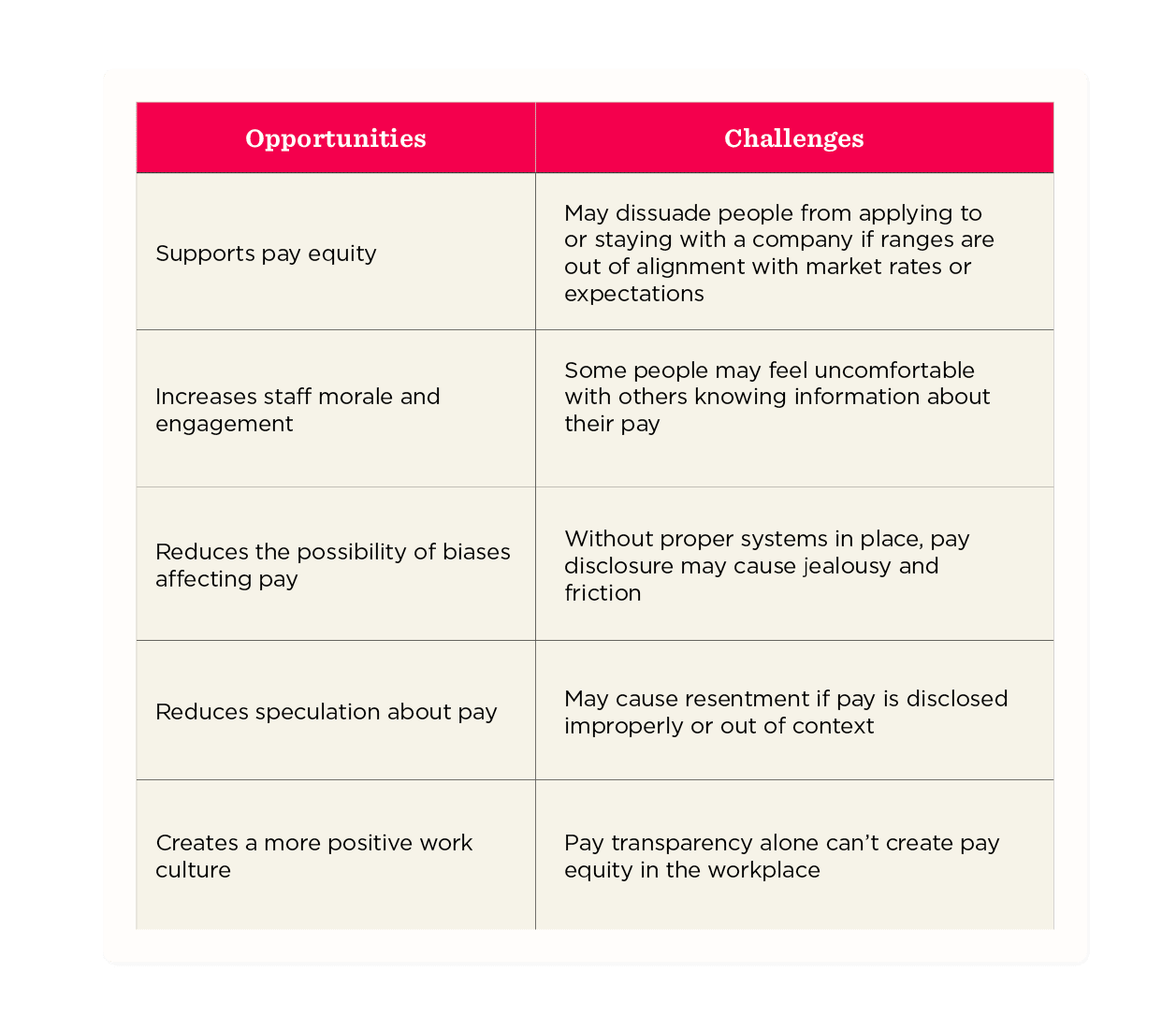
Here are some of the opportunities and challenges to consider when implementing pay transparency:
1. Build (and stand by) a core compensation philosophy
The first step to getting pay transparency right at your organization is ensuring you have a core compensation philosophy that guides how everyone approaches pay decisions. The second step is ensuring you’ve communicated it well to your managers.
A consistent philosophy about pay ensures that no one at your company is forced to make compensation decisions in a vacuum. It gives decision makers like recruiters, hiring managers, and compensation and benefits specialists a shared reference point they can turn to during the hiring process.
Your core compensation philosophy is also there for you to lean on when making decisions around team member lifecycle events, such as promotions, raises, role changes, and retention adjustments. If you’ve never built one before, start by aligning the core tenets of your philosophy with any compliance and legal requirements and ensuring every decision is made based on reliable, HR-reported data.

2. Ensure access to HR-reported market data
When your people team and hiring decision makers can pull from reliable, HR-reported benchmarks, it’s much easier to set ranges that hold up in the real world and stay competitive. “You’re probably not as skeptical about your position in the market as you should be,” says Jessica Zwaan, Chief Operating Officer at Talentful. “So take a look at the data, think about where you are within that, and where you should be.”
It’s okay to pay 50th-percentile salaries, she adds, if that’s what makes strategic sense for you as a business. What matters is that you’re making these decisions intentionally with solid market data rather than gut feelings and guesswork.
3. Gain visibility into your internal compensation data
Visibility into internal compensation data allows your HR and compensation and benefits teams to conduct pay gap analyses on similar jobs and roles within the company—and communicate accurate information to your managers.
Company-specific compensation analytics help you identify pay gaps and inconsistencies, enabling you to create a data-driven action plan that rectifies them on a rolling basis. Internal data also provides a clearer picture of how prepared you are to launch a successful pay transparency program.
<< Download a free pay equity audit template and start your audit today >>
4. Price job roles, not candidates and current team members
Another key to achieving your pay transparency and equity goals is pricing job roles, not people. Job pricing—or setting salary ranges for roles—keeps compensation equitable. Zwaan puts it this way: “You’re building a team member experience subscription, so treat compensation the way you’d price a product.”
The traditional practice of pricing candidates rather than roles naturally encourages unfair pay practices and pay secrecy. It relies on how much individual candidates request during an interview or on a hiring manager’s feelings about particular professionals, the value they’ll bring to the company, and their price points.
Pricing job roles, on the other hand, matches job descriptions to survey data and groups of positions, which helps you avoid bias against (or for) specific candidates. “A protein researcher for a DeepMind type environment is a completely different compensation problem than a warehouse role you can train quickly,” says Zwaan. “Get clear on the market position for the role first, then set ranges from that.” Once you have role-based ranges in place, every hire slots into the same predefined salary band, keeping pay consistent and equitable across the board.
How to effectively implement a successful pay transparency policy
Now that we’ve talked about the challenges and some of the solutions, it’s time to dig into how to embrace pay transparency as the untapped opportunity it is.
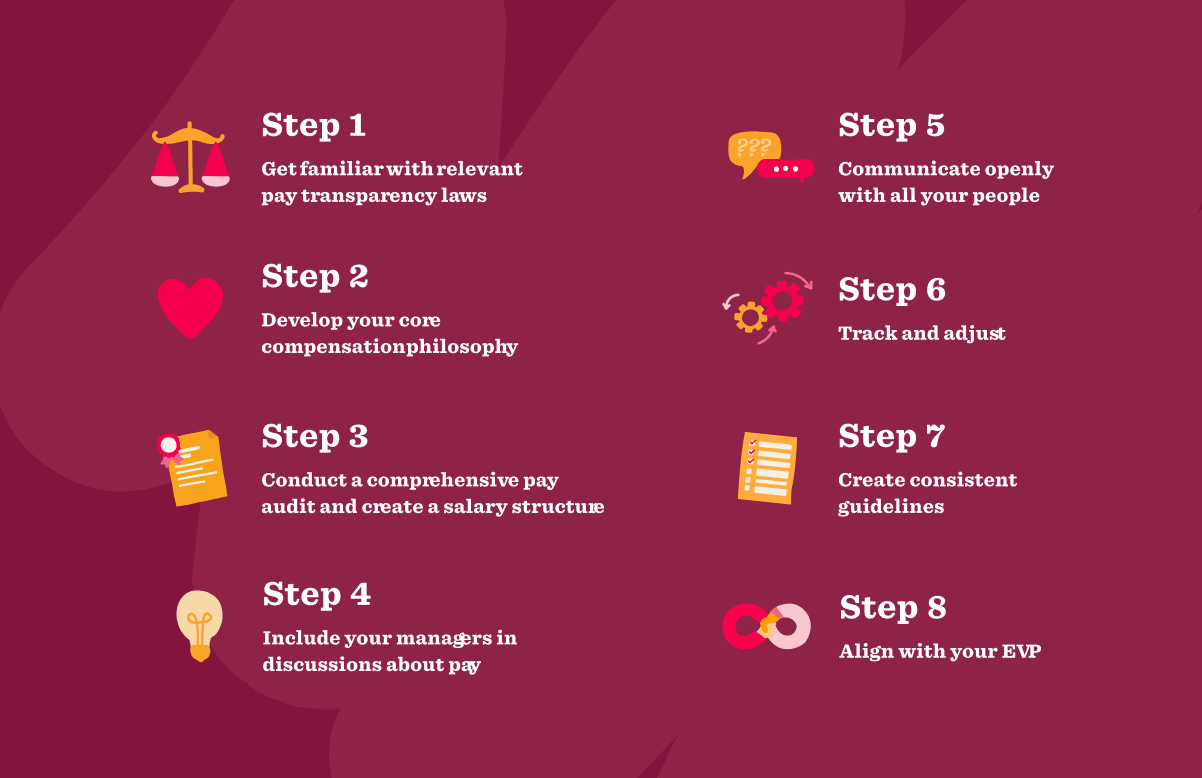
Follow these steps to develop a consistent pay transparency framework that supports taking a proactive stance for equity and inclusion in pay.
1. Get familiar with relevant pay transparency laws
Every jurisdiction has its own legislation pertaining to pay transparency. That’s why the first move is to get crystal-clear on the current and upcoming legal requirements where you operate and keep your legal counsel in the loop.
Create a list of every country/state/city your people reside in now and where you plan to hire in the next year. For each location, document three things:
- What you must disclose: Range, bonuses, commissions, benefits
- When you must disclose it: Job ad, interview stage, on request
- Who it applies to: Size thresholds, remote hires, internal moves
Have HR and legal share ownership of this list. Review it every quarter and make updates whenever your company hires in a new location.
2. Develop your core compensation philosophy
Your core compensation philosophy sets the tone for your pay transparency policy, establishes the framework for why you’re choosing certain structures and compensation policies, and ultimately determines the right level of transparency for your organization.
Ask yourself and other decision-makers questions like these when developing your compensation philosophy:
- How open do we want to be about compensation?
- Does full transparency—where everyone, from new joiners to the CEO, sees each other’s compensation—support our culture and goals?
- Who should have access to compensation data—only HR and Finance, or should managers also see their teams’ information?
- Where do we currently stand on the pay transparency spectrum, and where do we aim to go?
- How can we use our talent strategy and culture to build a strong, equitable pay philosophy?
- What does market data reveal, and how can we use it to set consistent salary ranges for each role?
- Do our salary ranges stay competitive with current market benchmarks?
- Do current salaries fall within our defined bands, and what steps will help us align them?
- Do we see any pay gaps or trends that signal bias or discrimination?
- How well do our managers understand and apply fair, equitable pay practices?
- How can we build greater trust and openness about compensation across the company?
Before you start, conduct a compensation analysis to help you determine where you currently stand and what changes you need to make to align with your core compensation philosophy. Whether you decide to be fully transparent with everyone or limit full visibility to people in key roles, any step toward transparency helps create a healthy company culture rooted in the principles of equitable pay practices.
<< Use this template to conduct your own compensation analysis >>
3. Conduct a comprehensive pay audit and create a salary structure
To understand how well you’re combating pay gaps and inequities, conduct a comprehensive pay equity audit. “This is an opportunity to review your entire compensation practice, from reward philosophy to program design and administration, not just pay grades,” says Yanina Koliren, a senior client partner at Korn Ferry North America.
Draw on compensation benchmarking data—internal and external—and conduct salary surveys to provide insight into where, if any, pay gaps exist, how wide they are, and what departments or roles have the most. Pay audits are also a great starting point for job pricing and creating an equitable salary structure for your company.
Once you get a sense of the internal pay gaps and inconsistencies with HR-reported market data, you’ll have the salary benchmarks and other information you need to define competitive and internally equitable pay for every position and role across your company.
Make it easier for yourself by grouping pay bands into a company-wide structure, determining where team members fall within it, and then identifying the gaps and the cost of adjusting them to competitive market rates.
<< Download and print the pay equity template to run a fair and equitable process >>
4. Include your managers in discussions about pay
Transparency depends on keeping your managers in the loop about any compensation decisions. After all, they’re the first ones people speak to when they have questions about their compensation. “Team members show up on a random Tuesday and say, ‘I don’t think my pay is fair,’ and that manager becomes the entire face of your company in that moment,” says Sarah Reynolds. When managers have the facts, pay conversations stay grounded and productive.
Giving managers a clear view into your compensation philosophy—and the pay data for their teams—sets them up to lead these conversations well. To ensure they have full fluency around compensation topics and can respond effectively to challenging questions from team members about pay, provide them with ongoing training on compensation and benefits and communication best practices.
5. Communicate openly with all your people
Educating and communicating with all your people about your compensation philosophy matters just as much as imparting that information to your managers. Give your people visibility into how you make decisions about pay, explain why those decisions make sense (and how they benefit everyone), and open up spaces for them to have in-depth conversations about career development and pay progression.
Before going fully transparent, Roza Tapini, Head of People Operations at Skroutz, recommends taking time to correct any outliers: “Once companies share compensation bands, whether within a team or across the company, people naturally want to understand where they sit,” she explains. “Having those corrections in place upfront makes the rollout smoother and helps team members engage with the information confidently.”
That means tightening up your salary bands, fixing obvious gaps, and preparing simple explanations for why people sit where they do in-range. From there, share your compensation plan proactively so your people hear it from you first, with context and clarity, and not through guesswork or side chats.
6. Track and adjust
Now that you have a set pay philosophy and salary structure, it’s time to measure its efficacy. The market is always changing, which means keeping your pay fair and equitable is a commitment that requires continuous monitoring and adjustment.
Fall back on the data: Conduct pay audits once or twice a year, continue communicating with your people, and ensure you stay on top of the latest salary benchmarks and pay gap data available so you can adjust your policy accordingly.
7. Create consistent guidelines
Next, turn your compensation strategy into an official playbook that leaders use to set offers, promotions, and raises, and that your people use to understand how you choose those numbers. Set clear rules that stay true across teams, like giving every role a market-based range by level and location, keeping offers and promotions inside those ranges, and spelling out what moves someone through the band so raises follow the same logic everywhere.
Then weave these guidelines into everyday workflows. When a manager submits an offer, promotion, or raise through your compensation management software, for example, ask them to include the job level, the approved range, and where their number sits within it. And if they want to go outside the range, have them add a brief reason and send it to HR and finance for sign-off.
Before each compensation cycle, run a quick calibration check. Review proposed changes by team and level, and confirm with your managers that everyone’s applying the playbook the same way. This keeps compensation aligned, expectations clear, and pay transparency consistent over time.
8. Align with your EVP
Pay transparency can enhance your company’s employee value proposition (EVP) by “taking your culture and your values and really showing how you’re executing them,” says Rony Reich, Director of Compensation and Benefits, HRIS, and People Analytics at Yotpo. When pay practices line up with what you promise, your people feel that alignment in tangible ways, which strengthens job satisfaction, engagement, and trust.
To keep that connection clear, link each EVP pillar to a real pay practice. If your EVP centers on growth, make ranges visible and explain what moving through them looks like in practice. If you lead with fairness and inclusion, share how you benchmark roles and keep pay decisions consistent across teams. And if trust is core to your brand, talk about pay with the same openness you bring to the rest of the employee experience.
Now put that alignment where people can feel it: Spell it out in recruiting and onboarding to set the narrative clearly from the start. Then echo it in internal communications and career conversations, so everyone can understand the logic behind pay and feel confident in company decisions around compensation.
Sticking to these steps and committing to pay transparency is the cornerstone of creating a culture of fairness and equity. Keep it fair and equitable to stay competitive and attract the talent that excels at powering business agility and achieving goal-crushing results.

Pay transparency FAQs
Can payroll software help with creating pay transparency?
Yes, payroll software helps create pay transparency by automating processes and keeping compensation data accurate, consistent, and easy to share. You can quickly pull the right salary range for a role, show how your team calculates base pay and bonuses on payslips, and flag when someone sits outside their band so you can fix it early. That consistency builds trust with your people and keeps you audit-ready as pay transparency laws continue to expand.
What’s the difference between pay equity and pay transparency?
Pay equity is the outcome, while pay transparency is part of the process that leads to it. Equity means making sure you pay team members fairly for comparable work, without unjust gaps tied to gender, race, age, or other irrelevant factors. Transparency is about sharing how compensation works so your people understand how you determine pay, what moves someone up or down a range, and why differences exist. Together, they make fair compensation something you can actually prove and sustain.
Do pay transparency laws require bonuses to be posted?
Yes, a growing number of pay transparency laws require disclosing both a base pay range and plain-language note about any other compensation the role is eligible for, like bonuses and commissions. So far, this is a requirement in US states like Colorado, Illinois, Maryland, and Washington, with California following suit in 2026.
Meet Bob
Bob’s powerful and flexible HR solution is here to help modern, global organizations get the data and tools they need to be proactive about pay transparency and build a fair and equitable company culture. With Bob, it’s easy to accurately price jobs, define pay ranges, assess gaps, make smart compensation decisions, stay on top of changing regulations, and communicate about pay with confidence—all from one platform.
Bob helps you stay compliant
- Create a salary structure: Tap into Bob’s Compensation Benchmarking Powered by Mercer and use our Compensation module to build a comprehensive salary structure for your entire organization. Group similar jobs together and create salary ranges and bands to help with workforce and budget planning, compensation management, and reporting.
- Continuous monitoring: Bob’s Analytics makes it easy to stay on top of all your data with out-of-the-box dashboards and the ability to customize your own. You can also create custom reports to track and monitor the compensation and pay equity metrics that matter most to your organization.
Bob helps you define your pay philosophy
- Conduct a comprehensive pay audit: HR and managers can easily identify pay gaps by gender, ethnicity, age, sexual orientation, disability, and other protected classes. Dig even deeper with Bob’s Compensation Benchmarking Powered by Mercer to quickly and accurately price jobs according to market rates and define geo-specific pay ranges to ensure your offerings are competitive to attract top talent in every market.
- Get buy-in for adjustments: Bob’s Workforce Planning module helps you quickly and easily understand what needs to be adjusted at your company and the cost of those adjustments.
Bob helps you create a transparent culture
- Get managers involved: Provide managers with the ability to answer tough questions from your people about compensation and pay fairness all year round. Bob’s Compensation module provides managers with access to the critical compensation data they need to make fair and equitable decisions about pay for their teams, like current salary and compensation history, position-in-range, performance, tenure, eligibility for increase, and more—all in one place on an ongoing basis.
- Ensure fair performance evaluations: Bob’s Talent module gives your managers side-by-side views into peer reviews and team member self-reviews, goal attainment, growth plans, activities and check-ins, and other information to help drive fair and unbiased performance evaluations. View talent and compensation data simultaneously to improve data-driven decisions about pay, and easily audit the entire process, ensuring pay-for-performance policies are applied equitably.
- Openly communicate about pay: HR leaders can model company-wide scenarios to close gaps, and easily share the information with colleagues in Finance and members of the C-suite and board for review and approval.
<< Learn more about how Bob helps you achieve your pay transparency goals >>