If you’re responsible for running performance appraisals, you already know how much they influence the way people feel about their work, their growth, and their future at your company. With more than half of the global workforce actively looking for new opportunities, teams need recognition and development support more than ever to feel they have a promising future at their current organization.
Performance appraisals are a great way to do this, and they provide one of the few moments where those conversations happen without distraction. But what do effective appraisals actually look like in practice? And how do you make sure the conversation feels useful rather than formal or forced?
In this guide, you’ll learn how to set up effective appraisals, choose the right methods for your organization, and use these conversations to support your performance management strategy.
<< Download a free employee performance review template >>
Key insights:
- Performance appraisals bring clarity to workplace expectations by reviewing someone’s work and using concrete examples to assess results and behaviors
- Leaders can combine different appraisal types—self, peer, negotiated, probationary—and evaluation methods—360 feedback, peer review, OKRs— to create a more complete, fair view of performance
- Behavior-based competencies and clear performance rating scales make evaluations more consistent across teams and reduce the subjectivity that can lead to confusion or bias
- Appraisal insights directly support real decisions around compensation, promotions, development plans, and role alignment
- Effective performance appraisals rely on ongoing feedback, manager preparation, and structured follow-up through goals or improvement plans so people know exactly what success looks like in the next cycle
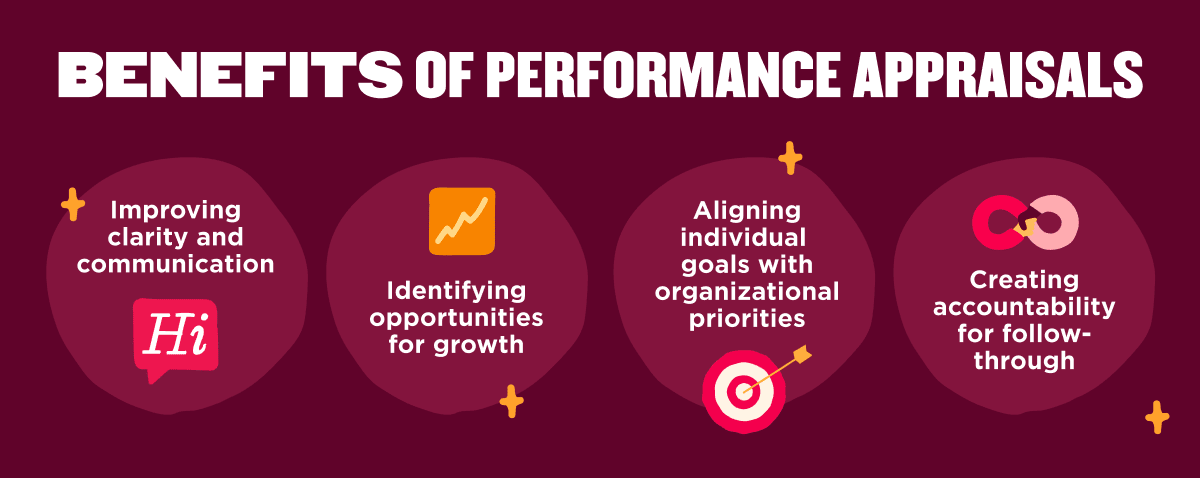
Benefits of performance appraisals
Performance appraisals give managers and team members a dedicated space to review the full scope of the team member’s work for the entire review period. They bring together examples, outcomes, and expectations in one place, creating a clear record to support decisions about compensation, promotions, and development planning.
Additional benefits of performance appraisals include:
- Improving clarity and communication: Appraisals help both sides see the same picture by grounding the performance conversation in specific examples. This reduces misunderstandings and makes it easier to talk openly about achievements and challenges.
- Identifying opportunities for growth: A structured performance review highlights skills that need strengthening and areas where someone is ready to take on more. These insights guide decisions about training, coaching, or new responsibilities.
- Aligning individual goals with organizational priorities: As company goals evolve, appraisals help recalibrate individual work so it supports what the business needs next.
- Creating accountability for follow-through: Appraisals end with agreed-upon goals or actions for the next cycle. This gives people a clear understanding of what’s expected and how they can continue growing.
Types of performance appraisals
Different types of performance appraisals give you alternative perspectives on someone’s work. Many teams use more than one method, especially when they want to balance self-reflection, manager feedback, or peer input. The right mix depends on your culture, your goals, and how you prefer to evaluate performance. Here are some common types of performance appraisal:
- Self-assessment: A self-assessment asks team members to evaluate their own performance against goals or expectations. Companies often use it to encourage reflection, and it helps managers understand how their people view their progress before the formal review.
- Peer assessment: Peer assessments gather feedback from colleagues who work closely with the team member day-to-day. This method is helpful for roles where collaboration and effective team communication affect performance and managers may not see all behaviors directly.
- Negotiated appraisal: A negotiated appraisal involves a neutral facilitator who helps the manager and team member discuss performance and reach a shared understanding. It’s often used when there’s a noticeable gap between how each person views the work or when previous reviews were tense or unclear.
- Probationary appraisals: Probationary appraisals evaluate performance during the first 30, 60, 90, or 180 days of employment (or the probationary period). They’re useful for checking early progress, confirming role fit, and identifying support or training new hires may need.
Performance appraisal methods
There’s no single way to evaluate performance perfectly. Different methods highlight different parts of someone’s work, and many organizations combine approaches to get a more complete picture. Let’s look at a few methods you can use to support fair, consistent decisions.
1. 360-degree feedback
A 360-degree review collects feedback from multiple sources, such as managers, peers, direct reports, and sometimes customers. This multi-perspective approach helps managers build a fuller picture of how a team member performs across different relationships and situations.
Benefits:
- Gives a well-rounded perspective into behaviors managers may not see day-to-day
- Reduces single-source bias by getting feedback from multiple people
- Highlights where someone’s self-perception differs from others’ experience
- Encourages accountability to peers, not just managers
Challenges:
- Adds administrative load having to coordinate multiple contributors
- May reduce feedback honesty if people worry about being identified
- Can lack consistent feedback quality if some reviewers provide detailed examples while others give vague comments
- Overloads some people if too many inputs make it hard to know what to focus on
Implementation recommendations:
- Use standardized questions or rating criteria so all reviewers evaluate the same behaviors
- Keep contributions anonymous when possible to encourage candid, actionable feedback
- Limit the number of reviewers to the people who worked closely with the team member during the review period.
- Provide guidance on writing useful feedback, including examples and behavior-focused language
- Help the team member sort the themes into “strengths,” “areas to improve,” and “next steps” so they’re not overwhelmed
2. Peer review
Like 360-degree feedback, peer review offers insights managers may miss, but it focuses specifically on feedback from colleagues who work side-by-side with the team member. It’s particularly helpful for assessing collaboration, communication, and informal leadership.
Benefits:
- Reveals how someone contributes within a team setting
- Surfaces collaboration strengths and challenges that affect project outcomes
- Sheds light on work habits and interpersonal dynamics
- Highlights influence, initiative, and support behaviors peers observe firsthand
Challenges:
- May introduce potential unconscious bias if personal relationships influence scores
- Creates discomfort for some peers who feel uneasy evaluating coworkers
- Produces uneven feedback quality if criteria aren’t clearly defined
- Risks conflict if companies don’t anonymize feedback or frame it constructively
Implementation recommendations:
- Use a simple, behavior-based form to keep feedback focused and fair
- Choose peers who worked directly with the team member during the review period
- Keep submissions confidential to encourage honest, specific responses
- Offer guidance on giving balanced feedback with examples
- Combine peer feedback with manager observations rather than relying on it alone
Recommended For Further Reading
3. OKR method
The objectives and key results (OKR) method evaluates performance by reviewing progress against agreed-upon objectives and key results. It focuses on measurable outcomes tied directly to team or company goals, making it best suited for roles with clear, quantifiable expectations.
Benefits:
- Creates transparent alignment between individual work and company priorities
- Makes performance easier to evaluate using specific, measurable results
- Encourages focus by limiting goals to what matters most each cycle
- Provides a clear picture of what the team member planned and what they delivered
Challenges:
- Overemphasizes metrics if managers don’t consider qualitative contributions
- Requires consistent goal-setting habits that some teams may struggle to maintain
- Causes overwhelm if teams use too many OKRs or if priorities shift frequently
- Limits evaluation accuracy when goals rely on cross-functional dependencies
Implementation recommendations:
- Start with a small number of OKRs to keep expectations realistic and manageable
- Review progress throughout the cycle so you can make adjustments early
- Combine OKR outcomes with behavioral and qualitative feedback for a balanced evaluation
- Train managers and team members on writing effective OKRs that are specific, measurable, and achievable
- Use tools or dashboards to track OKRs so progress stays visible and easy to update
Best practices for a strong performance appraisal process
Performance appraisals work best when the process is clear, consistent, and grounded in real examples rather than vague statements or one-off conversations. The goal is to give people a fair look at their work, outline next steps, and make better-informed compensation and professional development decisions. Follow these performance management best practices to design a process that supports development while still fitting the needs of different teams and roles.
1. Define competencies clearly
Clear competencies set the foundation for fair evaluations by describing what good performance actually looks like. Instead of broad labels like “communication” or “leadership,” define the specific behaviors that show up in day-to-day work. Involve team members in creating these definitions to build buy-in and ensure the language reflects the reality of the role.
Use action-oriented phrasing so managers and team members can point to real examples over personal interpretations. Examples of behavior-based competencies include:
- Instead of “good communication,” use: “Explains complex ideas clearly to non-technical teammates”
- Instead of “shows leadership,” use: “Facilitates team discussions and drives decisions with clear next steps”
- Instead of “team player,” use: “Collaborates across departments to move shared projects forward”
2. Use effective job performance and behavior measurement scales
Rating scales only work when they’re clear, consistent, and tied to real behaviors. Choose a scale that fits your company culture and the type of work you’re evaluating. This might mean hitting measurable goals, demonstrating specific behaviors, or comparing performance across a team.
For example, you can use:
- Management by objectives (MBO): Evaluates progress against specific goals. This works well for roles with measurable outcomes and clear deliverables.
- Behaviorally anchored rating scales (BARS): Uses concrete examples for each rating level to reduce subjectivity. For example, a “3” in teamwork might mean “regularly offers support to help colleagues meet deadlines.”
- Graphic rating scales: Relies on simple numeric or descriptive ratings such as 1-5 or “meets expectations”). These are best paired with clear definitions so ratings don’t rely on personal interpretation.
- Forced ranking: Compares team members to one another. You can use this to identify top performers, although it might create unnecessary competition and may not work for collaborative cultures.
3. Create clear performance appraisal meeting templates
A good meeting template keeps the conversation focused without making it feel scripted. It ensures managers cover the essentials like achievements, challenges, and future goals, while still allowing space for personal context. Both managers and team members should bring examples, review previous goals, and think through what they want to discuss.
A simple meeting flow might include:
- Starting with recent wins and what went well
- Reviewing challenges with specific examples
- Collaborating on goals for the next cycle
- Agreeing on concrete action items and timelines
- Scheduling follow-ups to track progress
Use open-ended questions to encourage discussion, such as: “What made this project challenging for you?” or “What would help you be more effective next quarter?”
4. Prioritize managing biases
Bias shows up easily in performance conversations, especially when reviews rely on memory or personal impressions. Helping managers understand common biases make evaluations more accurate and fair.
Recency bias, for example, can cause someone’s last few weeks of work to overshadow months of consistent contributions. Another bias, called the halo effect, can make one strong skill influence ratings in unrelated areas, while affinity bias can lead managers to rate people more favorably when they work or think as they do.
To integrate anti-bias into your company culture, encourage ongoing documentation throughout the year, and evaluate each competency independently using specific examples. Talking about behaviors rather than personality traits helps keep the conversation objective and focused on job-related performance.
5. Use HR tech to document appraisals and feedback
HR tech makes it easier to keep track of performance information and ensure nothing falls through the cracks. Instead of juggling spreadsheets, you can have past reviews, comments, goals, check-ins, and next steps in one place.
Some performance management software provides automated reminders that can help managers stay on track with deadlines and dashboards. This makes it easier to spot trends across teams, such as common development needs or areas where coaching may be needed. Integrations with learning management platforms (LMS) or goal-tracking tools allow appraisal insights to turn into real development actions.
6. Follow up with performance improvement plans
A performance improvement plan (PIP) turns appraisal feedback into a concrete, structured path forward when someone needs extra support. Effective PIPs focus on specific behaviors or results, not just vague statements like “be more proactive.” For example, a clearer plan might outline: “Prepare meeting agendas in advance and facilitate weekly team updates for the next eight weeks.”
Good PIPs use SMART goals—specific, measurable, achievable, relevant, and time-bound— and break larger improvements into manageable steps so progress is easier to track. Regular check-ins keep the conversation supportive and ensure the person has the tools, coaching, or training they need to make meaningful progress.
<< Download a free performance improvement plan template >>
Performance appraisal examples
Let’s look at a few examples of how managers might describe performance in common areas like punctuality, accountability, and communication. Notice how they focus on observable behavior rather than opinions or personality.
Punctuality:
- Positive example: “Consistently arrives on time and is prepared for meetings. Maintains reliable attendance even during high-volume periods, which helps the team stay on schedule.”
- Constructive example: “Frequently arrives late to morning standups, which delays team updates and disrupts planning. Could benefit from establishing a consistent routine and communicating in advance when delays may occur.”
Accountability:
- Positive example: “Takes ownership of tasks from start to finish and keeps stakeholders informed when timelines shift. Regularly follows through on commitments and proactively solves problems without needing reminders.”
- Constructive example: “Misses deadlines and often requires follow-up to complete assigned work. We recommend improving task tracking and communicating earlier when obstacles may impact delivery.”
Communication:
- Positive example: “Communicates clearly in meetings and written updates, making complex information easy for cross-functional partners to understand. Actively listens and checks for alignment before moving forward.”
- Constructive example: “Tends to provide limited context when sharing updates, which causes confusion for teammates who depend on that information. Could benefit from offering more detail and verifying their understanding with stakeholders.”
Empower your people with effective performance appraisals
Performance appraisals become powerful tools when they focus on development rather than judgment. The most successful organizations use them to build stronger relationships between managers and team members while driving continuous improvement.
Effective appraisals contribute to building a culture where feedback flows freely and people feel supported in their growth. They enhance engagement by showing people how their work connects to larger organizational goals and create transparency around expectations and opportunities.
When done well, performance appraisals help develop future leaders by identifying potential and providing structured development paths. They create trust between managers and team members through regular, honest conversations about performance and aspirations.
Performance appraisal FAQs
How do I write a performance appraisal?
Start by reviewing the team member’s goals, documented examples, and outcomes from the full review period. Use clear, behavior-based language—“delivered X,” “improved Y,” “demonstrated Z”—so the feedback is specific and measurable. End with actionable next steps so the person knows exactly what to continue, adjust, or develop in the next cycle.
What is the purpose of a performance appraisal?
The purpose of a performance appraisal is to give team members a clear picture of how their work is going. It helps people understand their strengths, identify areas to grow, and see how their work supports the organization’s evolving priorities. Appraisals also provide the documentation needed to make fair decisions around compensation, promotions, and role changes.
What does a performance appraisal consist of?
A performance appraisal typically includes a review of goals, key accomplishments, challenges, and behavior-based competencies relevant to the role. Managers often add detailed examples to show how the person’s work contributed to team or company priorities. The appraisal ends with agreed-upon goals or next steps, creating a clear plan for the next review period.
Are performance appraisals effective?
Yes, performance appraisals are effective because they pair real examples of performance with ongoing feedback throughout the year. They help people understand expectations, recognize achievements, and identify growth opportunities. Appraisals also give organizations a consistent, documented way to make fair decisions about compensation, development, and promotions.