
Employee performance metrics reflect your team members’ contributions and their impact on your organization. They can help you make data-driven decisions and successfully plan for tweaks and changes.
However, this often goes unrealized, with only 45 percent of organizational leaders reporting that their organization uses consistent tools for employee performance management. Without consistency, it becomes difficult to fully capture the value of these metrics and ensure they drive fair, effective decision-making.
Let’s take a look at some of the most critical performance HR metrics to keep track of in the modern workplace.
<<Download the top employee performance metrics every HR leader should track.>>
Key insights
- Performance metrics are crucial for understanding individual contributions and aligning efforts with organizational goals
- You can measure performance by setting KPIs, running performance reviews, and assigning self-assessments
- HR platforms can simplify tracking and analysis of these metrics, providing HR professionals with actionable insights to enhance team performance
What are employee performance metrics and why are they important?
Employee performance metrics are a set of measurable values that gauge your team members’ individual productivity, efficiency, and overall performance. They can help identify high-performing talent and spot several areas that you may need to improve. As Dr. John Sullivan, corporate speaker and advisor, explains: “Performance management metrics aren’t just historical, but they are also forward-looking projections so that managers can know who has a positive trajectory.”
However, research shows that only 21 percent of people believe their performance goals are within their reach. This underscores the importance of selecting fair, transparent measures that not only track outcomes but also give team members confidence in how their contributions are evaluated.
How to measure employee performance metrics
There’s no one-size-fits-all approach to tracking performance. Depending on your goals, culture, and tools, there are several ways to measure how your people are doing. Here are some effective methods to consider.
Key performance indicators
The most common method is setting a variety of clear, relevant, and measurable key performance indicators (KPIs), then analyzing the results to get a comprehensive picture of performance.
You can tailor these KPIs to fit your organization, taking into account things such as the specific roles of your people, what department they’re in, or more general company-wide goals.
360-degree feedback
This comprehensive method gathers input from peers, teams, supervisors, managers, and other key members who regularly interact with the individual. 360-degree feedback provides a more holistic view of a person’s performance and highlights specific areas for improvement.
Recommended For Further Reading
Self-assessments
Sometimes, the best approach is to ask someone to look inward and evaluate their own performance on a regular basis. You can use multiple-choice questions, surveys, or other methods to help gather insights.
Compare these self-assessments to your expectations and feedback, then address any discrepancies you identify.
9-box model
The 9-box grid or model evaluates people based on both performance and potential, creating a clear snapshot of where individuals stand. For example, someone placed in the “high performance, high potential” box might be fast-tracked for leadership opportunities, while others may be identified for targeted development.
Forced ranking
Forced ranking compares people against one another to identify top performers and those needing additional support. For example, recognizing the top 20 percent of sales representatives may lead to targeted rewards, while the bottom 10 percent can be given extra coaching.
This method creates clarity around performance standards and helps organizations make informed decisions about promotions, bonuses, and development opportunities.
Management by objectives (MBO)
Management by objectives (MBO) measures performance based on how well someone meets specific, agreed-upon goals that align with broader company priorities. For example, if a marketing manager achieves 90 percent of their quarterly objectives, it shows strong alignment with business strategy.
MBO creates a clear link between individual efforts and company outcomes. It not only helps track progress on strategic goals but also provides a structured, meaningful way to guide performance reviews.
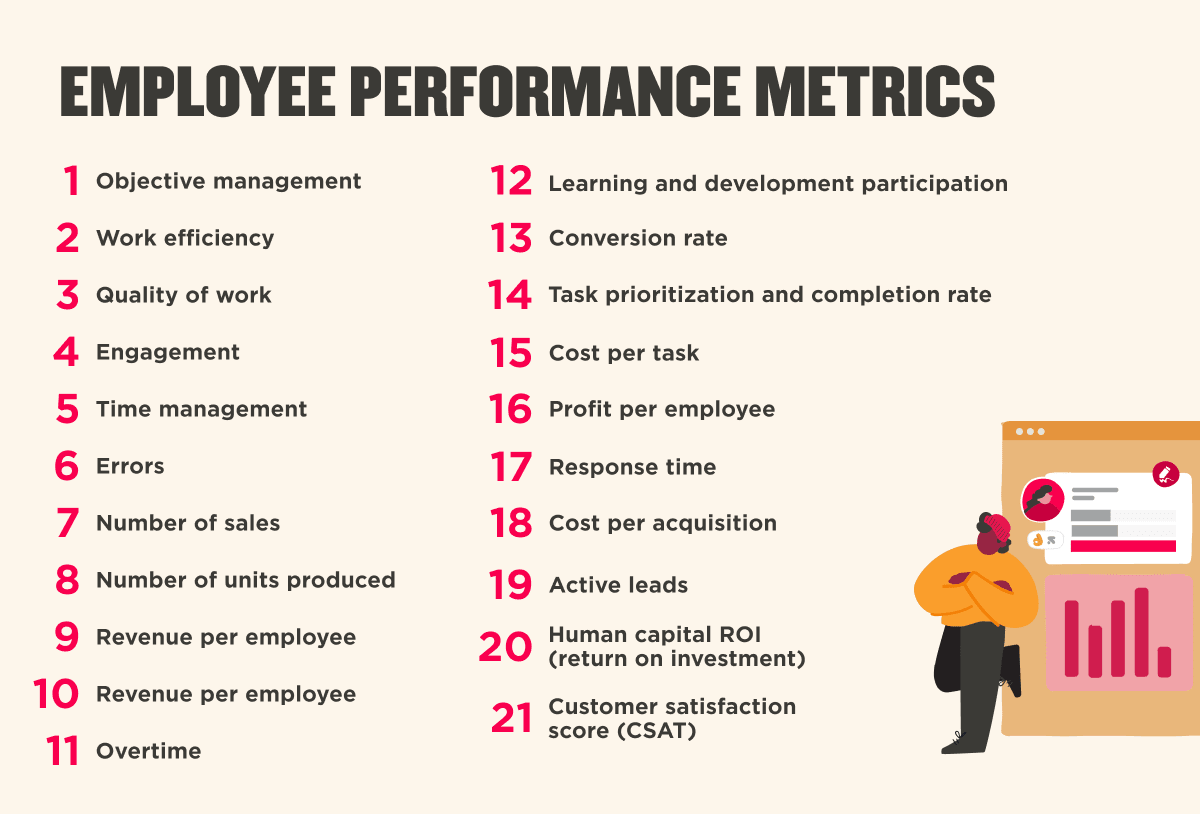
Key employee performance metrics to track
Explore these important metrics that can transform how you measure and improve team member performance.
<<Download this performance metrics list to keep your team on the right track.>>
1. Objective management
Objective management tracks how well a team member is managing and meeting their objectives. This can span a wide range of goals and aims, from broad factors such as clarity and timeliness to more specific company-oriented goals.
For example, a marketing specialist might be measured on completing campaign deliverables on time while staying within budget and achieving target reach metrics. This connects individual performance to organizational success, helping leaders identify who excels at driving results and who might need additional support or resources.
2. Work efficiency
Teams do their best work when they can focus, prioritize, and deliver efficiently. That’s why work efficiency is a valuable metric: It helps highlight how much your people can accomplish within their working hours. For example, if a customer service team member resolves 25 tickets a day while the team average is 15, that’s a strong sign of standout efficiency.
Understanding your current work efficiency can also help pinpoint areas for improvement.
3. Quality of work
Efficiency only goes so far if the output doesn’t meet expectations. Quality of work is just as important. For example, a content writer might be evaluated on how often their articles are error-free and need minimal editing.
Tracking this metric encourages teams to maintain high standards around accuracy and attention to detail—especially since even small mistakes can impact your brand and business outcomes.
4. Engagement
Engagement measures your team members’ commitment to their work, peers, and organization. This metric takes into account factors such as participation, enthusiasm, and a general willingness to get things done. Studies show engaged team members are 87 percent less likely to leave their organizations, directly impacting retention rates and reducing costly turnover.
5. Time management
Time management encompasses everything from a person’s ability to efficiently allocate their time across their tasks to making sure they are punctual each day. It can give you insight into a person’s ability to prioritize, schedule, and meet their deadlines.
For instance, a graphic designer who consistently delivers projects on schedule while managing multiple deadlines exhibits excellent time management. Poor time management can create bottlenecks, delay projects, and ultimately impact your company’s ability to meet client expectations.
6. Errors
Monitoring errors can reveal whether someone needs more support or if your processes need a closer look. For example, a software engineer might track bugs per 1,000 lines of code, aiming for fewer than five. Left unchecked, errors can lead to product issues, customer frustration, or security risks that impact both reputation and results.
7. Number of sales
The number of sales is an easy way to quantify a salesperson’s performance. This can be something as simple as the output of a car salesperson on an average weekday. However, sales numbers get complex since various factors come into play, such as the length of the sales cycle, the economy, and the quality of the product.
8. Number of units produced
The number of units produced is a common metric in manufacturing that reflects how efficiently a team member works. For example, it might track how many physical units someone completes per hour. However, it’s not just for the factory floor—you can apply this to roles like data entry too, where keystrokes per minute help measure output.
This metric directly influences production capacity, delivery timelines, and customer satisfaction.
9. Revenue per employee
Revenue per employee is the average revenue generated per person within a specific time frame. It can gauge your team members’ overall productivity and efficiency and also help pinpoint specific areas that need improvement.
Let’s say your company generates $2 million annually with 20 people. This means your revenue per employee is $100,000. In addition to assessing workforce efficiency, you’ll also be able to compare performance against industry benchmarks, where higher figures typically indicate a more productive organization.
10. Absenteeism
Absenteeism tracks the frequency and overall duration of a person’s absences from work. It gives leaders insight into the impact of unplanned absences on team performance, workload, and morale.
A sudden spike in absenteeism across a department or the organization may point to deeper issues such as widespread disengagement, low morale, or cultural or leadership challenges. Tracking absenteeism trends over time helps identify when something’s off, so leaders can take meaningful action to support their people and improve overall wellbeing.
11. Overtime
Overtime measures how often team members work beyond their scheduled hours. While occasional overtime can reflect flexibility or project urgency, consistently high overtime may signal workload imbalances, inefficient processes, or pressure to overperform.
Tracking this metric helps identify potential burnout risks, uncover operational issues, and support healthier work habits across the organization.
12. Learning and development participation
Tracking participation in learning and development programs can indicate a commitment to growth. It highlights how engaged your people are in building skills and advancing their careers. Continuous learning fuels innovation, adaptability, and long-term competitiveness.
13. Conversion rate
Conversion rate measures how effectively people turn prospects into customers. It helps assess the effectiveness of both sales and marketing efforts. Analyzing when leads convert—or drop off—at different funnel stages (top, middle, or bottom) can also offer valuable insights.
14. Task prioritization and completion rate
This assesses how well team members prioritize tasks and complete them on time. Effective prioritization ensures critical work is completed first, maximizing productivity and preventing bottlenecks that could delay entire projects.
15. Cost per task
This efficiency metric calculates the resources required for team members to complete specific activities. For example, if your accounting team members spend $200 in labor costs processing each vendor payment versus an industry benchmark of $150, you’ve identified an individual performance opportunity. Tracking this at a team member level, you can identify which team members excel at completing tasks efficiently and which might need additional training or support.
Understanding how much each task costs per team member can directly impact your operational efficiency and profitability. When individuals reduce their cost per task, they contribute to helping your organization accomplish more with existing resources or reallocate savings to higher-value activities.
16. Profit per employee
This financial metric measures the average profit generated by each team member. Unlike revenue per employee, which shows how much sales each person generates, employee profit shows how much of that revenue actually turns into profit after costs. For instance, a company generating $3 million in profit with 100 team members has a profit per employee of $30,000.
Knowing the profit per person can help leadership evaluate the overall effectiveness of their talent investment strategy. A higher profit per person typically indicates a well-optimized workforce with the right skills and tools to drive business results.
17. Response time
Response time measures how quickly team members address inquiries or requests. It’s particularly important in customer-facing roles where prompt attention directly impacts satisfaction. Faster response times can improve customer experience, reduce churn, and distinguish your service quality from competitors.
18. Cost per acquisition
This metric calculates the expense of acquiring each new customer, including marketing and sales efforts. It helps evaluate the effectiveness of customer acquisition strategies and individual sales performance.
Cost per acquisition directly impacts profitability, so understanding which team members or approaches yield the lowest acquisition costs allows organizations to optimize their growth strategies and maximize return on marketing investment.
19. Active leads
Active leads measure the number of ongoing potential sales opportunities. For example, a sales representative maintaining 50 active leads in their pipeline versus the team average of 30 can demonstrate strong prospecting skills. Active leads help track your sales pipeline health and future revenue potential.
The metric serves as a leading indicator of future sales performance. From an HR perspective, tracking active leads also highlights hiring needs, training opportunities, and individual performance patterns, helping ensure the sales team is properly supported and developed.
20. Human capital ROI (return on investment)
Human capital ROI evaluates the return on investment in human capital, reflecting the value generated by team members relative to their cost. For example, if your company invests $2 million in compensation and generates $10 million in revenue, your human capital ROI is 5:1.
This metric is important because it helps organizations determine if they’re effectively converting their largest expense—team member compensation—into profitable outcomes.
21. Customer satisfaction score (CSAT)
CSAT measures how satisfied customers are with a specific interaction, product, or service—typically through a quick survey asking them to rate their experience. It offers a real-time snapshot of how well you’re meeting customer expectations at key touchpoints.
As a leading indicator, CSAT helps predict repeat business. Studies show that satisfied customers are far more likely to purchase again, directly fueling revenue growth. High or low CSAT scores also give HR valuable insight into where additional training, coaching, or recognition may be needed to strengthen customer-facing teams.
<<Get your guide to the most impactful performance metrics for modern teams.>>
Best practices for tracking performance metrics
To get the most value from your performance metrics, focus on implementing a strategy that’s aligned, flexible, and people-driven. Here’s how to make it work:
- Align with business goals: Choose metrics that support your company’s broader strategy. When performance tracking reflects real priorities, it drives impact where it matters most.
- Use a balanced mix of metrics: Combine quantitative data (like output or error rates) with qualitative insights (like peer feedback or engagement levels) for a fuller view of performance.
- Review and refresh regularly: Keep your metrics relevant by revisiting them as business needs evolve. For example, a sales team may start the year focused on lead volume, but shift mid-year to prioritizing conversion rates as the pipeline matures.
- Automate with tech: Use tools and platforms, like employee management software, to collect and analyze performance data. This reduces manual effort and improves accuracy, freeing up time for deeper insights.
- Make metrics clear and relatable: Ensure everyone understands how performance is measured and how it connects to their role, team, and the company’s success.
- Invite input: Create space for team members to give feedback on how performance is tracked. This builds trust, boosts engagement, and helps refine your approach.
Effectively track performance metrics to drive performance
When performance metrics align with your goals and reflect both the numbers and the nuances, they give you a clear view of progress. With the right tools, these insights can shape smarter decisions and sharper strategies.
However, it doesn’t stop at measurement. Regular one-on-one meetings, clear communication, and open feedback loops help make metrics meaningful—not just for leaders, but for every team member. When performance tracking becomes part of your culture, it encourages continuous improvement and empowers people to grow, contribute, and succeed.
<<Use these performance metrics to measure what matters most for your team’s success.>>
How Bob helps track and analyze employee performance metrics
At HiBob, we’ve developed a modern HR platform tailored to address today’s multifaceted business needs.
For HR professionals, Bob offers a simplified solution for employee performance tracking by consolidating metrics data into an intuitive, user-friendly interface. Bob makes it easy for you to keep track of performance trends, pinpoint areas for improvement, and keep your team running smoothly.
Managers benefit from immediate access to HR analytics and actionable insights on their team’s performance, helping them be more effective when managing and supporting their teams.
Allow Bob to streamline your workflow and be your partner in fostering a culture of excellence and growth.

From Tali Sachs
Tali Sachs is a senior content manager at HiBob, focused on thought leadership for modern HR teams. She writes about HR strategy, AI in HR, workforce transformation, HR analytics, pay transparency, and the future of work—helping people leaders stay ahead of workplace trends, people data, and emerging regulations with practical action. Off the clock, she’s reading, road-tripping to archaeological sites, snuggling with her cats, or listening to and writing music.