
Growth exposes gaps fast. As teams scale, priorities shift and more stakeholders get involved. Without clear ownership, work slows, accountability blurs, and decisions lose momentum.
A roles and responsibilities template brings clarity back into focus. It gives teams a shared, practical way to define who owns what and how work gets done—so people move faster, make confident decisions, and stay aligned as the business grows.
That clarity matters. In 2024, Gallup found that only around half of U.S. professionals strongly agreed they understood what was expected of them at work, a gap that directly drives lower engagement and performance. As Gallup workplace expert Jim Harter notes, “Most people come to work wanting to make a difference and wanting to have a clear role.”
For HR and Finance, role clarity goes even further. It strengthens planning, supports fair and defensible decisions, and helps workforce changes flow smoothly from approval to payroll to reporting. Clear role design—backed by strong job descriptions and a structured hiring approach—sets teams up for success from day one.
<< Download a free roles and responsibilities template and bring clarity to how your teams work >>
Key insights
- Clear roles reduce friction, rework, and slow decision cycles
- The best templates define outcomes and decision rights—not just tasks
- Validation with team members improves accuracy and adoption
- Regular updates keep roles aligned with org, system, and compliance changes
- Shared structure across HR and Finance improves planning and trust in data
What is a roles and responsibilities template?
A roles and responsibilities template is a simple, structured way to document why a role exists, what outcomes it owns, and how it connects to other roles across the organization.
Unlike a job description, which supports hiring, this template supports execution. It clarifies accountability, responsibilities, decision authority, and reporting relationships, so teams can work together without confusion.
Used consistently, it becomes a reference point for onboarding, performance review conversations, audits, and cross-functional workflows.
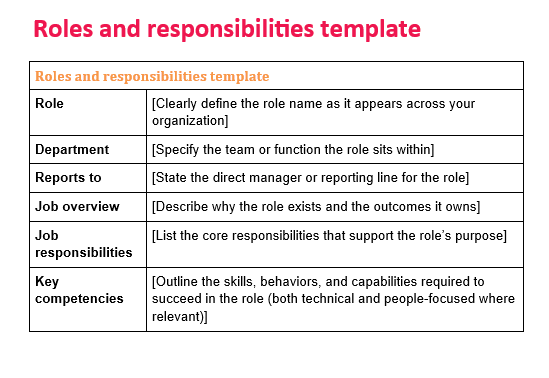
Roles and responsibilities template
When you create a new position or fill an existing role, clarity from day one matters. A roles and responsibilities template helps you define expectations early, align stakeholders, and set the role up for success before work even begins.
Use this template to document the role’s purpose, core responsibilities, and reporting structure in one clear place—so everyone understands what the role owns, how it contributes, and where it fits within the organization.
| Roles and responsibilities template | |||
| Role | [Clearly define the role name as it appears across your organization] | ||
| Department | [Specify the team or function the role sits within] | ||
| Reports to | [State the direct manager or reporting line for the role] | ||
| Job overview | [Describe why the role exists and the outcomes it owns] | ||
| Job responsibilities | [List the core responsibilities that support the role’s purpose] | ||
| Key competencies | [Outline the skills, behaviors, and capabilities required to succeed in the role (both technical and people-focused where relevant)] | ||
Benefits of defining roles and responsibilities
Defining roles and responsibilities creates the foundation for how work gets done. When ownership is clear, teams move faster, decisions stay consistent, and expectations are easier to meet. Here are just a few of the benefits that clarity brings.
Improves accountability
Defined roles make ownership explicit. Team members know what they are accountable for, how the team measures success, and where decisions sit. This creates fair, consistent accountability and stronger manager effectiveness.
When accountability feels unclear or inconsistent, revisiting role definitions often brings alignment back into focus.
Enhances collaboration
Collaboration improves when handoffs are clear. Outlining responsibilities shows where teams need to work together, where tasks require approval, and where quick updates are enough.
Rose Rocket saw this benefit after centralizing people data in HiBob. Before HiBob, employee information lived across spreadsheets and disconnected tools, making it harder for managers to access reliable information and slowing down people-related decisions.
HiBob now serves as a single source of truth, giving managers clear visibility into their teams while HR maintains consistency and governance. This shared access reduces confusion around who can take action, improves trust in the data, and helps leaders make people decisions faster and with greater confidence.
Recommended For Further Reading
Increases efficiency
Unclear roles quietly slow teams down. Duplicated work, extra meetings, and delayed approvals pull focus away from meaningful progress. In 2024, research showed that 60 percent of managers spend more than three hours assembling data before making people decisions—time lost to uncertainty, not complexity.
Clear responsibility mapping brings work back on track. When teams define who owns decisions and what inputs matter, managers spend less time chasing information and more time moving work forward with confidence.
Ensures compliance
Compliance works best when ownership is clear. Documented roles and responsibilities make it easier to assign accountability for approvals, audits, access controls, and policy adherence, reducing reliance on informal knowledge or last-minute fixes.
Clear ownership also strengthens governance as organizations grow. When each requirement has a named owner, teams can respond faster to audits, maintain consistent processes, and reduce risk without adding unnecessary complexity. Pair role definitions with an HR compliance checklist to ensure every obligation is covered, reviewed regularly, and supported by an audit-ready trail.
<< Streamline protecting your people and your organization with a free HR compliance checklist >>
Clarifies new hire expectations
New hires perform better when expectations are clear from the start. Defined onboarding responsibilities give them a clear picture of what success looks like in their role, which priorities matter most, and how their work connects to others across the organization.
This clarity shortens ramp time and builds confidence early. New team members spend less time second-guessing decisions or navigating unclear handoffs and more time contributing meaningfully. Clear role definitions also help managers provide more consistent guidance during the onboarding process, creating a stronger foundation for long-term performance and engagement.
<< Clarify new hire expectations from the start with a free HR job description template >>
Reduces team overlap
When responsibilities overlap, even well-intentioned teams can lose momentum. People may duplicate work, decisions take longer, and ownership feels unclear. Over time, that friction can strain collaboration.
A shared roles and responsibilities template brings structure to that complexity. It makes ownership visible, highlights where responsibilities overlap or fall through the cracks, and helps teams align around clear decision boundaries. With accountability defined, teams focus on what they do best and work together with greater trust and confidence.

How to define roles and responsibilities
Effective role definition is practical, not theoretical. Start simple, validate quickly, and refine as the organization evolves. Here’s how you can build clarity consistently:
1. Identify the role’s purpose
Start by defining why the role exists in one clear sentence. Focus on the impact the role delivers and the outcomes it supports, rather than listing day-to-day activities. A strong purpose statement anchors the role and helps teams understand where it adds the most value.
For example, you may write: “Owns accurate workforce reporting to support HR and Finance planning.”
Once defined, check the role’s purpose against your broader HR department structure to ensure it complements other roles, avoids duplication, and supports how the organization operates today—and where it’s heading next.
<< Ensure alignment during recruitment with a free hiring process checklist >>
2. Outline key responsibilities
List the responsibilities that directly support the role’s outcomes. Use clear, verb-led language so expectations are easy to understand and act on, and define scope where possible to avoid ambiguity around ownership.
Move beyond high-level job description language by translating responsibilities into day-to-day ownership. Clarify which decisions sit within the role, what approvals the team member filling the role requires, and which tools or systems support the work. This turns responsibilities into practical guidance teams can rely on.
For example, instead of “support workforce reporting,” specify “prepare monthly headcount and cost reports, approve data changes in payroll software before rollout, and maintain reporting accuracy in HR and finance systems.”
3. Consult all team members about their responsibilities
Validate role responsibilities with the people doing the work and with the teams that rely on it. This helps ensure the template reflects how work actually happens day to day, not just how the organization intends for it to go.
These conversations often reveal responsibilities that sit outside formal role definitions, along with unclear handoffs or approval bottlenecks. They’re especially valuable across HR and Finance, where shared workflows—such as hiring, compensation changes, and workforce planning—depend on clear ownership and timely decisions. Aligning early helps teams remove friction and stay focused on progress.
4. Specify reporting structure
Clearly define where the role sits within the organization. Document who the role reports to, any dotted-line relationships, and how escalation works when decision-making stalls or priorities conflict. Specify not just the role title but the name of the person currently in that role to remove ambiguity.
For example, note that a People Operations manager reports to the Head of HR (Jane Doe), partners with Finance on payroll approvals, and escalates budget exceptions to the CFO (John Smith).
For critical processes, include backup ownership to reduce risk and maintain continuity during time off or role changes.
5. Look for responsibility overlap and gaps
Review roles side by side to understand how responsibilities connect across the team. This makes it easier to spot duplication, blurred ownership, or critical work that falls between roles.
When overlaps occur, assign one accountable owner for each outcome and clarify how other roles support the work. When gaps emerge, define ownership first, then determine the right level of support. This approach reduces confusion, strengthens collaboration, and helps teams move forward with confidence.
6. Use clear and concise language
Write responsibilities so they are easy to understand and difficult to misinterpret. Clear language helps team members act with confidence and reduces the need for follow-up clarification.
Use short, focused bullet points, start each responsibility with a consistent action verb, and avoid internal jargon where possible. Plain, specific language makes expectations clear across teams and supports consistency as roles scale or change.
Examples of roles and responsibilities
Use these examples as a baseline, then adapt based on size, industry, and structure.
HR manager
This example shows how an HR manager role can be defined with clear ownership, cross-functional partnership, and consistent accountability. It focuses on core people operations, manager support, and alignment with Finance to enable accurate, well-governed people decisions.
| Roles and responsibilities | |||
| Role | HR manager | ||
| Department | Human resources | ||
| Reports to | Head of HR [Sally Smith] | ||
| Job overview | Owns core people operations and partners across the business to ensure consistent, compliant, and well-supported team member experiences. The role supports managers and leaders by providing clear processes, accurate data, and guidance that enables effective people decisions. | ||
| Job responsibilities | Own people operations across the team member lifecycle
Partner with Finance to maintain accurate workforce data for payroll and planning Maintain company policies and support compliance readiness Coach managers on expectations, feedback, and accountability Coordinate hiring with clear role scope and structured recruitment |
||
| Key competencies | Strong knowledge of people operations and HR compliance
Ability to partner cross-functionality with Finance and leadership Clear, confident communication with managers and team members Structured, detail-oriented approach to process and data Coaching mindset with a focus on consistency and fairness |
||
Project manager
This example outlines a project manager role built around structure, visibility, and outcomes. It highlights responsibility for planning, coordination, risk management, and delivery, so teams stay aligned, and projects move forward with confidence.
| Roles and responsibilities | |||
| Role | Project manager | ||
| Department | Project management/Operations | ||
| Reports to | Head of operations [James Hall] | ||
| Job overview | Owns the planning and delivery of projects from start to finish. The role ensures work stays aligned to goals, timelines, and stakeholders by creating structure, driving accountability, and keeping teams focused on outcomes. | ||
| Job responsibilities | Define project scope, success metrics, and timelines
Maintain a RACI for key milestones to clarify ownership and decision-making Run project ceremonies and regular status reviews Identify risks early and drive resolution through clear escalation paths Coordinate stakeholders and manage change control across teams Document decisions and maintain a single source of truth for project status and deliverables Close projects with an outcomes review and structured handoff to operational teams |
||
| Key competencies | Strong planning, prioritization, and organizational skills
Clear communication across cross-functional teams Ability to manage risk, dependencies, and trade-offs Confident stakeholder management and facilitation Structured, detail-oriented approach to documentation and follow-through |
||
Streamline team alignment with a roles and responsibilities template
As teams grow and change, having a shared point of reference becomes increasingly important. A roles and responsibilities template provides that structure, giving teams something consistent to return to as priorities shift and new roles emerge.
Treat the template as a living document. Start with one role or workflow, revisit it regularly, and update it as the organization evolves. Over time, this simple practice supports alignment, reduces friction, and helps teams scale with clarity and confidence.
<< Download the roles and responsibilities template for ultimate team clarity and operations >>
Roles and responsibilities template FAQ
How do you write roles and responsibilities?
Writing clear roles and responsibilities starts with focus and ends with alignment. Use these steps to define ownership, remove ambiguity, and create a shared understanding of how all team members accomplish their work:
- Define the role’s purpose and the outcomes it owns
- List core responsibilities that directly support those outcomes, using clear, action-led language
- Clarify decision rights and approvals so ownership is easy to understand
- Document stakeholders and handoffs to support smooth collaboration
- Confirm reporting lines and escalation paths to remove ambiguity
- Validate with team members to ensure the role reflects how work happens in practice
- Review and update regularly as priorities, systems, and team structures evolve
What should I consider when writing a position’s responsibilities?
Start with outcomes, not just tasks. Each responsibility should connect to a clear result and have a single accountable owner. Document approvals and decision boundaries so ownership is easy to understand, and keep responsibilities aligned with compliance requirements and organizational changes.
Finally, ensure responsibilities stay consistent with job descriptions and recruiting materials. That alignment helps set accurate expectations for candidates and supports stronger performance once the role is in place.
How do I write a job description that will attract applicants?
Start with a clear sense of purpose so candidates understand why the role exists and how it contributes to the business. Be specific about responsibilities and reporting lines to set accurate expectations, and separate must-haves from nice-to-haves to attract a broader, more relevant pool of applicants.
A roles and responsibilities template helps you translate that clarity into a repeatable structure. It prompts hiring managers to define scope, decision rights, key outcomes, and cross-functional touchpoints before the role goes live. That alignment reduces ambiguity, strengthens accountability, and ensures HR and Finance share the same understanding of headcount, impact, and cost.
Use inclusive, straightforward language and pair the job description with a structured recruitment process. Consistent evaluation helps teams make fairer decisions and creates a better candidate experience from the start.