
HR teams can better align people strategy with business goals when they stay ahead of external change. Labor laws, economic shifts, evolving workplace expectations, and new technology all shape how you hire, support, and plan for your team.
A PESTLE analysis helps HR bring that strategic perspective into focus. It highlights the external forces influencing human resources decisions so teams can see the full picture and plan with confidence. You can use this free PESTLE analysis template to organize research, spot patterns, and guide strategic decisions in real HR scenarios—from adjusting compensation to planning for workforce shifts.
<<Download a free PESTLE analysis template.>>

What is a PESTLE analysis?
A PESTLE analysis helps teams assess six external forces that shape the business: political, economic, social, technological, legal, and environmental. It captures shifts and translates them into implications for hiring, compliance, and workforce planning.
For HR, the value is clarity. Teams use PESTLE analyses to:
- Keep external research in one place
- Prioritize which trends need attention now
- Spot potential risks and opportunities
- Ground workforce planning in real-world context
It’s a simple framework, but when updated regularly, it gives HR clear visibility into the forces shaping what comes next. For example, when GoCardless reviewed external pressures around pay transparency and equality, their HR team identified a gender pay gap that required action. Combining regulatory awareness with workforce data, they adjusted compensation practices, improved reporting, and established clear accountability to close the gap. The result was not just better compliance, but a fairer, more transparent pay structure backed by data.
PESTLE analysis template
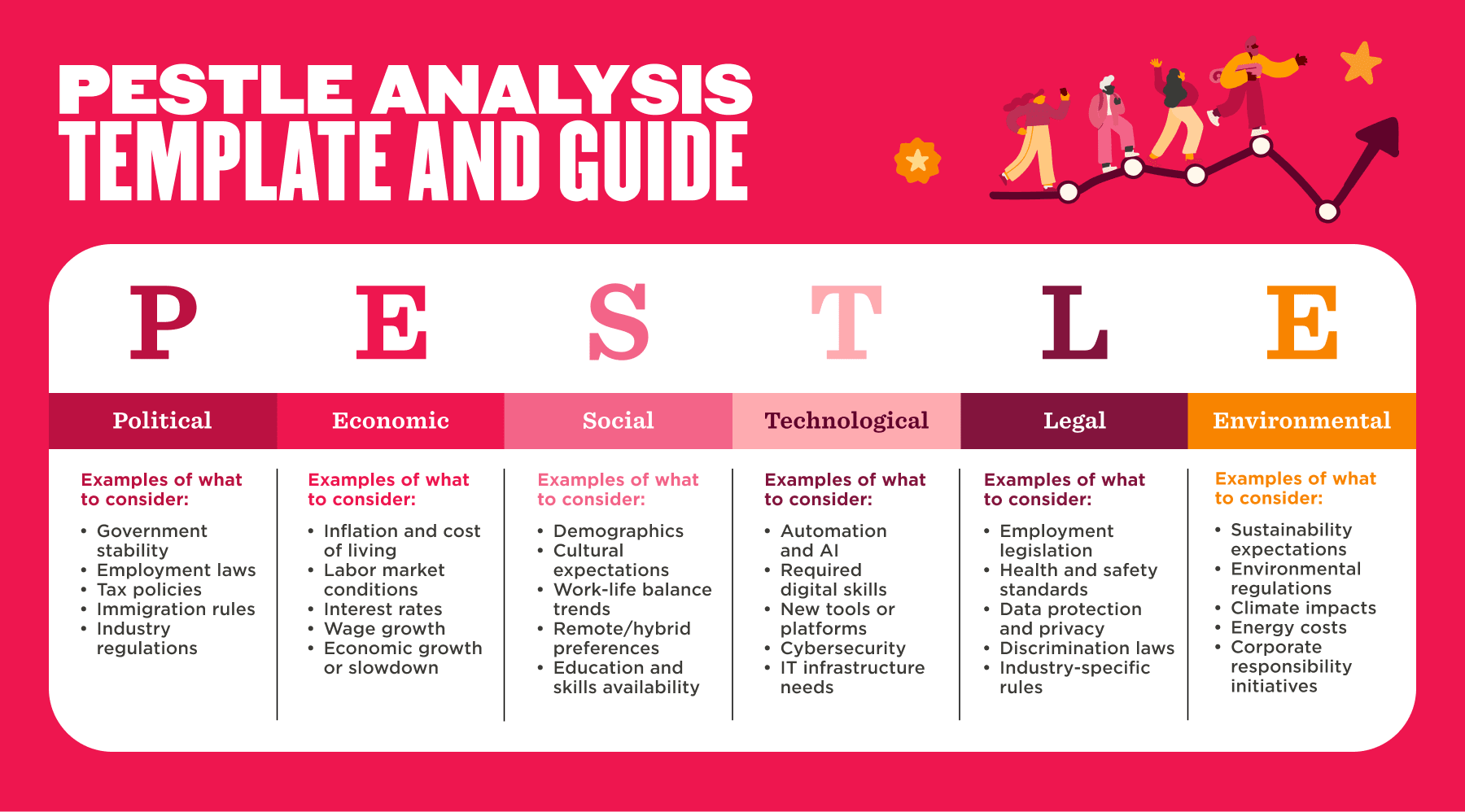
This PESTLE analysis template helps you document what’s happening in your environment and outline how it could affect your people, operations, or long-term plans. The template is flexible, so you can adapt it to a company-wide assessment, a specific HR initiative, or a project like scenario planning, revenue forecasting, or market expansion.
Name: ___________________
Date of analysis: _________________
P: Political factors
Examples of what to consider:
- Government stability
- Employment laws
- Tax policies
- Immigration rules
- Industry regulations
Key factors:
____________________________________________________________________________________________________________
Impact on the business/HR:
____________________________________________________________________________________________________________
Opportunities:
____________________________________________________________________________________________________________
Threats:
____________________________________________________________________________________________________________
Recommended actions:
____________________________________________________________________________________________________________
E: Economic factors
Examples of what to consider:
- Inflation and cost of living
- Labor market conditions
- Interest rates
- Wage growth
- Economic growth or slowdown
Key factors:
____________________________________________________________________________________________________________
Impact on the business/HR:
____________________________________________________________________________________________________________
Opportunities:
____________________________________________________________________________________________________________
Threats:
____________________________________________________________________________________________________________
Recommended actions:
____________________________________________________________________________________________________________
S: Social factors
Examples of what to consider:
- Demographics
- Cultural expectations
- Work-life balance trends
- Remote/hybrid preferences
- Education and skills availability
Key factors:
____________________________________________________________________________________________________________
Impact on the business/HR:
____________________________________________________________________________________________________________
Opportunities:
____________________________________________________________________________________________________________
Threats:
____________________________________________________________________________________________________________
Recommended actions:
____________________________________________________________________________________________________________
T: Technological factors
Examples of what to consider:
- Automation and AI
- Required digital skills
- New tools or platforms
- Cybersecurity
- IT infrastructure needs
Key factors:
____________________________________________________________________________________________________________
Impact on the business/HR:
____________________________________________________________________________________________________________
Opportunities:
____________________________________________________________________________________________________________
Threats:
____________________________________________________________________________________________________________
Recommended actions:
____________________________________________________________________________________________________________
L: Legal factors
Examples of what to consider:
- Employment legislation
- Health and safety standards
- Data protection and privacy
- Discrimination laws
- Industry-specific rules
Key factors:
____________________________________________________________________________________________________________
Impact on the business/HR:
____________________________________________________________________________________________________________
Opportunities:
____________________________________________________________________________________________________________
Threats:
____________________________________________________________________________________________________________
Recommended actions:
____________________________________________________________________________________________________________
E: Environmental factors
Examples of what to consider:
- Sustainability expectations
- Environmental regulations
- Climate impacts
- Energy costs
- Corporate responsibility initiatives
Key factors:
____________________________________________________________________________________________________________
Impact on the business/HR:
____________________________________________________________________________________________________________
Opportunities:
____________________________________________________________________________________________________________
Threats:
____________________________________________________________________________________________________________
Recommended actions:
____________________________________________________________________________________________________________
<<Start your PESTLE analysis with a free template.>>
Components of a PESTLE analysis
Here’s a deeper dive into the factors you’ll explore during your analysis.
Political
Political factors include government policies, employment regulations, tax rules, trade agreements, and the general stability of the political climate. Changes in labor laws—such as overtime rules, paid time off (PTO) requirements, or collective bargaining rights—can require immediate updates to HR policies and team member contracts.
For example, immigration rules can influence whether you can hire internationally or rely on visa-sponsored talent. Shifts in government leadership can also affect long-term planning, especially when new administrations prioritize different regulatory or economic agendas.
For HR teams, political factors often determine compliance obligations, hiring flexibility, and the cost of maintaining certain workforce practices.
Recommended For Further Reading
Economic
Economic conditions—like interest rates, inflation, wage growth, unemployment, and overall market health—directly impact how you hire, retain, and develop your team. When inflation rises or talent becomes scarce, salary benchmarks shift, and competition for candidates intensifies.
In a tight labor market, companies often offer stronger benefits, streamline hiring, or boost compensation to stay competitive. During a slowdown, hiring freezes, reorganizations, or revised headcount plans tend to follow.
HR teams rely on economic insights to guide compensation planning, workforce forecasting, and strategic decision-making.
Sociological
Sociological factors reflect demographics, cultural values, lifestyle trends, and evolving attitudes toward work. They can include shifts such as younger generations prioritizing flexibility, older workers delaying retirement, or growing AI usage at work.
Changing norms around remote work affect everything from office planning to performance management. HR teams may need to rethink how roles are structured and adjust onboarding, collaboration, and manager training to support people who rarely work in the same location.
Population changes like declining birth rates or increased urban migration can also alter talent availability in specific regions. These sociological shifts shape how organizations attract, support, and retain the people they need.
For example, when IDH expanded its global, remote workforce, HR needed better visibility into engagement, workload, and regional differences. They reassessed how teams collaborated across locations and time zones, adjusted onboarding, standardized global processes, and improved how managers supported distributed teams. This helped maintain engagement as the workforce became more geographically diverse.
Technological
Technology evolves fast—from AI and automation to digital infrastructure and industry-standard tools. As new systems change how work gets done, roles shift, and training needs grow. In fact, 85 percent of organizations use HR technology to manage people operations.
Staying competitive may require new platforms, updated workflows, and stronger data and security practices. Tech adoption also shapes how teams collaborate, especially across locations.
For HR, this means planning for reskilling, updating job descriptions, and making sure people have the tools and support to adapt.
Legal
Legal factors include employment laws, health and safety requirements, data protection regulations, discrimination rules, and industry-specific compliance obligations. A single regulatory update, such as changes to overtime classification, can require immediate adjustments to contracts, policies, and documentation.
Data privacy regulations, including GDPR and CCPA, dictate how team information must be collected, stored, and accessed. Legal expectations also impact how organizations handle hiring, termination, accommodations, and workplace conduct.
Environmental
Sustainability expectations, climate risks, and environmental regulations all shape how companies operate. Rules around emissions, waste, and reporting can impact sourcing, facilities, and compliance efforts. Climate events—like heat waves or supply chain disruptions—also affect workplace safety and business continuity.
People and stakeholders increasingly expect organizations to act responsibly. Sustainable practices now influence employer branding and internal HR initiatives, helping teams build trust and plan with accountability.
How to conduct a PESTLE analysis
Instead of trying to capture every external trend at once, this process helps you focus on the factors that are most relevant to your organization right now.
1. Define the scope and objective
Start by defining the purpose of your analysis and the decisions it will inform. Decide whether you’re focusing on the entire organization or a specific area—like hiring, compliance, expansion, or workforce planning. Set the geographic scope, since local, national, and global trends often differ. Clarify the timeline, too, so it’s clear whether you’re looking at short-term shifts, long-term trends, or both.
For example, if you’re assessing legal factors, your objective might be to understand how upcoming pay-transparency laws could affect compensation planning in the next 12 months. You would focus specifically on roles in the US and EU.
Bringing in the right people—typically from HR, finance, operations, and any teams tracking external trends—ensures your analysis is well-rounded without becoming overly complex.
2. Research and collect data
Gather reliable, up-to-date information for each PESTLE category. Combine quantitative data—like inflation rates or employment figures—with qualitative insights, such as changing team member expectations or emerging technologies.
For legal factors, HR might review government labor sites, regulatory guidance, and trusted industry resources such as U.S. Department of Labor updates, EU employment directives, or legal summaries from employment law firms. Then, track new pay-transparency or reporting requirements.
Use credible sources like government websites, industry reports, and regulatory updates—not second-hand summaries. Keep track of your sources so it’s easy to revisit or update the information later.
3. Analyze the findings
Once you’ve gathered your data, assess each factor to identify what matters most. Focus on potential impact—whether on hiring, budgets, compliance, or long-term workforce needs—and note if the effect would be major or minor.
Estimate how likely each factor is to occur within your timeframe, and highlight anything that could significantly support or challenge your plans. Look for connections across categories, too—a political shift might lead to new legal requirements, while new tech could drive skills gaps. Prioritize what needs attention now and flag the rest for ongoing monitoring.
For example, a new pay-transparency law might require updated job postings, revised salary bands, manager training, and changes to how compensation data is documented. HR can flag this as high impact and high likelihood, making it a priority for action.
4. Formulate strategies and take action
Translate your PESTLE findings into concrete next steps. This could mean preparing for new compliance requirements, adjusting hiring timelines, or modeling different budget scenarios.
Share your findings with the stakeholders responsible for these areas so they can weigh the implications and decide on next steps. Assign clear ownership for each action, set timelines, and define how you’ll measure progress.
Since external conditions change, schedule regular reviews to update your PESTLE analysis and adjust your plans accordingly.
If conducting legal analysis, HR might update compensation frameworks, review job descriptions, partner with legal on compliance timelines, and train managers on how to discuss pay ranges confidently and consistently.
Use a PESTLE analysis template to drive strategic decisions
A structured PESTLE analysis template makes it easier to keep track of the trends shaping your organization. Instead of starting from scratch each time, your team can document what’s changing, revisit it regularly, and use it to inform planning conversations across HR and leadership.
Teams often return to their PESTLE analysis when updating headcount plans, reviewing compliance needs, or preparing for market changes. Having everything organized in one place helps you make smarter business decisions as you respond to outside changes.
<<Download a free PESTLE analysis template to start analyzing external factors.>>
PESTLE analysis template FAQs
How do you perform a PESTLE analysis?
Start by defining the decision or project you’re evaluating. For example, an upcoming hiring plan, a new market expansion, or a policy update. Use a PESTLE analysis template to review each external factor one at a time and record what’s happening in your environment, where the information came from, and why it matters. Once everything is documented, sort the findings into what requires action now, what should be monitored, and what needs follow-up from HR or leadership.
What are common mistakes in PESTLE analysis?
Teams often make the mistake of listing broad statements like “economic uncertainty” or “technology changes” without specifying what those trends actually look like in their industry or region.
Another common issue is skipping the “impact” step, which leads to long lists of observations with no clarity on which ones matter for hiring, compliance, or planning. Many teams also complete a PESTLE once and never revisit it, even though external conditions shift regularly.
What is the difference between SWOT and PESTLE analysis?
A SWOT (strengths, weaknesses, opportunities, and threats) analysis looks at both internal and external factors, making it useful for evaluating your organization’s current capabilities. A PESTLE analysis focuses only on external forces that could influence your plans.
Many teams use both together. PESTLE helps you understand what’s changing outside the business, and SWOT helps you decide how well positioned you are to respond.