
Performance appraisals can be valuable for both managers and team members. When done well, they’re a chance to celebrate progress, clarify expectations, and align on the next steps for professional growth.
However, for many organizations, that potential is still untapped. Fewer than 18 percent of HR leaders say their current performance management approach drives real impact. Without the right structure, reviews can feel rushed, unclear, or disconnected from actual development.
A well-designed performance appraisal form creates space for honest, two-way feedback—turning reviews into meaningful conversations. This template does just that, encouraging open dialogue, supporting development planning, and allowing easy customization by role or department.
Inside, you’ll find:
- What to include in a strong appraisal form
- How to customize it by role or seniority
- Ways to use the form to spark deeper, people-focused conversations
<<Download a free performance appraisal form template.>>
Key insights
- A well-structured performance appraisal form helps managers run more consistent, meaningful reviews that support real growth
- You can tailor appraisal templates for different roles or seniority levels to make feedback more relevant and actionable
- Adding clear criteria and real examples makes it easier to address underperformance and track progress over time
- Use consistent forms to improve decision-making around promotions, compensation, and career development
- Download this free performance appraisal form template to simplify your review process and support stronger manager–team member conversations
What is a performance appraisal form?
A performance appraisal form is a structured performance review tool managers use to review how a team member has performed over a set period. Most appraisal forms include basics like role information, key responsibilities, performance criteria, and space for comments or goals for the next cycle. Some organizations keep things simple with short rating scales, while others add sections for self-reflection or peer input, depending on their process.
Only 38 percent of HR leaders believe their performance management processes keep pace with business needs. A form can guide the performance review conversation so both sides can focus on specific examples instead of broad impressions. It also gives managers a clear framework to follow, ensuring evaluations remain consistent across the organization rather than relying on memory or informal notes.

Performance appraisal form template
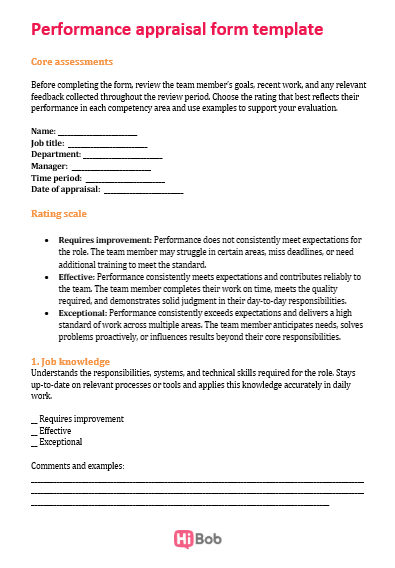
This performance appraisal form template breaks performance into clear competency areas like job knowledge, work quality, and communication. Use it during reviews to guide the conversation, document performance, and shape next-step goals for employee development.
____________________________________________________________________________
Core assessments: Before completing the form, review the team member’s goals, recent work, and any relevant feedback collected throughout the review period. Choose the rating that best reflects their performance in each competency area and use examples to support your evaluation.
Name: _________________________
Job title: _________________________
Department: _________________________
Manager: _________________________
Time period: _________________________
Date of appraisal: _________________________
Rating scale
- Requires improvement: Performance does not consistently meet expectations for the role. The team member may struggle in certain areas, miss deadlines, or need additional training to meet the standard.
- Effective: Performance consistently meets expectations and contributes reliably to the team. The team member completes their work on time, meets the quality required, and demonstrates solid judgment in their day-to-day responsibilities.
- Exceptional: Performance consistently exceeds expectations and delivers a high standard of work across multiple areas. The team member anticipates needs, solves problems proactively, or influences results beyond their core responsibilities.
- Job knowledge
Understands the responsibilities, systems, and technical skills required for the role. Stays up-to-date on relevant processes or tools and applies this knowledge accurately in daily work.
__ Requires improvement
__ Effective
__ Exceptional
Comments and examples: ________________________________________________________________________________________
________________________________________________________________________________________
________________________________________________________________________________________
- Work quality and output
Produces accurate, complete work with minimal errors. Manages tasks effectively, meets deadlines, and follows established processes. Looks for opportunities to improve efficiency or quality where appropriate.
__ Requires improvement
__ Effective
__ Exceptional
Comments and examples: ________________________________________________________________________________________
________________________________________________________________________________________
________________________________________________________________________________________
- Communication
Communicates clearly and professionally with colleagues, stakeholders, or customers. Listens actively, shares updates in a timely manner, and adapts communication style to the audience or situation.
__ Requires improvement
__ Effective
__ Exceptional
Comments and examples: ________________________________________________________________________________________
________________________________________________________________________________________
________________________________________________________________________________________
- Collaboration and customer focus
Works effectively with others, contributes to team goals, and responds to internal or external customer needs in a helpful, professional way. Builds positive working relationships and resolves issues constructively.
__ Requires improvement
__ Effective
__ Exceptional
Comments and examples: ________________________________________________________________________________________
________________________________________________________________________________________
________________________________________________________________________________________
- Dependability and accountability
Follows through on commitments, manages time well, and owns outcomes—both successes and setbacks. Demonstrates reliability, professionalism, and responsible decision-making.
__ Requires improvement
__ Effective
__ Exceptional
Comments and examples: ________________________________________________________________________________________
________________________________________________________________________________________
________________________________________________________________________________________
Key accomplishments this period:
________________________________________________________________________________________
________________________________________________________________________________________
________________________________________________________________________________________
Goals for next review period:
________________________________________________________________________________________
________________________________________________________________________________________
________________________________________________________________________________________
Development or support needed:
________________________________________________________________________________________
________________________________________________________________________________________
________________________________________________________________________________________
OVERALL RATING
__ Requires improvement
__ Effective
__ Exceptional
Manager summary:
________________________________________________________________________________________
________________________________________________________________________________________
________________________________________________________________________________________
Future areas for improvement:
________________________________________________________________________________________
________________________________________________________________________________________
________________________________________________________________________________________
Team member comments (optional):
________________________________________________________________________________________
________________________________________________________________________________________
________________________________________________________________________________________
Manager signature: _________________________ Date: _________
Team member signature: ________________________ Date: _________
____________________________________________________________________________
What to include in a performance appraisal form
A strong appraisal form gives both managers and team members a clear, shared view of progress—and what comes next. Each section should guide the conversation, reduce ambiguity, and help ensure consistency across the organization.
Here’s how to fill it out to drive real value for your people and your business.
Team member and reviewer information
Start by entering basic details like the team member’s name, job title, department, and the period you’re evaluating. This ensures HR has the correct record and avoids confusion when reviewing past appraisals.
Recommended For Further Reading
Performance evaluation criteria
Use the rating scale to assess the team member’s performance in each competency area. Make sure to choose the rating that best reflects their work during this review period, not based on past cycles or assumptions about future potential.
Add short examples or context where you can. Even a one-sentence example like “Delivered project ahead of deadline,” or “Missed weekly status updates several times,” gives the team member clarity and makes the feedback more meaningful.
Team member achievements and improvements since the last appraisal
List the work the team member is most proud of or contributed significantly to, like completed projects, process improvements, positive customer feedback, or moments where they stepped up.
Focus on outcomes, not just effort. For example, “Improved ticket response time by 20 percent,” or “Trained two new team members.” If they’ve improved in any specific area—communication, prioritization, technical skill—call it out directly so they see what’s working and where they’ve grown.
Future areas for improvement
Use this section to outline the specific skills, behaviors, or habits that will help the team member be more effective in their role. Keep the feedback clear and actionable by focusing on what they should do differently or more consistently, not vague ideas like “be better at communication.”
Pair each improvement area with one or two concrete next steps, such as: “Share weekly status updates every Friday with the team,” or “Shadow a senior teammate to learn the new workflow.” This helps the team member know exactly how to move forward.
Team member comments
Encourage the team member to share their perspective on what they’re proud of, where they felt challenged, and what support they may need. This section gives them space to correct misunderstandings, provide additional context, or highlight work you may not have seen firsthand.
Remind them that their comments help shape the next review period’s goals and ensure the appraisal feels like a two-way conversation for their satisfaction.
<<Streamline your performance reviews with a free performance appraisal form template.>>
Benefits of consistent performance appraisals
Consistent performance appraisals give teams a steady rhythm for feedback, coaching, and recognition. This can lead to:
Improved performance and productivity
Nearly 80 percent of people worldwide are not engaged at work. A clear appraisal form can help raise employee motivation by managers highlighting exactly where a team member is strong and where support is needed before they start disconnecting or quiet quitting. When expectations are spelled out and tracked over time, people know what to focus on and can adjust sooner.
This makes it easier to catch small issues before they become bigger problems and keeps progress moving in the right direction. Managers can also use the form to compare current performance to the last appraisal and show the team member how far they’ve come.
Better decision-making
Consistent appraisals give HR and managers a clear record of performance over time—not just recent impressions—making decisions around promotions, projects, and compensation more fair and data-driven. Nearly half of L&D professionals say leaders worry about skill gaps. Strong appraisal forms help spot trends across teams, from missing skills to rising talent ready for more responsibility.
Informed training and development
When managers can point to real examples from the appraisal period, they’re better equipped to create targeted plans that offer the right support, practice, or resources. However, according to SHRM, 61 percent of HR professionals say fewer than half of managers effectively address underperformance or areas for improvement.
A well-structured appraisal process gives them the clarity and confidence to have those important conversations and follow through with actionable support. Over time, HR teams can review feedback across the organization to spot patterns and build training, coaching, or workshops that address common needs. This creates more relevant development opportunities and a stronger, more capable workforce.
Stronger retention and engagement
More than 55 percent of employers find it challenging to hire and retain people. Appraisals are a great opportunity for managers to talk about career paths and future opportunities that many team members want but rarely get.
Recognizing achievement and addressing concerns early can also help people feel more valued and connected to their work. Research also shows that organizations with highly engaged team members are more profitable than other companies. Showing team members a clear growth path forward increases their likelihood of staying and investing in their roles.
Improve team member growth with a performance appraisal form
Performance appraisal forms serve as more than evaluation tools. They’re growth catalysts that help your people reach their full potential. When you design them thoughtfully and implement them consistently, these forms create the structure needed for meaningful development conversations and strategic workforce planning.
<<Download a free performance appraisal form template.>>
Performance appraisal form FAQs
What is a performance appraisal?
A performance appraisal is a structured review of a team member’s work over a set period, focusing on achievements, challenges, and growth areas. Managers use them to give clear feedback, align on expectations, and set goals for the next review cycle. Appraisals help build trust and give team members a better sense of where they stand and how to grow.
How do you write a performance appraisal form?
The best performance appraisal forms start with a solid foundation. It’s best to use a template and make sure it includes:
- Basic team member details
- Clear performance criteria
- A place for comments or examples
- Sections for accomplishments, improvement areas, and future goals
- A simple rating scale
These elements make the form easy to follow, so managers can spend their time giving meaningful feedback and team members get a clearer understanding of how they’re doing and what comes next.
How do you fill out a performance appraisal form?
Follow this simple performance review checklist:
- Review the form sections so you know what details you’ll be evaluating like competencies, goals, comments, and ratings
- Choose the rating that best matches their performance in each competency, focusing only on this review period
- Write honest, specific comments that explain why you chose each rating
- Add at least one concrete example for each key area to help the team member understand what went well or what needs improvement
- Summarize achievements and outline goals so the team member leaves the appraisal knowing exactly what to continue, adjust, or work toward
- Review the form for clarity and make sure the feedback is something you’d feel comfortable discussing openly in the meeting