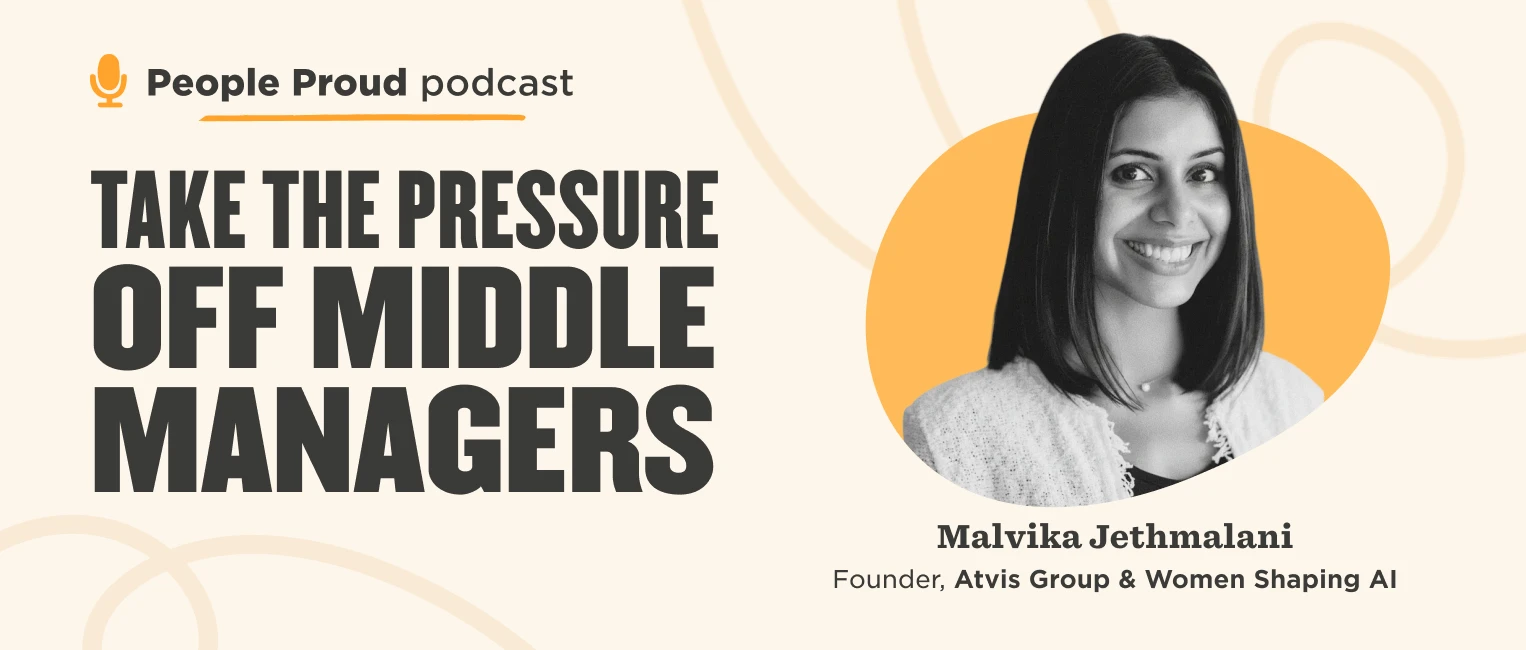
Can flatter organizations really do more with less leadership?
Across industries, organizations are stripping away layers of management. Teams are expanding, reporting lines are widening, and many assume that fewer managers automatically mean greater efficiency.
But where does this leave middle managers? Too often, their roles are misunderstood and their value underestimated.
But leadership work doesn’t disappear when layers are removed. It shifts—often without the structure, clarity, or support to match.
As organizations flatten, they expect managers to do even more. Meanwhile, managers end up supporting larger teams while navigating constant change. They also bear the impact of fast-evolving technologies like AI (often with fewer resources).
On a recent episode of our People Proud podcast, Flatter orgs, higher stakes: The future of middle managers, we explored why removing managers without rethinking how work gets done can introduce new risks rather than reduce them. The conversation featured:
- Malvika Jethmalani, fractional CHRO and founder of Atlas Group and Women Shaping AI
- Tali Sachs, senior content marketing manager at HiBob
- Dr. Ken Matos, director of market intelligence at HiBob
Together, we unpacked why leadership matters more (not less) in flatter organizations.
Or listen on your favourite platform:
Spotify
Apple Podcasts
The manager role is getting harder, not smaller
“The manager role is one of the hardest and most stress-inducing roles in modern organizations today,” Malvika said, especially as pressure increases from both above and below.
Wider spans of control mean managers are responsible for more people, while expectations around leadership have expanded far beyond task oversight.
Organizations no longer expect people to leave personal challenges at the door, and they increasingly ask managers to support the whole person.
Add in growing global uncertainty and compounding generational shifts, and the role becomes harder to sustain.
“It’s the perfect storm,” Malvika explained. “And now you add AI on top of that, and it is another seismic layer of complexity.”
Ken pointed out that many organizations expect managers to serve in two roles simultaneously. They’re responsible for leading people while continuing to deliver as individual contributors—doing their own jobs while training and supporting teams doing similar work.
That dual expectation is driving manager burnout.
Research shows that many managers would step away from leadership roles if they could keep their pay. A growing number are opting out of management altogether.
AI is widening the experience gap
Amidst the AI hype, AI is often positioned as the solution to this overload. But according to Malvika, AI adoption isn’t nearly as straightforward as leaders assume.
“AI adoption is not a one-size-fits-all,” she said. The value AI creates depends heavily on role, function, and experience level.
In some professions, early-career professionals benefit most from AI guidance. In others—like law or strategic work—experienced professionals extract more value because they have the judgment to evaluate and refine AI output.
The difference in experience levels creates a real gap.
Organizations experimenting with replacing early-career roles with AI risk hollowing out their future leadership pipeline, leaving managers responsible for team members who lack the experience to guide or govern AI effectively.
“We need to be thinking about AI with precision,” Malvika said, “not spreading it like peanut butter.”
The gap between AI hype and reality
One of the biggest pressures on middle managers today comes from the disconnect between executive expectations and day-to-day reality.
“There are very few executives who are actually using these tools themselves,” Malvika noted.
Instead, many leaders are reacting to headlines about cost savings and headcount reduction, without fully understanding AI’s current limitations.
That pressure rolls downhill. Executives expect managers to demonstrate return on investment from AI initiatives while still figuring out how the technology fits into real work.
“We haven’t yet graduated into the phase of reinventing work,” Malvika explained. “We’re still in the phase where AI can augment and help re-engineer work. Leaders just need to be patient.”
Power skills, judgment, and the future manager
As technical expertise becomes easier to acquire, the skills that define effective management are changing.
“Soft skills, or what I like to call power skills, are rising in importance,” Malvika said. These include communication, empathy, coaching, feedback, and—most importantly—judgment.
Judgment and discernment remain deeply human capabilities, especially in environments shaped by ambiguity and AI-generated output.
That matters even more as organizations flatten. Gallup’s research shows that 70 percent of the variance in employee engagement sits with the manager. And as layers disappear, that influence concentrates.
From org charts to work charts
Rather than simply removing managers, Malvika argued that organizations have an opportunity to rethink how they design work in the first place.
Citing Microsoft’s concept of “frontier firms,” she described a shift away from static org charts toward dynamic “work charts” in which teams form around outcomes rather than titles.
“I think we need to stop thinking in terms of the org chart and start thinking in terms of a work chart—thinking about organizations as a collection of tasks and responsibilities that need to be done in order to move business outcomes forward.”
In this model, managers act as work designers. They scope initiatives, assemble the right mix of human and AI resources, and oversee quality, risk, and delivery.
Why humans still matter in an AI-driven world
AI doesn’t burn out or miss deadlines. But it also can’t replicate what makes people uniquely valuable.
Malvika pointed to three human capabilities AI can’t authentically replace: genuine creativity, critical thinking, and social authenticity. These skills are what drive trust and meaningful customer experiences.
“Efficiency matters,” Tali added. “But customers don’t care about efficiency. They care about experience.”
AI can amplify human potential, but it can’t replace it. The organizations that succeed will be those that balance efficiency with creativity and technology with humanity.
Investing in the middle matters more than ever
As business models evolve under AI pressure, businesses still need someone to translate strategy into execution. Rather than disappearing when structures flatten, that responsibility concentrates.
Middle managers sit at the center of business model disruption. They turn direction into action when priorities shift, roles blur, and work changes faster than org charts can keep up. Investing in their development isn’t optional. It reflects a recognition that the traditional idea of management no longer fits the work organizations now ask managers to do.
As the engine behind high-performing teams, middle managers need sustained investment to meet that shift. When organizations get this right, they don’t just adapt to change. They build a model of organizational strength designed for whatever comes next.
“When your business model is disrupted,” Malvika said, “guess who you’re going to really need? Your middle managers.”
Key takeaways: What the great flattening means for middle managers
- Redefine management for flatter organizations. Flattening organizations changes what great management looks like. Companies that clarify expectations and equip managers for broader, more complex roles avoid leadership gaps as layers disappear.
- Support middle managers through the great flattening. As organizations cut middle managers and widen spans of control, remaining leaders absorb more complexity. Investing in manager development reduces burnout and protects performance during structural change.
- Redesign work before cutting middle managers. Flatter organizations succeed when leaders rethink how work gets done, not just who does it. Removing managers without redesigning workflows and accountability increases risk and fragmentation.
- Balance AI efficiency with human judgment. AI can accelerate execution, but managers provide the context, discernment, and people leadership that technology can’t replace, especially in flatter, faster-moving organizations.
- Develop managers as designers of work, not controllers of people.
The future of flatter organizations depends on middle managers who can shape teams around outcomes, integrate human and AI capabilities, and keep work aligned to strategy.