
Why strong HR impact starts with intention
HR leaders are increasingly expected to show the impact of their programs with clarity. That impact goes beyond activity or participation. It shows how HR works, and the HR data behind it, connects to tangible business outcomes.
Strong HR impact doesn’t start with dashboards or reports. It starts earlier, and it begins with intention—by taking the time to define what success looks like, what kind of change you’re aiming to create, and how that change will show up in the business.
This is where HR data analytics plays a critical role. When HR teams design programs with impact and ROI in mind from the outset, they collect more meaningful data. Decisions are easier to prioritize, metrics feel more purposeful, and conversations with leadership and Finance start from a place of shared understanding.
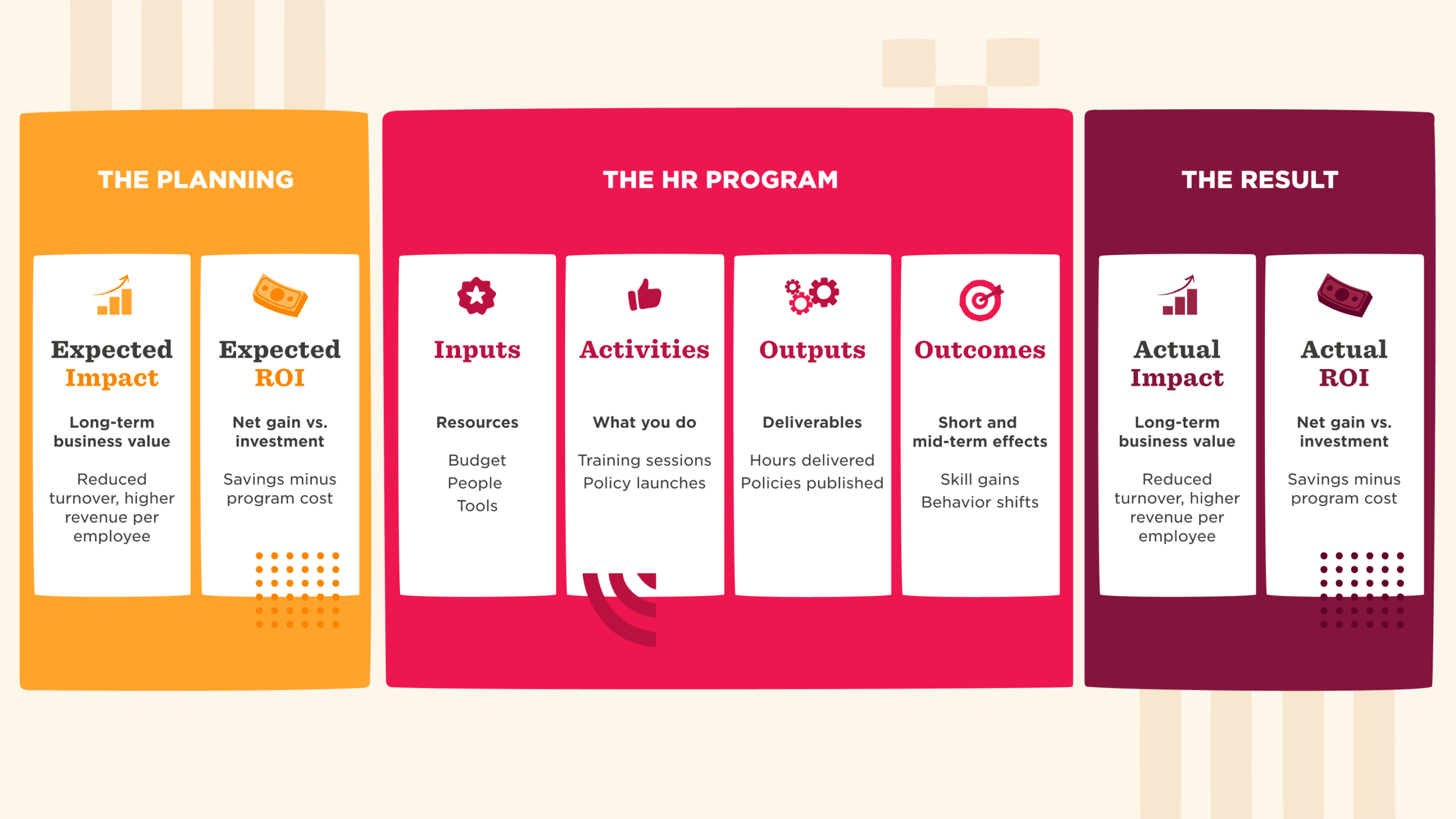
In our Proving impact webinar for HR analytics, we shared an infographic to support this process. This downloadable infographic is a practical planning model you can use before, during, and after an HR initiative to stay aligned on outcomes and use HR data to measure what matters most.
The result is a clearer path from HR effort to business impact and more confidence in how you plan, deliver, and prove the value of your work.
<<Download the proving impact infographic here to measure what matters most.>>
The mindset shift: Starting with impact and planning with intention
Without a shared definition of long-term business value and ROI, like a 10 percent drop in turnover or a 5 percent increase in revenue per employee, teams struggle to prioritize the activities that genuinely move the needle.
High-impact HR teams understand this. They take a strategic approach to HR data and program planning, and they start with outcomes, not activities.
The mindset shift here is subtle but powerful. Rather than diving straight into execution, it helps to pause and clarify what success looks like from the outset.
This approach supports more apparent prioritization and more confident decision-making throughout the program lifecycle. It also creates stronger alignment with leadership and Finance, so everyone is working toward the same outcomes.
The proving impact infographic supports this way of thinking. It serves as a shared alignment model, breaking HR projects down into three connected phases:
- Planning: Establishing the expected impact and ROI of an HR program.
- HR program: Mapping the inputs, activities, outputs, and outcomes of the project.
- Results: Using HR data analytics to understand actual impact and ROI.
This model connects decisions across phases, helping HR teams see how early choices shape later outcomes. It’s a thinking framework (not a checklist or a reporting template) that supports more intentional planning and more credible impact across the organization.
Let’s take a closer look at how each phase works in practice.
The planning: Clarifying impact and ROI before you begin
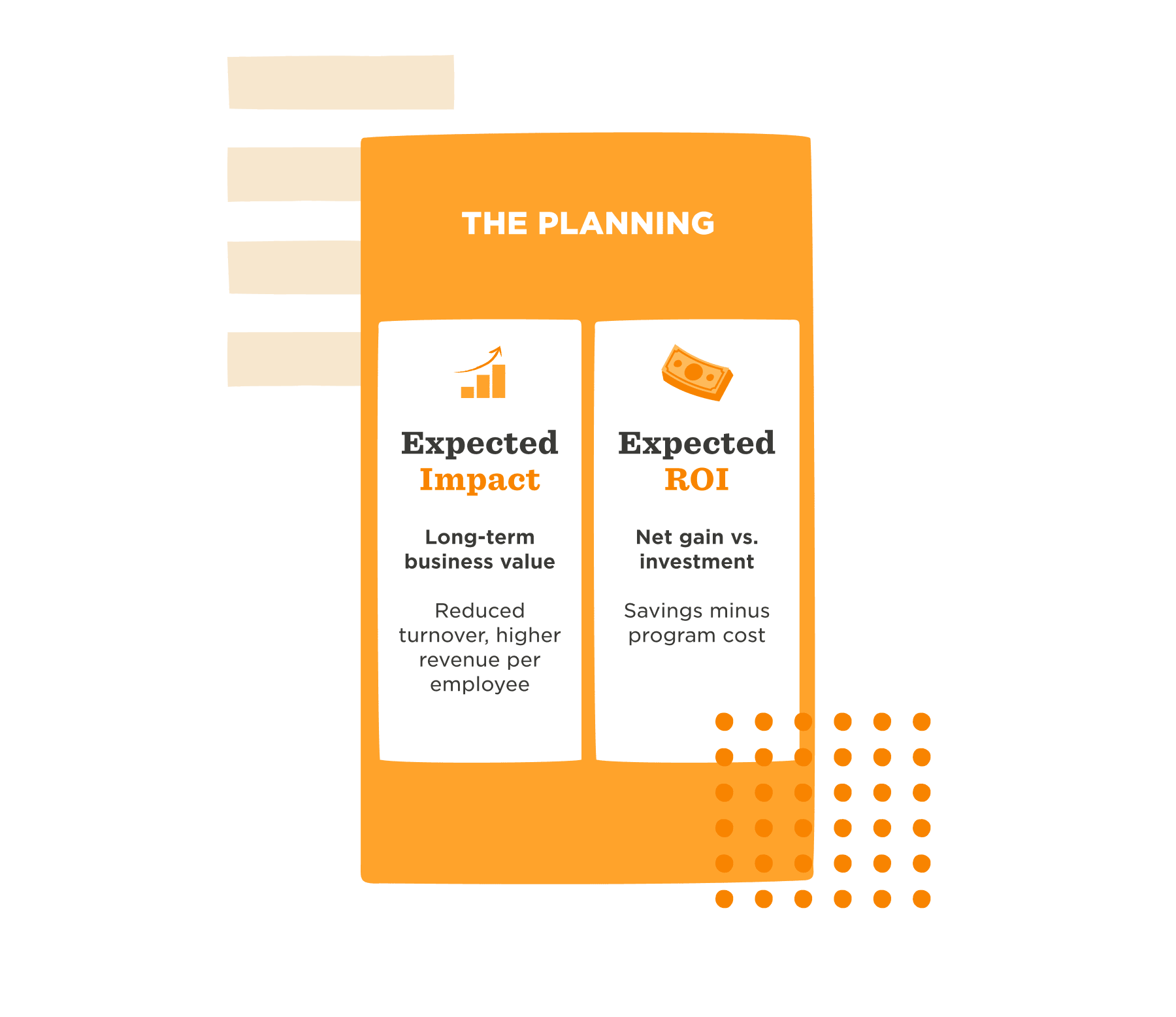
The first step in planning for impact is clarifying expected outcomes. This means defining the expected impact and the expected ROI of an HR program in terms of the long-term business value it’s intended to create.
Expected impact
Expected impact can show up as reduced turnover, improved employee sentiment, or a higher proportion of open roles filled by the target deadline.
Expected ROI
It’s also helpful to think through the program’s expected ROI. This is the anticipated net gain compared to the investment. For example, cost savings relative to the program’s operating costs.
Partnering with Finance early can strengthen the planning phase. It allows you to sense-check revenue and cost assumptions using their shared systems, and ground your projections in real-world data.
Starting here creates clarity and alignment within your HR team and across other teams. It establishes shared assumptions and strategic intent, so everyone understands what success looks like from the start.
<<Download the infographic here to start planning for impact and ROI.>>
The HR program: Connecting effort to outcomes
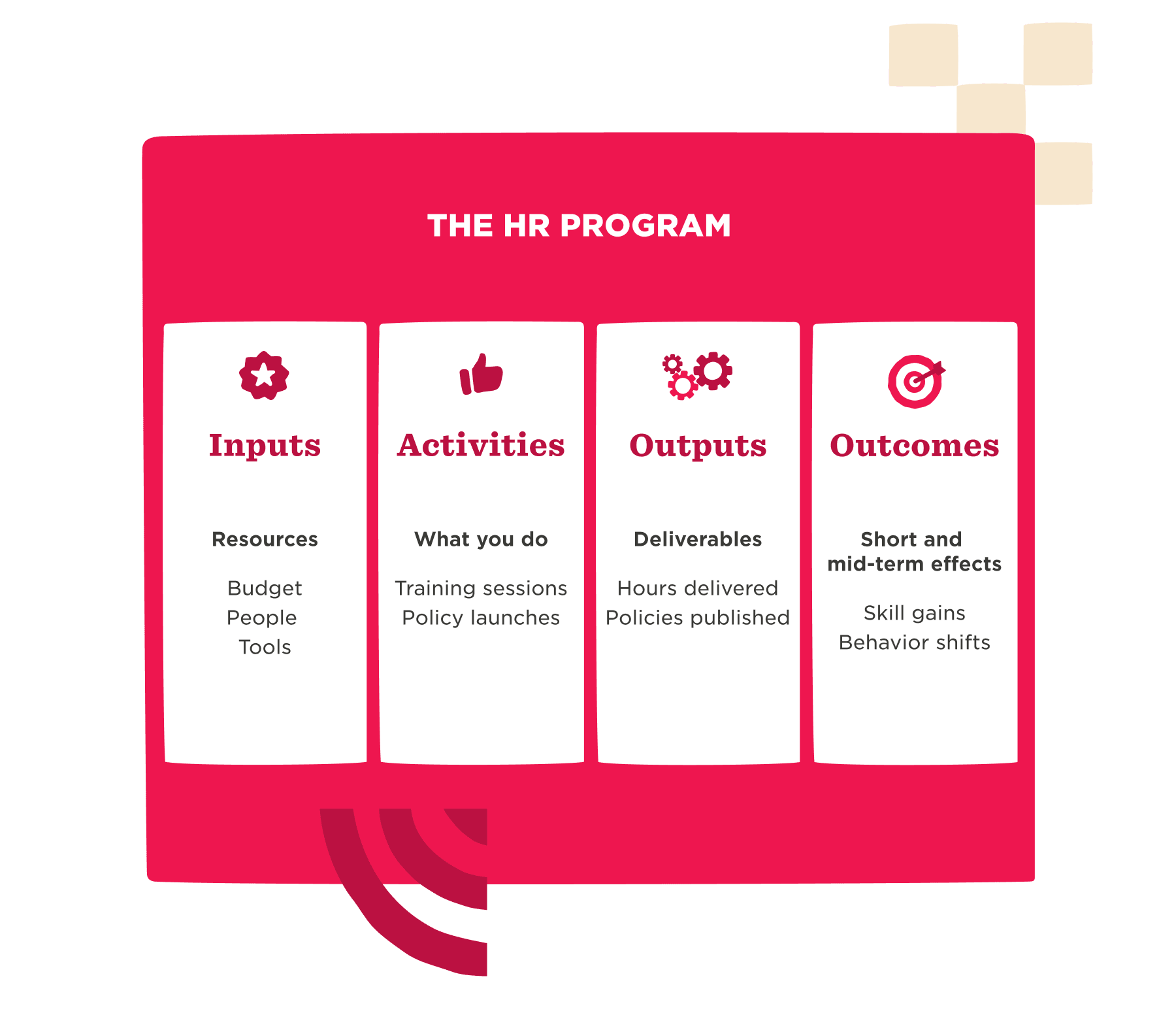
In this stage, planning turns into action. It’s where you map a logical path from intention to results, connecting the dots so each action supports the impact you’re aiming to achieve.
Recommended For Further Reading
Inputs
First, clarify the inputs. Inputs are the resources involved, such as budget, people, and tools. This helps set clear expectations before work begins.
Activities
You can then outline the activities included in the program. Activities might include training sessions, a new policy, or the launch of an employee engagement tool.
Outputs
Then you can consider the outputs these activities are expected to produce. These deliverables include hours delivered or policies published.
Outcomes
The last step in this stage is to consider the outcomes or the short- and mid-term effects of the program. Are employees responding positively to a new onboarding process? Are there early signs of change in manager behaviors or skill levels? Those are your outcomes.
Outcomes serve as early signals of impact, while final proof comes later in the process.
Mapping HR programs in this way helps keep attention on what matters most. It supports selecting meaningful metrics and provides a shared view that keeps stakeholders aligned.
When your program is clearly mapped out, everyone understands not just what’s happening, but why it matters.
<<Download the infographic here to keep attention on what matters most.>>
The results: Understanding actual impact and ROI
At the start of this process, you defined expected impact and ROI. In this final stage, you close the loop by understanding the HR program’s actual impact and ROI.
Using HR data and the metrics already in place, you can see where the HR program has made a meaningful difference.
This serves a few important purposes:
- It helps clarify the program’s impact. Put simply, you see whether the work led to the outcomes you were aiming for.
- It strengthens future planning. Comparing expected outcomes to actual outcomes and expected ROI to actual ROI creates a learning loop that improves projections over time.
- It reinforces credibility. When you can show both business and financial impact, HR’s process becomes easier for leadership and Finance to trust, supporting stronger buy-in for future programs.

The results you gather here bring the current program to a clear close while strengthening how future HR programs are planned and evaluated.
<< Download the infographic and keep ROI top of mind>>
Mini case study: Applying the model to a training program
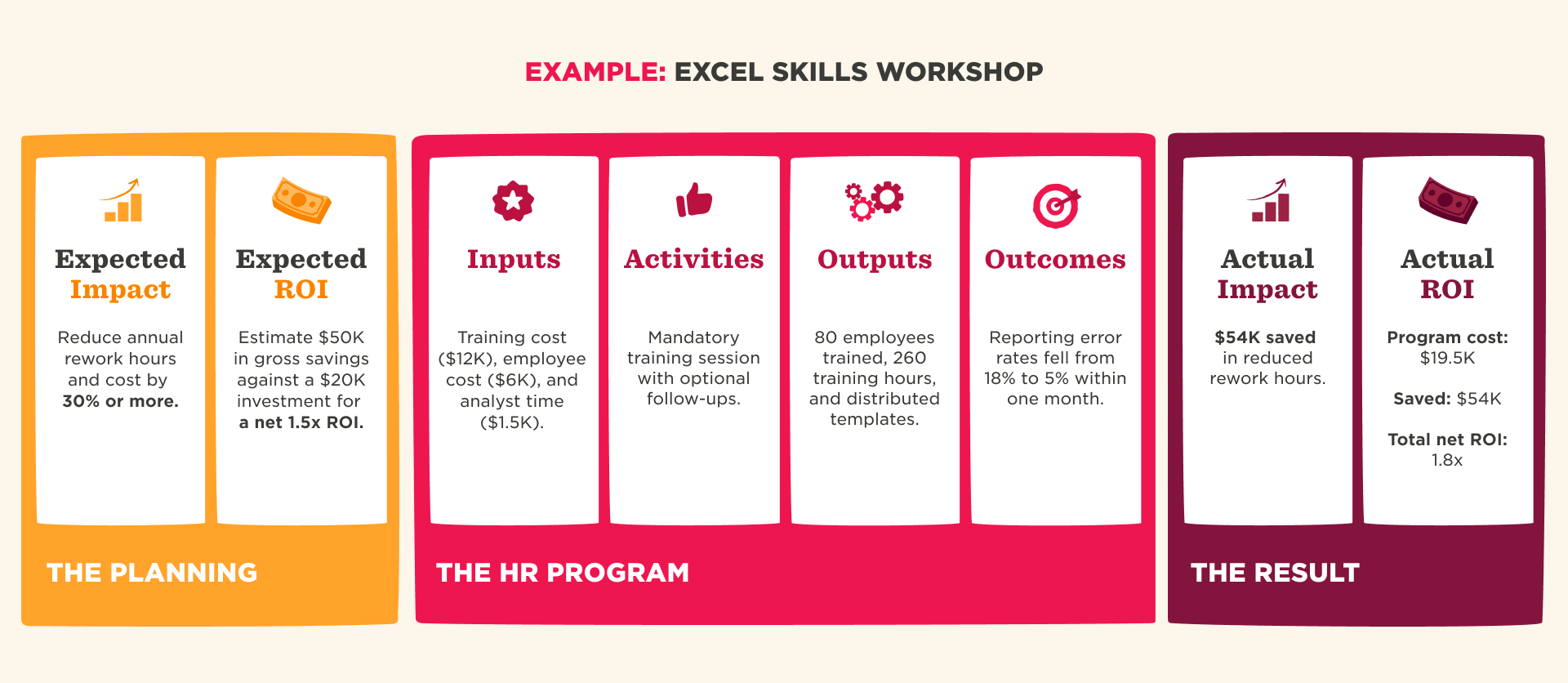
Imagine you’re an HR Business Partner at a mid-sized firm that just rolled out a two-day Excel skills workshop to improve analysts’ reporting accuracy. Some managers are understandably curious about whether the investment will translate into better performance.
How do you apply the proving impact process to this HR project?
You begin the planning phase by clarifying the program’s expected impact and ROI. For example, will this skills workshop reduce annual rework hours or improve analyst productivity? What will it cost the company, and what kind of financial return would make it worthwhile?
You then move into the program itself. You outline the resources involved (such as training costs and analyst time), plan the activities and follow-ups, and identify expected outputs (such as the number of employees trained or the training hours completed). You also define short- to mid-term outcomes such as changes in reporting error rates.
Finally, you use the results phase to understand the program’s real-world impact using HR data. You assess time and money savings from reduced rework hours, and translate those findings into an ROI figure you can share with Finance and leadership.
Here’s what the impact of this Excel skills workshop might look like, mapped out with our process:
Designing HR programs with impact in mind
To deliver meaningful impact, HR programs need clear, business-focused goals from the start. It’s much harder to retrofit goals once the project is already underway. That’s because HR analytics works best as a planning discipline grounded in logic and strategy.
Our process and infographic support this approach by giving HR teams a clear structure for planning and evaluation. It helps HR work in closer partnership with leadership and Finance, creating a shared roadmap that teams can champion together.
You can download, print, and use this infographic as a practical planning companion. It’s designed to be kept close at hand and reused across your HR programs as needs evolve.
<<Improve the impact of your HR programs with the proving impact infographic.>>
Key takeaways
- Strong HR impact starts with intention. Designing HR programs with clear business outcomes in mind creates a stronger foundation for impact than retrofitting goals after launch.
- HR data analytics works best as a planning discipline. When analytics shapes decisions early, HR data becomes more meaningful, focused, and aligned with business priorities.
- Starting with impact and ROI improves alignment. Defining expected impact and ROI upfront helps HR teams prioritize the right activities and partner more effectively with leadership and Finance.
- Mapping inputs to outcomes keeps programs focused. Connecting resources, activities, outputs, and outcomes clarifies how HR initiatives are expected to create value and which metrics matter most.
- Early outcomes signal progress before final results. Short- and mid-term outcomes provide directional insight, helping teams stay aligned without overreacting too soon.
- Comparing expected and actual results builds credibility. Closing the loop with HR data strengthens future planning and reinforces trust with Finance and leadership.
- The proving impact infographic supports a repeatable mindset. Used consistently, it helps HR teams plan, deliver, and measure programs with greater clarity, confidence, and business relevance.