
HR teams receive employment verification letter requests for many reasons, from background checks and internal transfers to vendor onboarding or partnership confirmation. These letters provide clear, factual employment details like job title, start date, status, and, when approved, compensation.
Accurate records make it possible to respond with confidence, but they’re only part of the equation. HR also needs a fast, professional way to write letters that meet compliance standards and fit different scenarios.
This guide breaks down what to include and how to tailor your approach—plus, you’ll get a free, customizable template to make responding easier.
<< Download a free employee verification letter template >>
What is an employee verification letter?
An employment verification letter confirms specific job-related details requested by an external party. It follows a clear structure and uses standardized language to keep the information accurate and easy to understand. These letters help third parties trust that the details come directly from your HR team.
Employment letters focus only verifiable facts only, leaving out opinions, performance feedback, or personal references. HR teams typically pull this information from their employee management software or personnel records.
Employee verification letter vs. employment letter
People often confuse these two types of letters, but they serve different purposes. An employment verification letter confirms key employment facts—like job title, dates of employment, and salary (if authorized)—usually for background checks, loan approvals, or housing applications.
An employment letter goes further. It may include job responsibilities, qualifications, or even an endorsement—similar to references. Professionals often request this type of letter when applying for a visa, enrolling in a program, or providing a general overview of their role and experience.
Why are employee verification letters important?
Employment verification letters help facilitate important life events for your team members. These letters enable people to secure housing, obtain loans, complete immigration processes, and pursue new career opportunities.
Common scenarios requiring verification letters include:
- Mortgage applications: Banks verify income and employment stability
- Rental agreements: Landlords confirm ability to pay rent consistently
- Background checks: New employers verify previous work history
- Immigration processes: Government agencies require employment documentation
- Loan applications: Financial institutions assess repayment capability
- Government programs: Assistance programs verify eligibility requirements
HR plays a key role in ensuring the information shared is accurate and consistent. A well-defined process helps organizations respond quickly and reduces the risk of miscommunication.
Standardizing your verification letters helps HR control what information they share, how they share it, and with whom. A consistent format reduces the chance of including details that weren’t approved for release and keeps the process running smoothly.
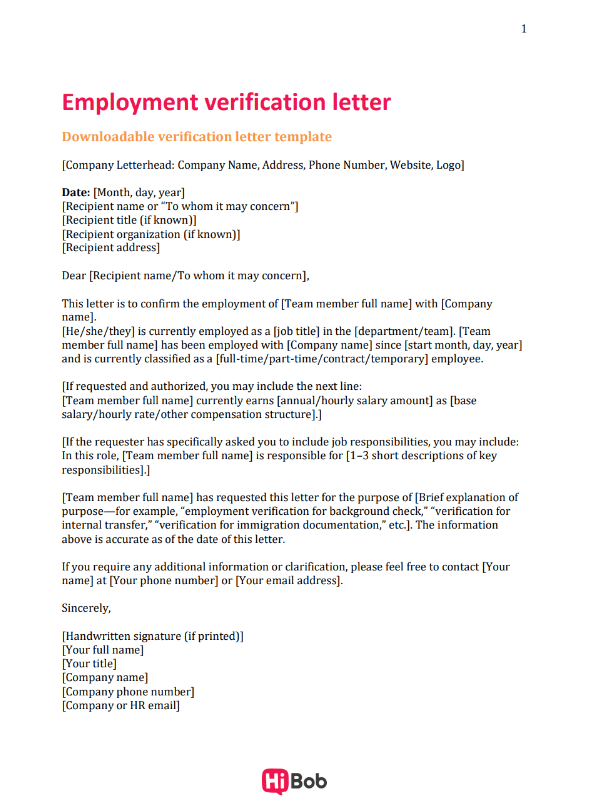
Downloadable verification letter template
Use this free employment verification letter template to ensure your letters have all the information your team members need. Make sure to customize it for different verification scenarios as needed:
[Company Letterhead: Company Name, Address, Phone Number, Website, Logo]
[Date: Month day, year]
[Recipient name or “To whom it may concern”]
[Recipient title (if known)]
[Recipient organization (if known)]
[Recipient address]
Dear [Recipient name/To whom it may concern,]
This letter is to confirm the employment of [Team member full name] with [Company name].
[He/she/they] is currently employed as a [job title] in the [department/team]. [Team member full name] has been employed with [Company name] since [start month, day, year] and is currently classified as a [full-time/part-time/contract/temporary] employee.
[If requested and authorized, you may include the next line:
[Team member full name] currently earns [annual/hourly salary amount] as [base salary/hourly rate/other compensation structure].]
[If the requester has specifically asked you to include job responsibilities, you may include:
In this role, [Team member full name] is responsible for [1–3 short descriptions of key responsibilities].]
[Team member full name] has requested this letter for the purpose of [Brief explanation of purpose—for example, “employment verification for background check,” “verification for internal transfer,” “verification for immigration documentation,” etc.]. The information above is accurate as of the date of this letter.
If you require any additional information or clarification, please feel free to contact [Your name] at [Your phone number] or [Your email address].
Sincerely,
[Handwritten signature (if printed)]
[Your full name]
[Your title]
[Company name]
[Company phone number]
[Company or HR email]
<< Download our free employment verification letter template >>

How to write an employee verification letter
A clear format ensures you include the right details, stick to what your team member requested, and follow a consistent format to avoid errors or oversharing. Follow these steps to standardize your process while tailoring each letter to the specific request:
- Start with a standardized template: Use a professional format to reduce errors and ensure every letter includes the essential components. This also saves time when requests come in unexpectedly.
- Add company letterhead: Include your organization’s name, address, contact information, and logo to confirm the document’s authenticity.
- Include the date and recipient details: Add the current date and—when available—the recipient’s name, organization, or department.
- Use a professional greeting: “To Whom It May Concern” works when you don’t have a specific contact.
- Identify the team member clearly: Provide the person’s full name, current job title, and department.
- Confirm employment dates: List the start date and—if applicable—the end date of their employment or note that the person still works with your company.
- Specify employment status: State whether the person is full-time, part-time, contract, or temporary.
- Include salary details only when authorized: Compensation information should be added only when the team member has explicitly approved it and it is relevant to the request.
- Add a brief description of responsibilities (if requested): Keep this factual and high-level. Avoid performance details or subjective commentary.
- Provide a follow-up contact: List an email or phone number the recipient can use to contact your HR team for additional questions.
- Close with an authorized signature: Make sure someone with the authority to verify employment details signs the letter.
Recommended For Further Reading
Employee verification letter example
Use this example letter to see how all the elements from an employment verification letter template come together:
Travel Hotel, Inc.
100 Pepperwood Drive
Los Angeles, CA 94710
(555) 778-4321
www.travelhotelcompany.com
Nov 1, 2025
James Williams
Human Resources Department
Travel Hotel Company
1820 Pepperwood Avenue
Los Angeles, CA 94508
Dear James,
This letter is to confirm the employment of John Smith with Hotel Group. He is currently employed as a Security Specialist in the Operations Team. John Smith has been employed with Hotel Group since October 24, 2014, and he is currently classified as a full-time employee.
John Smith currently earns $60,000 annually as base salary.
In this role, John Smith is responsible for monitoring on-site security systems, coordinating safety protocols during events, and training team members on emergency procedures.
John Smith has requested this letter for the purpose of employment verification and a background check as part of a job application with Travel Hotel, Inc. The information above is accurate as of the date of this letter.
If you require any additional information or clarification, please feel free to contact Jane Doe at (555) 778-4377 or [email protected]
Sincerely,
Jane Doe
HR Manager
Hotel Group
(555) 778-4377
Create a lasting impact with this employment verification letter template
Verification letters may be simple, but they support meaningful moments, helping your people secure housing, complete background checks, or take the next step in their careers. A clear, repeatable process helps HR respond quickly, protect sensitive data, and reduce unnecessary admin.
With well-organized people data and a customizable template, writing these letters becomes a quick task—not a compliance risk. Start with the downloadable template, tailor it to each request, and create a smoother experience for your team and the people you support.
<< Download a free employment verification letter template >>
Employee verification letter FAQs
Can you write an employment verification letter using AI tools?
While AI tools can help you draft a first version of the letter quickly, human review is still helpful. AI can make up information, so only HR can confirm the accuracy of employment records and what information a team member has authorized for release. Before sending the letter, always double-check salary details, dates, and work status against your HRIS or employee directory to avoid sharing incorrect or sensitive data.
Who has the authority to write and issue employment verification letters?
Most organizations route verification letters through HR because they have direct access to official records. In smaller companies, a manager or business owner may issue the letter as long as they can verify the information and sign as an authorized representative. The important qualifier is that the person responsible can confirm employment facts and follow the organization’s privacy and compliance guidelines.
What are the most common mistakes HR professionals make when creating employment verification letters?
Common issues include sharing salary information without proper authorization or adding details that the team member didn’t request. HR teams also run into problems when they don’t verify the legitimacy of the request or include subjective commentary instead of sticking to factual data.
Another frequent mistake is leaving out contact information, which causes delays when the recipient needs clarification.
