
A 30-60-90 plan is a structured onboarding framework that outlines clear learning, contribution, and ownership goals for a new team member’s first three months.
As an HR leader, you already know that structure and clarity are the difference between smooth onboarding and a drawn-out adjustment period. As Matthew Kosinski of the Society of Human Resource Management puts it, “Those first few days, weeks, and months on the job shape the habits and values employees will carry through their tenure.” A thoughtful plan helps you shape those habits intentionally to set up successful performance.
A 30-60-90 plan brings that structure to life by giving managers and team members a shared roadmap for learning, contribution, and growth. It helps new joiners understand what “good” looks like in their first 90 days and removes the uncertainty that may slow down early momentum.
In this article, you’ll learn how to build and customize a 30-60-90 day plan that fits your organization’s goals and your people’s needs. You’ll also get a downloadable Word template with examples to help you put it into action right away.
<<Ramp up your new joiners with a free complete 30-60-90 plan template.>>
What is a 30-60-90 plan?
A 30-60-90 plan is a structured framework for the onboarding process that outlines what a new team member should focus on during their first three months, divided into 30-day milestones.
Each of the three stages builds on the last to help new joiners ease into the role:
- Days 1-30 (learning phase): Understanding company culture, work processes, and role expectations
- Days 31-60 (contributing phase): Beginning to apply knowledge and take on responsibilities
- Days 61-90 (leading phase): Taking ownership and making meaningful contributions

Why a 30-60-90 plan matters
The first three months of employment are critically important for engagement and retention. In fact, organizations with a strong development plan see a productivity boost of over 70 percent.
Let’s look at how 30-60-90 day plans benefit both your organization and your people:
Benefits for organizations
A strong 30-60-90 plan can lift up the entire team and lead to:
- Lower costs and higher revenue: Companies that retain top talent through effective onboarding see a 60 percent increase in revenue per full-time team member. Confident, well-supported new joiners stay longer, saving time and resources that would otherwise go toward rehiring and retraining.
- Smoother collaboration: Defined goals and communication checkpoints keep everyone aligned and reduce missteps during handovers or projects.
- Higher engagement across teams: New joiners who feel guided and valued bring better energy into their work. Onboarding programs that encourage team building see 50 percent higher retention.
- Faster team performance: Clear milestones help new joiners contribute earlier by reducing the learning curve for required skills. Organizations with a strong onboarding process have seen productivity boosts exceeding 70 percent.
- More consistent onboarding across managers: A shared 30-60-90 framework keeps expectations uniform, even when roles sit across different teams or locations. It reduces variations in manager style and ensures every new joiner receives the same level of guidance.
- Clearer handoffs across departments: When other teams know what the new joiner is learning each month, it’s easier to plan training sessions, assign early projects, and prevent overlap or missed steps.
Benefits for your people
When people know what’s expected, they perform better, stay longer, and feel more connected to the culture around them.
Your plan can lead to:
- Higher engagement: A Gallup report found that team members who had a great onboarding experience are 2.6 times more likely to be “extremely satisfied” at work. Defined milestones and regular check-ins give them clear targets to hit and feedback that keeps motivation high.
- Longer retention: When people feel supported from day one, they’re more likely to stay. A consistent onboarding experience helps build trust early, reducing turnover and increasing the chances that new joiners grow with the company.
- Better first-day confidence: Preboarding can help new team members feel prepared for their work and acclimate to the company culture. A simple checklist of systems access, introductions, and role expectations before day one removes much of the early confusion and uncertainty.
- Stronger connection: Team members who feel connected at work are 44 percent more likely to recommend their company to others. Regular touchpoints in a 30-60-90 plan—like manager one-on-ones or peer introductions—help that connection form quickly.
- Faster detection of development needs: Managers can spot where someone needs extra support earlier. This shortens the adjustment period and prevents slowdowns months later.
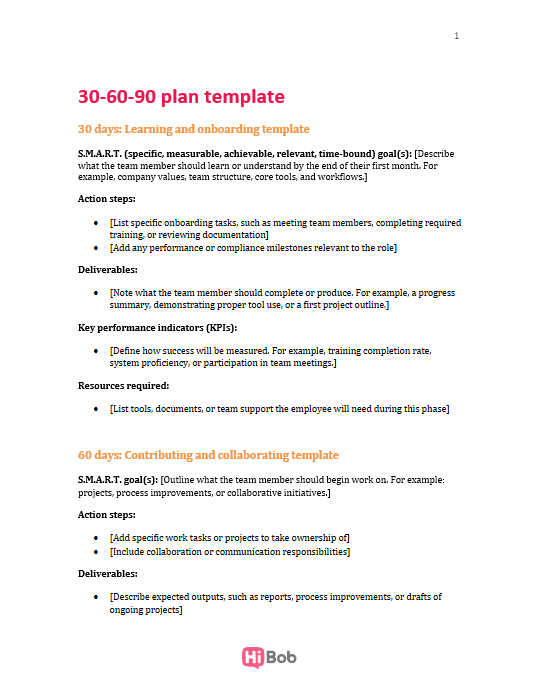
30-60-90 plan template
Every role has unique onboarding needs, so your 30-60-90 plan should reflect that. Use this framework to outline goals, deliverables, and milestones that fit each new joiner’s level, department, and responsibilities.
30 days: Learning and onboarding
S.M.A.R.T. (specific, measurable, achievable, relevant, time-bound) goal(s): [Describe what the team member should learn or understand by the end of their first month. For example, company values, team structure, core tools, and workflows.]
Action steps:
- [List specific onboarding tasks, such as meeting team members, completing required training, or reviewing documentation]
- [Add any performance or compliance milestones relevant to the role]
Deliverables:
- [Note what the team member should complete or produce. For example, a progress summary, demonstrating proper tool use, or a first project outline.]
Key performance indicators (KPIs):
- [Define how success will be measured. For example, training completion rate, system proficiency, or participation in team meetings.]
Resources required:
- [List tools, documents, or team support the employee will need during this phase]
60 days: Contributing and collaborating
S.M.A.R.T. goal(s): [Outline what the team member should begin work on. For example: projects, process improvements, or collaborative initiatives.]
Action steps:
- [Add specific work tasks or projects to take ownership of]
- [Include collaboration or communication responsibilities]
Deliverables:
- [Describe expected outputs, such as reports, process improvements, or drafts of ongoing projects]
Key performance indicators (KPIs):
- [Set measurable outcomes. For example: completion of assigned projects, collaboration metrics, or process improvements identified.]
Resources required:
- [Include tools, systems, or training support needed for independent contribution]
90 days: Executing and taking ownership
- S.M.A.R.T. goal(s): [Define what full performance looks like. For example: owning projects, hitting targets, or improving processes.]
Action steps:
- [List leadership-level or independent tasks to complete during this stage]
- [Include performance reviews, goal alignment meetings, or long-term planning sessions]
Deliverables:
- [Specify what should be finalized or launched. For example: completed projects, improvement reports, or team training sessions.]
Key performance indicators (KPIs):
- [Measure against original 90-day objectives. For example: project completion rate, quality metrics, or feedback scores.]
Resources required:
- [Identify continued support or development opportunities for sustained performance]
<<Access your free 30-60-90 day plan template.>>
How to create your 30-60-90 plan
Creating an effective 30-60-90 day plan requires collaboration between HR, hiring managers, and input from the team member itself. Here’s how it works:
Recommended For Further Reading
1. Define clear objectives and key metrics
Set S.M.A.R.T. goals for each 30-day phase. These objectives create accountability while providing clear success criteria for both the new joiner and their manager.
Balance learning goals with performance expectations, ensuring new team members have time to absorb information while contributing meaningfully. For example, a new recruiter might learn your ATS (applicant tracking system) in week one, manage their first candidate screen by day 30, and by day 60 build a plan to strengthen pipelines for priority roles.
Align people’s metrics with broader performance management strategies to ensure consistency across your organization by considering:
- Quantitative measures: Projects completed, training modules finished, system proficiency levels
- Qualitative assessments: Cultural fit, collaboration skills, communication effectiveness
- Relationship metrics: Stakeholder connections made, team integration progress

2. Map out key tasks and milestones
Break down the larger objectives into specific, actionable tasks that build competence progressively. Create a logical sequence that develops foundational knowledge before advancing to complex responsibilities.
Effective milestone categories include:
- Knowledge acquisition: Training completed, processes understood, systems mastered
- Relationship building: Key stakeholders met, team dynamics understood, networks established
- Task completion: First project delivered, systems mastered, processes followed independently
- Strategic contributions: Improvements suggested, initiatives launched, leadership demonstrated
For example, if you’re onboarding a new HR coordinator, their milestones might begin with completing core HRIS and policy training (knowledge), meeting hiring managers in their first two weeks (relationships), running their first onboarding session independently by day 30 (task completion), and proposing a small improvement to the onboarding checklist by day 60 (strategic contribution).
3. Secure resources and stakeholder support
Identify and secure all necessary resources before the new joiner’s start date. This includes training materials, system access, equipment, and most importantly, time commitments from key stakeholders.
Share the plan with team members who will interact with the new joiner during their first 90 days. Schedule introduction meetings, training sessions, and project collaboration time in advance to prevent scheduling conflicts.
4. Track progress
Surveys show that 80 percent of people who reported receiving meaningful feedback in the past week remained fully engaged. This kind of feedback is especially important during onboarding, since 20 percent of turnover happens within the first 45 days—often because new joiners lack clarity and effective training. Use regular check-in schedules to provide consistent feedback without micromanaging.
Use the plan as a living document that evolves based on changing priorities or discovered needs. If a new joiner excels in certain areas, you can accelerate their timeline, while other areas might require additional support or extended timelines.
Document progress against specific milestones while capturing qualitative feedback about the onboarding experience:
- Progress tracking: Milestone completion rates, goal achievement status
- Feedback collection: Regular surveys, informal conversations, manager observations
- Plan adjustments: Timeline modifications, resource additions, goal refinements
30-60-90 plan example: Step-by-step breakdown
Let’s go over an example of how a 30-60-90 day plan can look for a new sales representative. Each phase focuses on clear, measurable outcomes that help the rep transition from learning to contributing to fully owning their territory.
Day 1-30: Learning and observing
S.M.A.R.T. goal(s): Understand the company’s product line, target customers, and sales process while completing all onboarding and compliance training within 30 days.
Action steps:
- Attend product knowledge sessions and complete all LMS training modules
- Shadow senior reps on discovery calls and demos to observe best practices
- Review the CRM system and learn how to log activities, track deals, and manage the pipeline
- Meet with marketing, customer success, and product teams to understand how each supports sales
Deliverables:
- Complete required certifications or training
- Create a summary of key product differentiators and common customer objections
- Prepare a sample outreach sequence for manager feedback
Key performance indicators (KPIs):
- 100% of onboarding tasks completed by day 30
- Demonstrated understanding of CRM usage and company sales stages
- Manager sign-off on readiness to begin prospecting
Resources required:
- Product playbooks, CRM access, call scripts, and onboarding checklists
- Support from manager and senior sales mentors
Day 31-60: Planning and contributing
S.M.A.R.T. goal(s): Begin prospecting within the assigned territory and schedule at least 10 qualified discovery calls by the end of day 60.
Action steps:
- Build a prospect list using CRM and outbound tools
- Run first outreach campaigns using approved messaging and cadence
- Conduct discovery calls with new leads and log outcomes in the CRM
- Collaborate with the sales manager to refine pitch techniques based on call feedback
Deliverables:
- Record and review three discovery calls for coaching feedback
- Submit a short progress report on pipeline growth and conversion rates
- Identify three key prospects to nurture through to demo stage
Key performance indicators (KPIs):
- Minimum of 10 discovery calls booked by day 60
- At least 3 opportunities advanced to demo or proposal stage
- Documented improvements in outreach quality and conversion rate
Resources required:
- Prospecting tools, CRM data insights, and access to call recordings for review
- Regular coaching sessions with the sales manager
Day 61-90: Executing and leading
Goal(s): Own the sales pipeline for the assigned territory, close at least one deal, and demonstrate full independence in managing leads and follow-ups.
Action steps:
- Conduct full sales cycles from discovery to close with minimal oversight
- Lead demos independently and address client objections using data-driven insights
- Build a quarterly plan outlining pipeline goals, target accounts, and forecast accuracy
- Participate in team meetings to share learnings and propose improvements to the outreach process
Deliverables:
- Close one or more new customer deals by day 90
- Submit a 90-day review presentation summarizing performance, lessons learned, and next-quarter goals
Key performance indicators (KPIs):
- At least one closed deal or signed contract
- Pipeline coverage equal to 3x the monthly quota
- Manager evaluation confirming readiness for full sales ownership
Resources required:
- Access to proposal templates, pricing tools, and demo environments
- Ongoing manager support for performance feedback and strategic planning

Tips for creating a realistic 30-60-90 plan
Effective plans consider both the new joiner’s background and the specific demands of your organizational culture. Customize expectations based on role complexity, industry experience, and available support systems within your team. Make sure to:
- Balance goals with reality: Set challenging but achievable goals that stretch capabilities without creating impossible standards or unrealistic timelines. Instead of assigning a new HR coordinator ownership of the entire onboarding process in their first month, try breaking the work into smaller steps so they can take over in 90 days.
- Build in flexibility: Allow for adjustments as priorities shift or unexpected opportunities arise during the first 90 days. Rather than locking the plan to a set list of tasks, try adding optional checkpoints like “If time allows, review our workflow” or adjusting timelines when the new joiner moves faster—or needs more support—than anticipated.
- Include both technical and relational goals: Develop job-specific skills while building the relationships necessary for long-term success and collaboration. Avoid focusing only on system training. Instead, try pairing technical goals with people-focused ones like “Learn the time-off policy and payroll system” alongside “Meet with payroll, IT, and department leads to understand handoffs.”
- Connect to long-term career development: Link 90-day goals to future growth opportunities and career progression pathways within your organization. For example, try adding a growth task like reviewing one past engagement survey or turnover report to understand how HR uses data to guide decisions.
Support your people with a thoughtful 30-60-90 day plan
The first three months set the tone for everything that follows. As a leader, you can turn onboarding into an experience that drives consistent momentum for every person you work with. If you start building plans that help people hit the ground running, they’ll stay engaged long after day 90.
Start shaping stronger first impressions, faster performance, and long-term success.
<<Download our free 30-60-90 day plan template here.>>
30-60-90 plan FAQs
What is a good 30-60-90 day plan?
A good 30-60-90 day plan is clear and easy to follow, aligned with company goals, and adaptable over time. Clarity matters because new joiners can only meet expectations they understand. Alignment ensures the plan ties to team and company goals so the work feels purposeful, not arbitrary.
Does a 30-60-90 day plan include weekends?
It depends on how your team tracks time, but yes, most 30-60-90 day plans do include weekends in the count. That doesn’t mean new joiners are expected to work on weekends; it just helps keep the timeline easy to follow.
For example, if someone starts on November 1st, their first 30 days end on December 1st, not the 6th. Counting calendar days keeps the plan simple and aligned with how teams measure probation or review periods.
What is the 30-60-90 day rule?
The 30-60-90 day rule is a framework for guiding and evaluating a new joiner’s progress through their first three months. It typically breaks onboarding into three phases: learning (days 1-30), contributing (days 31-60), and executing (days 61-90). This phased structure helps managers provide the right mix of training, feedback, and autonomy at each stage. The goal is to ensure the person is fully equipped to deliver meaningful results by day 90.