
Every strong team thrives on clear expectations: how people communicate, collaborate, and treat one another. With hundreds of small decisions made each day, shared standards help ensure those choices reflect the organization’s values.
A code of conduct is more than a set of rules. It’s a commitment. As Jim Johnson, President and CEO of the Pearland Chamber of Commerce, puts it, it “sets expectations, models values, and ensures that everyone connected to the organization is working from the same standard of behavior.”
To maintain a strong culture as your company grows, it’s essential to define how people are expected to act and make decisions. It ensures everyone understands what’s acceptable, what’s not, and how to respond when judgment is required.
This guide walks you through how to create, implement, and sustain a strong code of conduct. You’ll also find ready-to-use templates and real-world examples from reputable companies to help you bring it to life.
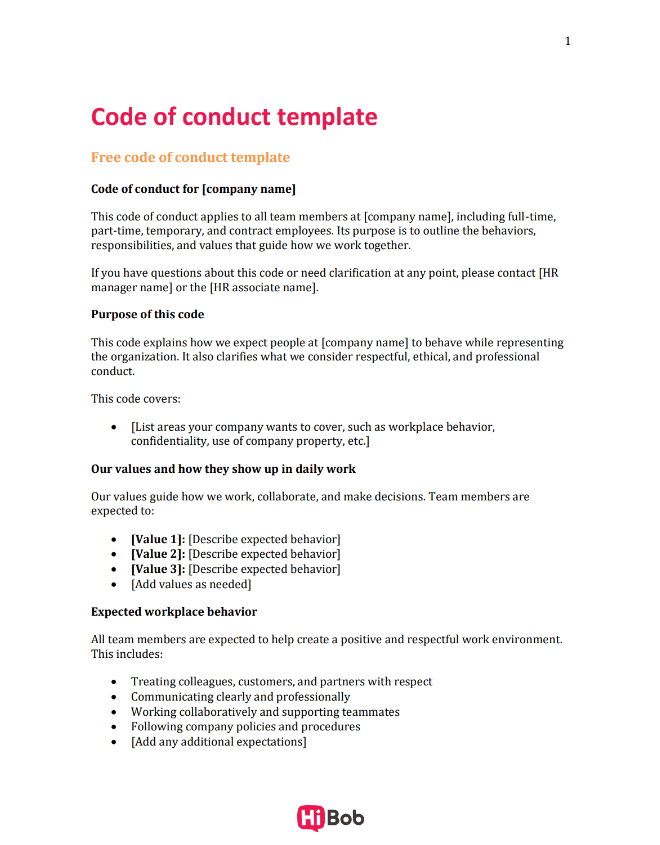
<<Download your free code of conduct template>>
Key insights
- A documented code of conduct gives people a shared understanding of what’s acceptable at work
- Use a structured code of conduct template to cover essential areas, avoid gaps, and reduce the need for rewrites
- Companies like Microsoft, Reformation, and The Gap demonstrate good examples of how different industries adapt their codes to fit their workforce and regulatory needs
Why is a clear code of conduct important?
According to the Ethics & Compliance Initiative’s survey, 65 percent of global team members reported observing workplace misconduct. It’s a strong reminder that without clear expectations and values in place, teams are more likely to face confusion, misalignment, and unnecessary risk.
As Johnny C. Taylor Jr., President and CEO of the Society for Human Resource Management, explains: “We can’t just tell employees to ‘be civil’ at work. We have to teach it and model it.” A strong code of conduct gives teams a shared understanding of what’s acceptable, which helps reduce misconduct before it ever reaches HR.
A clear code of conduct offers several other key benefits for modern organizations, including:
- Building trust: When expectations are written down and followed consistently by everyone, people see that the company lives its values. This signals fairness and shows that decisions are grounded in shared standards rather than personal judgment.
- Ensuring consistency: A documented code gives managers a common reference point when coaching, redirecting, or making decisions. Teams don’t have to guess what “appropriate behavior” means because the expectations are clearly defined.
- Supporting compliance: Clear guidance helps people understand their responsibilities around confidentiality, harassment, data protection, and other legal requirements. HR can show that the company took proactive steps following its legal duty.
- Strengthening onboarding: New joiners don’t need to piece together cultural norms on their own. A code explains how people communicate and represent the company, which helps them settle in faster and avoid early missteps.
- Connecting values to behavior: A code of conduct helps make values like “integrity” and “respect” more practical and actionable. It explains what those values look like in daily decisions, so values aren’t left up to interpretation.
<<Download your customizable code of conduct template>>

Free code of conduct template
Use this template to outline the behavioral standards, values, responsibilities, and reporting processes that guide your organization. Customize each section based on your culture and regulatory environment, then store it in your employee directory for easy reference.
Code of conduct for [company name]
This code of conduct applies to all team members at [company name], including full-time, part-time, temporary, and contract employees. Its purpose is to outline the behaviors, responsibilities, and values that guide how we work together.
If you have questions about this code or need clarification at any point, please contact [HR manager name] or the [HR associate name].
Purpose of this code
This code explains how we expect people at [company name] to behave while representing the organization. It also clarifies what we consider respectful, ethical, and professional conduct.
This code covers:
- [List areas your company wants to cover, such as workplace behavior, confidentiality, use of company property, etc.]
Our values and how they show up in daily work
Our values guide how we work, collaborate, and make decisions. Team members are expected to:
- [Value 1]: [Describe expected behavior]
- [Value 2]: [Describe expected behavior]
- [Value 3]: [Describe expected behavior]
- [Add values as needed]
Expected workplace behavior
All team members are expected to help create a positive and respectful work environment. This includes:
- Treating colleagues, customers, and partners with respect
- Communicating clearly and professionally
- Working collaboratively and supporting teammates
- Following company policies and procedures
- [Add any additional expectations]
Respect, inclusion, and anti-harassment
[Company name] is committed to an inclusive workplace. Team members should:
- Avoid discriminatory, harassing, or abusive behavior
- Follow our equal opportunity and anti-harassment policies
- Report concerns when behavior does not align with our standards
- [Add your own company language here]
Conflicts of interest
Employees should avoid situations that could influence, or appear to influence, their judgment. This includes:
- [Example 1]
- [Example 2]
Team members should disclose any potential conflict to [HR manager name].
Confidentiality and data protection
Team members are expected to protect sensitive company information, including:
- Personal employee data
- Customer and client information
- Financial or proprietary company details
- Follow all internal guidelines related to data security and privacy
- See: [Link to your confidentiality or data privacy policy]
Use of company property and technology
Employees are responsible for using company equipment and digital tools appropriately.
This includes:
- Using devices, software, and resources for work-related purposes
- Protecting passwords, accounts, and access badges
- Reporting lost or stolen equipment to [IT/HR contact]
- [Add your own technology guidelines]
Attendance and professional commitments
Team members should:
- Follow their assigned work schedules
- Communicate proactively about absences or delays
- Meet deadlines and complete tasks responsibly
- Refer to the [Attendance Policy] for more details
Reporting concerns
Employees are encouraged to speak up if they see or experience behavior that does not align with this code.
Concerns can be raised through:
- [Manager name]
- [HR contact]
- [Anonymous hotline/reporting system]
- [Email/portal]
Reports will be handled confidentially and without retaliation.
How we handle violations
If parts of this code are not followed, [Company name] may take corrective action.
Possible outcomes include:
- Coaching or additional training
- Written warnings
- Suspension
- Termination in cases of serious misconduct
- [Add additional steps based on your process]
Acknowledgment
All employees must confirm that they have read and understood this Code of Conduct.
Name: ____________________________
Signature: ____________________________
Date: __________________
Code of conduct examples
Let’s look at some strong examples of how different companies bring their values and expectations to life, depending on the industry and the behaviors they need to guide. Take the best aspects of each one and apply them to your own.
Microsoft’s Standards of Business Conduct
Microsoft designed their Standards of Business Conduct for a massive global workforce, including retail, support teams, engineers, executives, and partners operating across dozens of countries. The code has to work for people in very different roles while still supporting complex rules around privacy, security, AI, and global compliance.
Why it works:
- Breaks down complex legal and regulatory requirements into plain, easy-to-understand guidance
- Uses scenario-based prompts to help people make decisions in real situations
- Emphasizes core values like respect, integrity, and accountability in day-to-day actions
- Maintains global standards while adapting to local laws and cultural expectations
Their approach is a useful example of how global organizations can maintain consistency in values while adjusting expectations to fit different legal and cultural environments.
Recommended For Further Reading
Reformation’s Supplier Code of Conduct
Reformation crafted their Supplier Code of Conduct for the entire supply chain of the apparel brand. This applies to direct suppliers, subcontractors, and even home-workers. The company uses it to ensure labor rights, environmental standards, and traceability extend beyond its own operations into partner factories globally.
Why it works:
- Links the brand’s sustainability mission to clear supplier expectations for labor, environment, and transparency
- Applies to all levels of production, including sub-suppliers and migrant workers, so everyone in the chain is covered
- Uses third-party audits and corrective action plans to make the code actionable and enforceable
- Posts standards publicly and trains partners, which promotes accountability and partner alignment
This example shows how companies can use codes of conduct to reinforce brand identity while creating accountability throughout their business ecosystem.
The New York Times Code of Conduct
The New York Times Code of Conduct covers their major media organization operating in print and digital formats, with staff ranging from reporters and editors to digital producers and executives. It addresses both editorial integrity and broader conduct expectations across multiple platforms.
Why it works:
- Sets clear standards for independence, accuracy, and fairness that are industry-specific to journalism
- Offers guidance on modern challenges like social media usage, linking, and digital credibility
- Balances individual freedom with organizational accountability
- Tailors itself to a high-profile news environment.
Their approach demonstrates how industry-specific codes can address unique professional challenges while maintaining universal ethical principles.
Tom’s Shoes Code of Business Practices
Tom’s Shoes Code of Business Practices is written for a mission-driven footwear and apparel brand operating across global retail and supplier networks. It connects everyday business practices with its “One for One” mission, so the conduct standards apply both to internal teams and external partners.
Why it works:
- Aligns daily business actions with the brand’s social mission of giving and sustainability
- Sets supplier standards on wages, hours, forced labor, and environmental responsibility
- Requires all business partners and contractors to follow the same minimum standards
- Uses plain language and clear headings
This example shows how mission-driven companies can use codes of conduct to operationalize their values while maintaining business effectiveness.
Gap Inc.’s Worldwide Code of Business Conduct
Gap Inc.’s Worldwide Code of Business Conduct serves a global retail business with multiple brands that operate in many countries and rely on large vendor and supplier networks. The code needs to cover frontline retail staff, distribution, corporate teams, and third-party partners across many legal and cultural settings.
Why it works:
- Provides clear guidance for ethical decision-making in many contexts, not just corporate teams, but store staff and vendors too
- Published in multiple languages and includes a global hotline to support a truly international workforce
- Balances general principles, like integrity and respect, with very specific operational guidelines
- Sets clear expectations for vendors and factories through a linked Vendor Code of Conduct
Their approach demonstrates how large retail organizations can maintain ethical standards across diverse global operations while respecting local cultures and regulations.
Target’s Business Partner Code of Conduct
Target operates one of the largest retail supply chains in the U.S., relying on thousands of vendors, factories, and sourcing partners worldwide. Their code sets expectations for internal teams and every supplier that contributes to Target-owned or Target-sold products.
Why it works:
- Sets clear, measurable standards for labor practices, worker safety, and environmental responsibility
- Requires suppliers to follow Target’s policies on wages, working hours, and safe working conditions
- Includes formal audit processes and verification steps to ensure partners meet requirements
- Connects ethical sourcing directly to the reliability and safety customers expect from the brand
This example shows how organizations can use codes of conduct to influence ethical practices beyond their direct control while maintaining business relationships.
Chipotle Mexican Grill Code of Conduct
Chipotle operates in a very fast-paced food service environment with thousands of frontline team members handling food safety, customer service, and workplace safety every day. Their code is simple, direct, and accessible for teams who need training during busy shifts.
Why it works:
- Prioritizes food safety and cleanliness standards that are essential in restaurant operations
- Uses straightforward language that works for a diverse, multilingual workforce
- Covers real scenarios employees encounter daily, from customer interactions to health and safety issues
- Reinforces Chipotle’s focus on fresh ingredients, responsible operations, and respectful workplace behavior
Their approach demonstrates how service industry companies can create codes that work for frontline workers while maintaining high ethical and operational standards.
Chase Bank Code of Conduct
Chase Bank Code of Conduct covers one of the largest financial services firms in the world, spanning consumer banking, investment banking, asset management, and global operations. It must serve frontline banking staff, compliance teams, international branches, and executives while aligning with complex regulatory, ethical, and data privacy demands.
Why it works:
- States clearly that integrity matters “even when it’s not the easy thing”
- Requires people to raise concerns and assures protection from retaliation
- Provides detailed guidance on conflicts of interest, data use, and financial disclosures
- Applies firm-wide standards yet gives people tools to interpret them in their specific roles
This example shows how highly regulated industries can create codes that address both compliance requirements and ethical decision-making in complex business environments.

How to write an effective code of conduct
Creating a code of conduct is easier when you break the process into smaller steps. Follow this guideline to identify your values and create a document people can easily use:
- Start with your values: Identify the core company values that define your culture and translate them into behaviors people can recognize. For example, if you value transparency, describe what open communication looks like in daily work.
- Define who the code applies to: Clarify whether the code covers team members, contractors, temporary workers, volunteers, or suppliers. This ensures everyone understands the standards they are being held to.
- Outline your expectations clearly: List the behaviors people should follow at work. Include respectful communication, confidentiality, integrity, and professionalism. Use practical examples whenever possible.
- Address high-priority workplace areas: Explain expectations regarding respectful conduct, diversity, equity, and inclusion; conflicts of interest; technology use; attendance; and workplace safety. Keep explanations specific so people know exactly what the company expects.
- Build strong reporting channels: Give your people clear, confidential ways to raise concerns. Share how they can report issues, who receives the reports, and how retaliation is prevented.
- Include legal and regulatory obligations: Add relevant laws or regulations your organization must follow. This ensures your code reflects real compliance requirements without overwhelming the reader.
- Draft the code in clear, accessible language: write it so everyone can understand the standards. Avoid legal jargon and overly formal phrasing.
- Gather stakeholder feedback: Share the draft with leadership, HR, and your legal team. Confirm that the expectations feel fair, clear, and aligned with your values. Then, present the final draft to senior leadership or your board for approval.
- Communicate and integrate the code: Walk people through it during onboarding and make it easy to find in your HR software. Revisit it during training and performance discussions to ensure the document remains relevant and applicable.
Use your code of conduct to build a stronger workplace
A clear code of conduct helps people understand what’s expected and gives teams a consistent reference point when questions come up. It supports a workplace where decisions are easier to make and standards are applied the same way across the organization.
Treat the code as a living document. Review it regularly, update it as your culture evolves, and make sure it stays easy to find within the employee handbook. When policies are clear and kept up to date, people rely on them more often and use them with confidence.
Strong codes also make it simpler for managers to guide their teams and for new joiners to learn how the organization works. Clear expectations reduce preventable issues and allow HR to focus on supporting people rather than resolving misunderstandings.
A template can help you build a clear starting point and ensure nothing essential is overlooked as you create or update your own code.
<<Create a strong code of conduct with a free template>>
Code of conduct template FAQs
What components make a company code of conduct policy effective?
A good company code of conduct typically includes:
- Expectations for professional behavior
- Anti-discrimination policies
- Conflict of interest guidelines
- Confidentiality requirements
It explains what respectful communication looks like, how to handle confidential information, and how to raise concerns when something feels off. The strongest codes connect these expectations to your company’s values so people understand why each guideline matters.
What essential elements should every workplace code of conduct include?
Every code should include your company values, the behaviors you expect from people, and the situations where those expectations apply. It also needs clear reporting options, a simple explanation of how concerns are handled, and the consequences for misconduct. These elements help people know what to do, where to go for help, and how the company will respond.
How do you develop a code of conduct for your organization?
Start by identifying the values that guide your culture. Then translate those values into specific behaviors people can follow—like how to communicate, collaborate, and represent the company. Involve managers, HR, legal, and select people from different teams to make sure the code reflects real scenarios. Once you draft it, review it for clarity and keep the language simple enough for everyone to understand.
What are the core components every code of conduct document needs?
A complete code includes a values statement, a description of expected behaviors, examples of unacceptable conduct, and any legal or industry requirements your people should know about. It also needs a reporting process, an overview of how investigations work, and a clear explanation of the consequences for violations. Together, these components create a practical guide people can reference throughout their time at the company.
