
Why more HR data doesn’t always mean more clarity
HR teams today have more data than ever before. The numbers are there, but the insights often aren’t. And that’s not because of bad data. It’s because the starting point isn’t fully defined, and teams end up seeking answers that don’t quite match the challenge they’re trying to solve.
Asking the right questions is the first step toward meaningful HR analytics. It’s what guides your focus, helps you identify the metrics that matter, and ensures the insights you uncover actually connect to the business challenges you’re trying to solve.
Another reason to ask better questions is AI. With data more abundant and tools more powerful than ever, pausing to think strategically has become even more important. Framing your questions thoughtfully allows you to direct analysis and AI tools much more effectively.
This guide and worksheet, derived from our Foundations of HR & analytics webinar, examines what makes a good question in HR analytics. Because strategic HR analytics starts with a business concern about a dataset, and finding the right business questions shapes the right dataset.
<<Get the Ask better questions worksheet to move from analysis to action.>>
Why HR analytics can be a struggle to get started
When it comes to HR analytics, it’s natural to start with what’s easy to measure (especially when dashboards are already in place), even if the bigger picture is still unclear.
However, this can lead to insights that are interesting but not actionable. When metrics don’t clearly connect to business results, stakeholders may struggle to see their impact, limiting the reach of plans.
A slight shift in approach can unlock much more value from HR analytics. The trick? Defining your core business questions before turning to the data for answers.
Ultimately, people metrics are levers, not end goals. They exist to influence outcomes like productivity, retention, costs, and growth. But they only work when you start the process with the right questions.
Why the type of question you ask matters
So what kinds of questions should you be asking to get the most from your HR data? We like to think of it as asking academic questions versus applied questions.
- Academic questions are interesting. You’re intrigued to find out the answer. But they don’t always translate directly into day-to-day HR decisions.
- Applied questions may also be interesting, but that’s not the primary focus. Instead, these questions are practical and targeted. They’re directly tied to business outcomes and decisions.
Applied questions are often a better fit when you’re aiming to drive decisions.
- First-order questions are the foundation of strong analysis. These questions help you gather facts, understand the situation, and create shared context.
First-order questions usually start by looking at an HR issue and asking:
- What’s happening?
- Where is it happening?
- With or to whom is it happening?
First-order questions help teams slow down and build shared understanding. They give you space to understand what is happening before exploring why.
Better questions strip away the complexity to reveal clarity. And often, one of the best ways to keep analysis focused and aligned is to ask one unifying question. Let’s explore what that looks like.
Why one unifying question brings focus
A single unifying question ties all smaller data explorations together. It’s the guiding light that aligns data analysis and decision-making.
For example, if you’re investigating training effectiveness, the unifying question might be:
“Is our training improving employee performance and retention?”
You can then break this one unifying question into sub-questions:
- Who received training?
- How did their performance change?
- Did they stay longer than those who didn’t receive training?
These sub-questions are interesting. But without a single unifying question, insights can easily become fragmented. You end up with an analysis but no clear direction.
On the other hand, with a unifying question as the north star of your HR analytics, you can approach data much more strategically. That’s when you can develop hypotheses that lead to faster, more confident, more effective decision-making.
Why hypotheses matter before you touch the data
It’s tempting to dive straight into the data. But before you open your analytics dashboard to see what’s going on, there’s one more crucial step: the hypothesis. The hypotheses, or educated guesses, can help you test using the data you have available.
Why does this matter? Hypotheses play an essential role because:
- They focus your analysis. Hypotheses give your work a clear direction so you don’t waste time chasing irrelevant data.
- They help you identify the right metrics and data sources. When you know what you’re testing, it’s easy to head straight for the data points that matter most.
- They reduce confirmation bias. Rather than looking for evidence that supports your hunch, hypotheses encourage you to explore all plausible explanations.
- They build credibility with stakeholders. This approach shows structured thinking. It can withstand scrutiny because the insights are objective and trustworthy.
Imagine you’re asking the question, “Why is employee churn so high?” Your hypotheses might include reasons like:
- Inconsistent onboarding
- Poor team culture
- Misleading job ads
These hypotheses guide your approach to the data.
And remember: your guesses don’t have to be right. Instead, it’s about taking a deliberate and focused approach to HR data analysis.
Recommended For Further Reading
Better questions are a process, not a one-time exercise
HR analytics isn’t a one-off report or project. It’s an ongoing process based on sequential thinking. Once you’ve found an answer to your one unifying question, you circle back to the beginning, establishing a brand new question based on what you just learned.
Your process should look like this:
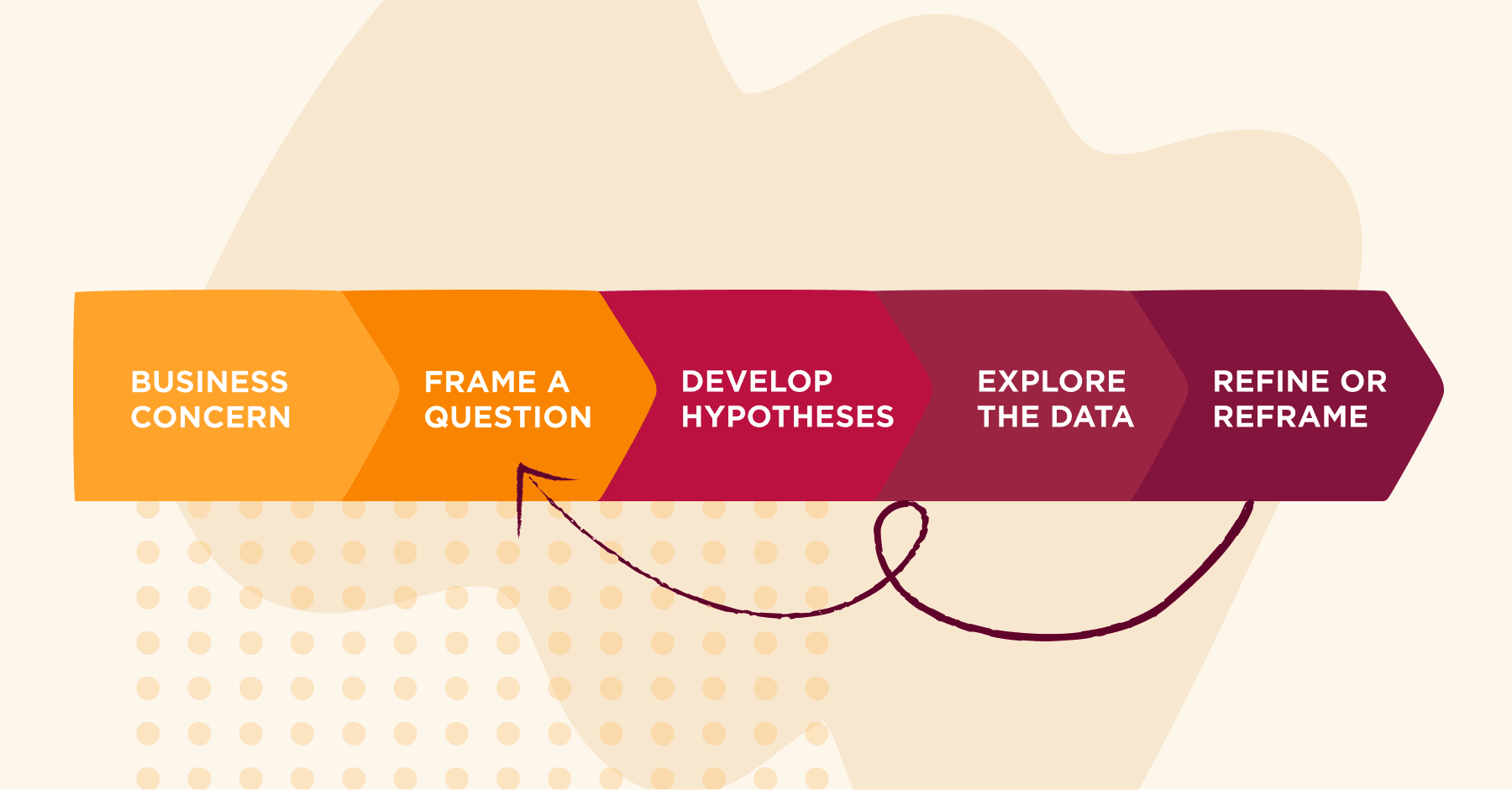
This isn’t an advanced analytics skill. It’s a practical, repeatable habit that anyone in HR can develop. Over time, the questions you ask will become sharper and more insightful, guiding your team toward even better data-driven decisions.
This free downloadable worksheet, Ask better questions: From concern to clarity, is something you can save and print, and use to run through the step-by-step process of asking the right question. Each round of inquiry gets you closer to an action that will make a difference.
The result is greater confidence as an HR data analyst and greater strategic maturity as an HR team. Every answer leads naturally to the next, creating a rhythm of continuous improvement that keeps HR proactive and impactful.
Turning HR data into meaningful decisions
Ultimately, data alone doesn’t create impact. Instead, it’s the questions you ask and the way you use that data that make the most difference to HR team performance and business goals.
To get from data to decisions, you need to:
- Ask the right kinds of questions. Applied, first-order questions focus your attention in the right direction.
- Use hypotheses to guide analysis. Taking a structured approach helps you arrive at objective, reliable, and relevant conclusions.
- Treat analysis as an ongoing conversation. Build on insights to develop a culture of continuous improvement.
By taking this approach to HR analytics, you reposition HR as a strategic partner. You bring clarity and direction to the table, not just numbers. That means greater confidence in your conversations with leadership and Finance, and concrete business impact.
Want to apply this approach to your own organization? Simply follow the step-by-step guidance we’ve laid out in our Ask better questions worksheet, part of our HR analytics course, HR Analytics Unlocked.
<<Start asking better HR analytics questions. Download our Ask better questions worksheet.>>
Key takeaways
- Asking better questions is the starting point for meaningful HR analytics, because data and AI tools only deliver value when clear, well-defined business questions guide them.
- HR analytics works best when it begins with a business concern, not a dataset, keeping people metrics focused on outcomes like retention, performance, cost, and growth.
- Applied, first-order questions lead to more valuable insights, helping HR teams understand what is happening before jumping to assumptions about why it’s happening.
- A single unifying question brings focus and clarity to analysis, aligning metrics, insights, and decision-making around one clear objective.
- Hypotheses provide structure and direction before analysis begins, making it easier to choose the right metrics, avoid bias, and build trust in the results.
- Effective HR analytics is a continuous, iterative process in which each answer informs the next question and strengthens data-driven decision-making over time.
- Better questions help HR move from reporting activity to influencing strategy, positioning the function as a credible, proactive partner to the business.