Job shadowing is a workplace learning method in which one team member follows a colleague through their day-to-day work to see what the job entails.
Job shadowing pairs a curious team member with an experienced colleague to observe, ask questions, and learn in the flow of real work. As a practical form of on-the-job learning, it helps people build new skills, gain cross-functional knowledge, and explore potential career paths. Plus, it’s easy to set up, requires minimal investment, and gives people firsthand insight into how work happens across the organization.
John Bremen, Chief Strategy, Innovation and Acceleration Officer at WTW, explains job shadowing gives people “an opportunity to gain access to new experiences, to access managers or leaders they haven’t had a chance to meet and to experience new job content. It’s an opportunity to, in a structured way, be exposed to new areas of growth and development.”
When people gain a broader understanding of the business and explore new career opportunities, organizations are better positioned to develop talent from within, strengthen internal mobility, and improve retention.
Key insights
- Job shadowing is a low-cost way to develop people, speed up onboarding, and strengthen retention
- The four main types—passive, interactive, hands-on, and virtual—let HR match the format to the goal and the role
- A strong program includes recruiting the right mentors, pairing and scheduling with intent, and gathering feedback to improve each round
- The most common misstep is treating job shadowing as a box to tick rather than a genuine learning experience
Job shadowing definition
Job shadowing pairs an existing team member with a colleague in a different role for a set period, so they can observe real tasks, ask questions, and get a grounded sense of what the job requires.
It’s an internal development tool: the person shadowing already works at the company, they’re just getting a closer look at a different seat. In practice, they mostly watch and ask questions rather than doing the work themselves, picking up the how behind the role by seeing a colleague do it live.
Benefits of job shadowing
According to a recent Strategic Education Workforce Survey, 50 percent of team members worry they lack the skills to move forward in their current job. Job shadowing addresses that challenge by helping people learn from experienced colleagues while giving organizations a cost-effective way to develop internal talent.
Here are some of the biggest benefits of job shadowing for both employers and team members.
For organizations
For organizations, job shadowing is a practical way to strengthen learning and development without requiring a significant investment. As Rachel Stewart of McLean & Company notes, “Job shadowing programs present a low-cost learning and development opportunity that uses resources already available to the organization: its employees.”
Tapping into the expertise that already exists across the business means organizations can improve:
- Knowledge transfer: Experienced colleagues pass on hard-won, tacit know-how that rarely makes it into a handbook
- Fewer silos: When people see how other teams operate, cross-functional understanding grows and handoffs get smoother
- Succession and upskilling insight: HR gets a clearer read on who’s ready to grow, where the skills gaps sit, and how to close them
- Lower training cost: Shadowing leans on colleagues’ existing expertise, so it takes far less to run than formal, facilitator-led programs
- Higher retention: Giving people opportunities to learn, explore career paths, and build new skills helps increase engagement and makes them more likely to stay with the organization
For your people
For people, job shadowing offers a chance to learn by observing real work in action. As Val Olsen, Executive and Leadership Coach at Korn Ferry Advance, explains, “It’s a hands-on way to get insight into what a typical day looks like. You have an idea in your mind what a particular job might be like, but until you really experience it, you don’t know. Job shadowing can help you clarify your career goals.”
That firsthand experience creates benefits that extend well beyond the shadowing session:
- Build practical skills: People develop role-specific knowledge by observing experienced colleagues and asking questions in real time
- Explore career paths with confidence: Seeing a role up close helps people determine whether it aligns with their interests and long-term goals
- Increase confidence: Experiencing the day-to-day realities of a role can make future career moves feel more achievable
- Broaden exposure across the business: Job shadowing introduces people to teams, functions, and career opportunities they might not otherwise encounter
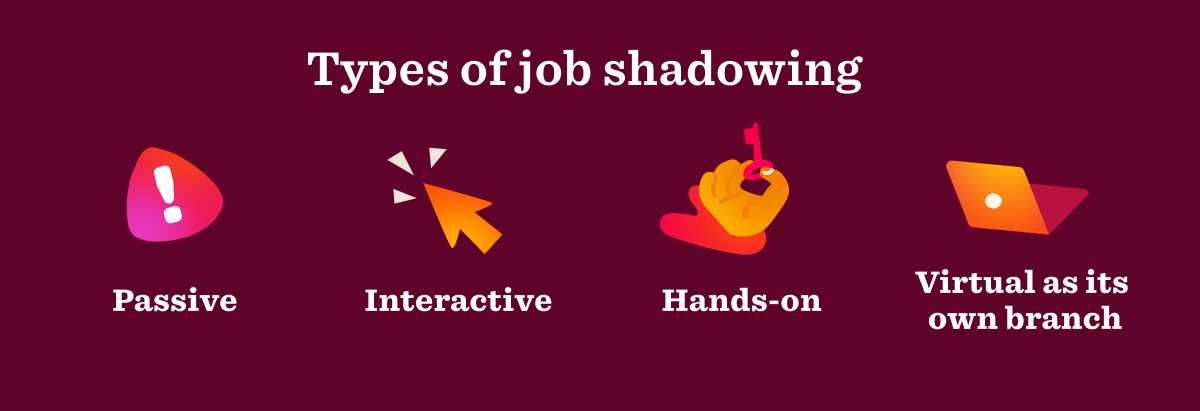
Types of job shadowing
The right format for job shadowing depends on what your people want to learn and how much they can safely get involved.
| Type | Best for | Interaction level | Example |
| Passive shadowing | Getting a broad feel for a role or team | Low, mostly observing | A new marketing coordinator sits in on a week of campaign planning meetings, observing how the team sets priorities without stepping in |
| Interactive shadowing | Understanding the why behind decisions | Medium, observing plus questions | A junior nurse follows a charge nurse through rounds, pausing between patients to ask why each care decision was made |
| Hands-on shadowing | Building practical, role-specific skills | High, doing the work with guidance | A new HR administrator works alongside an experienced manager to build an onboarding workflow, configuring tasks, permissions, and approvals under close guidance |
| Virtual job shadowing | Learning across locations and remote teams | Varies, observing live, often via video | A remote sales rep joins a top account executive’s video calls and screen shares, watching live demos and follow-up notes in real time |
How to design a job shadowing program
A job shadowing program works best when you treat it as a deliberate experience rather than a casual invite to sit in. Start by naming the outcome you want, whether that’s faster onboarding, cross-team fluency, or succession readiness, then build the program back from there.
1. Identify and recruit mentors
Look for team members who both know their craft and enjoy explaining it, since technical skill alone doesn’t make someone a good guide. Ask managers to nominate people, and be upfront about the time it takes so mentors can plan around it.
Mentoring takes real time, so make it visible and valued. Recognize shadowing mentors in performance reviews and development conversations, and give them simple resources, like a guide or checklist, to make the experience easier. When people feel supported and appreciated, they’re more likely to keep sharing their knowledge with others.
2. Pair participants and schedule
Match people based on the goal, not just the org chart. Someone exploring a career move needs a different partner than a new joiner learning the ropes. Block time on both calendars in advance and share a short agenda so the shadowing colleague knows what they’ll see each day.
Weaving a few sessions into a structured onboarding activity plan helps new joiners connect faster and get value from day one.
3. Gather feedback for improvements
Ask both the mentor and the shadowing colleague what landed and what fell flat, using a quick survey or a 15-minute debrief while it’s fresh. Fold those notes into your performance and feedback rhythm so each round gets sharper than the last.
A short survey works well here. A few questions worth including:
- What was the most useful part of this shadowing session?
- What, if anything, felt unclear or rushed?
- Would you recommend this pairing to someone else in a similar role? Why or why not?
- What’s one thing you’d change about how this session was set up?
Over time, this feedback loop tells you which pairings, formats, and durations work best for your teams.
Job shadowing vs. internship vs. training
Job shadowing, internships, and formal training all help people grow, but they ask for different levels of time, suit different goals, and carry different price tags. Here’s a quick look at how the three compare.
| Format | Objective | Time commitment | Cost |
| Job shadowing | Exploring a role, cross-team learning, and easing a career move | Low, from a few hours to a few weeks | Low, mostly the time of the person being shadowed |
| Internship | Building hands-on experience and testing early-career talent | Higher, often several weeks to a few months | Moderate, since interns take on real work and often earn a wage |
| Training | Teaching specific skills to a group in a structured way | Varies, from a short session to an ongoing program | Moderate to higher, depending on materials, facilitators, and tools |
For an HR leader weighing the three, it comes down to the goal: reach for job shadowing when people want a low-lift window into another role, an internship when they’re ready to do the work, and training when a whole group needs the same skills.
Mistakes to avoid when building job shadowing programs
A successful job shadowing program depends on more than good intentions. Avoid these five common mistakes to create a more valuable experience for both mentors and participants.
| Mistake | Solution |
| Treating it as a checkbox exercise: When shadowing becomes a formality with no clear goal, people tune out and the time goes to waste | Tie every pairing to a specific outcome and check in afterward to see whether it landed |
| Limiting exposure to only high-level tasks: Showing team members only the polished, strategic moments hides the everyday work that makes up most of a role | Give people a realistic view, including the routine tasks, so they leave with an honest picture |
| Ignoring preparation for mentors: Mentors who get no guidance tend to talk too little or overwhelm the shadowing team member with detail | Offer a short brief on what to explain, what to demonstrate, and how to invite questions along the way |
| Neglecting diversity and inclusion: If shadowing spots always go to the same profiles, you narrow who gets to grow and reinforce existing gaps | Open the program to a mix of backgrounds and career stages, and track who takes part to keep access fair |
| Mismanaging the duration: Too short and team members barely scratch the surface; too long and the mentor’s own work stalls | Set a duration that fits the goal, then confirm it’s working with a quick mid-point check |
Recommended For Further Reading
Turn job shadowing into a learning initiative
The most effective people development programs are part of an ongoing strategy that helps people build skills, explore career opportunities, and grow with the business. Whether you’re launching job shadowing, mentoring, or other development programs, clear goals, manager support, and regular feedback help turn learning into lasting impact.
HiBob helps you bring your people development strategy together in one place. Track skills, career growth, performance, and development activities, giving HR and managers the visibility they need to support every stage of the team member journey. With connected people data, it’s easier to identify growth opportunities, develop future leaders, and make more informed talent decisions.
Book a demo to see how HiBob can help you build and scale people development programs that support your people and your business.
Job shadowing FAQs
What is an example of job shadowing?
Say a customer support specialist spends three afternoons alongside the data team. They watch how analysts pull reports, sit in on a dashboard review, and ask questions between tasks. By the end, they understand how support tickets turn into insights the wider business acts on.
How long should a job shadowing program last?
The right length depends on the goal. A few hours can give someone a taste of a role, while a week or two lets them build real understanding of the day-to-day. As a rule of thumb, match the duration to what you want the shadowing team member to walk away knowing, and confirm it’s working with a check-in partway through.
How can HR ensure compliance in job shadowing programs?
Start by clarifying that the shadowing team member is there to observe, not to take on regulated or safety-sensitive tasks without proper training. Keep any confidentiality, data privacy, and health-and-safety requirements front and center, and brief both parties on them before the first session.
When shadowing crosses jurisdictions, check local rules on paid time and worker classification so the program stays compliant wherever your people are.