If you’ve ever been stuck trying to wrap up a performance review, you’re not alone. While a performance review summary may only span a few paragraphs, it can shape how someone leaves the conversation and approaches the next stage of their development.
“Setting clear expectations and knowing what success looks like allows for transparency in the business and leads to greater productivity,” says Alyson Sturgess, Head of Customer Success at HiBob. A well-written performance review summary reinforces that clarity by connecting results, expectations, and next steps in one focused message.
These performance review summary examples will help you strike the right balance between honesty, encouragement, and actionable direction. You’ll also find ready-to-use templates you can download to simplify the process and write clear, confident summaries every time.
<< Download these performance review summary templates to use during your next review cycle. >>
Key insights:
- A performance review summary explains what a team member delivered, how well they delivered it, and where they have room to grow
- It translates months of projects, metrics, and feedback into a clear bottom-line assessment of overall performance
- Decision-makers often rely on summaries when determining raises, promotions, expanded scope, or performance plans
- Performance review summary examples show what effective, outcome-driven feedback looks like, and ready-to-use templates provide a repeatable structure for writing your own
What is a performance review summary?
A performance review summary is the concluding section of a review that synthesizes key insights about someone’s performance over a specific period. It distills months of observations, feedback, and achievements into a clear snapshot that guides future development conversations.
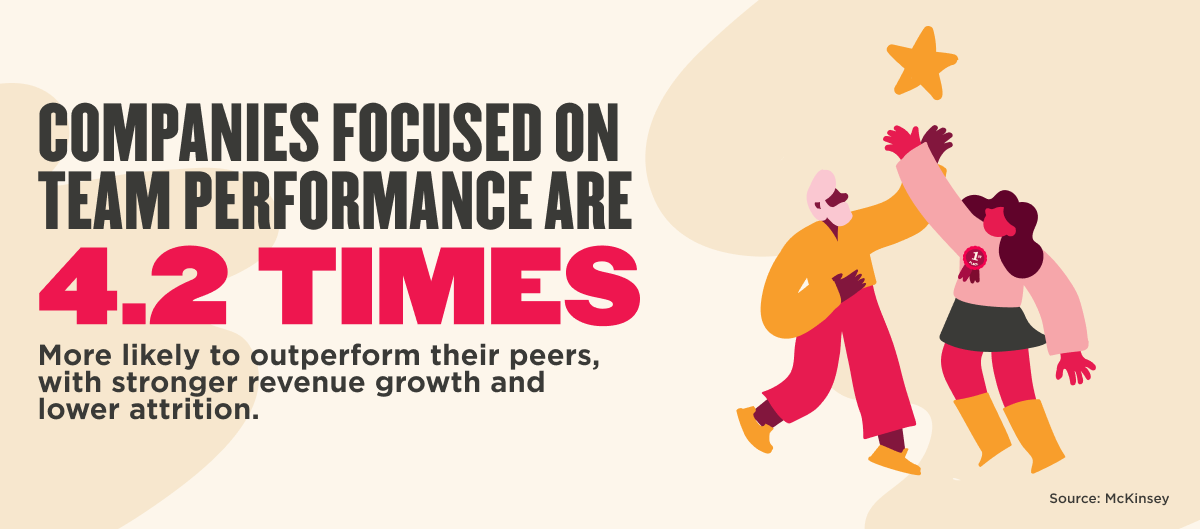
Well-crafted summaries help inform high-stakes decisions, including compensation, promotions, and future development priorities. In organizations that prioritize team member performance, those decisions also contribute to better business outcomes. These companies are 4.2 times more likely to outperform their peers, with stronger revenue growth and lower attrition.
Performance review summary examples and phrases
Here are some ready-to-use performance review summary examples and phrases organized by performance level and focus area. You can adapt them to fit specific roles, industries, and contexts to paint a complete picture of an individual’s contributions.
Exceeds expectations
Team members in this category consistently deliver beyond role expectations and create impact outside their immediate scope. Look for clear, measurable outcomes, strong ownership, and improved team execution. Signals like removing blockers early, raising quality standards, and helping others deliver faster all point to exceptional performance.
1. Outstanding impact and ownership
Best for: Team members who take initiative and own outcomes end-to-end
Key achievements: “Across [initiative/project], [name] took full ownership and delivered [specific metrics]. One of the strongest results was [specific outcome], which directly drove [measurable impact] and set a higher standard for [team/customer/business result].”
Strengths demonstrated: “What stands out most is how [name] always delivers at an exceptional level. In [area of work], [he/she/they] produce(s) work that others can rely on and build from. [His/her/their] strength in [core competency] is evident in [specific example], and it repeatedly results in [game-changing benefits].”
Growth opportunities: “With performance already exceeding expectations, the next step is expanding into [next-scope skill] and [broader impact skill]. This will allow [name] to influence direction, not just execution, and drive outcomes across [team/org] at a broader level.”
2. High performance in complex work
Best for: Team members who handle ambiguity well and deliver in high-pressure situations
Key achievements: “[Name] handled demanding work in [project/initiative] exceptionally well and delivered [specific metric/outcome] despite [challenge or constraint]. A standout moment was [specific situation], where [his/her/their] approach resulted in [measurable impact] and elevated how [process/system/business area] operates.”
Strengths demonstrated: “Complex work is where [name] shines. In [specific example], [he/she/they] worked through [challenge] and delivered [specific outcome] under extreme pressure. [His/her/their] strength in [technical/problem-solving skill] shows in how quickly [he/she/they] cut through ambiguity and make confident calls.”
Growth opportunities: “With performance already at a high level, the next focus is [prioritization/judgment skill] and [long-term thinking]. Strengthening these will help [name] choose the right problems to focus on and direct effort toward the work that drives the biggest results.”
3. Cross-functional standout
Best for: Team members who keep cross-team work moving and align stakeholders
Key achievements: “Work across [teams/stakeholders] led to impressive outcomes in [initiative/project], where [name] helped deliver [specific results]. A standout contribution was [specific example], which brought teams into alignment and resulted in [measurable impact].”
Strengths demonstrated: “[Name] raises the bar on how teams work together. In [specific situation], [he/she/they] pushed conversations forward, challenged unclear thinking, and brought [teams/stakeholders] to clear decisions around [shared goal]. On [project], this led to accelerated progress that significantly improved [metric/result].”
Growth opportunities: “One way to build on [name]’s incredible momentum is creating repeatable ways of working—like templates, cadences, and shared dashboards—based on [his/her/their] processes. This allows [name] to extend [his/her/their] impact without relying on [his/her/their] direct involvement.”
4. Operating above their level
Best for: Team members who take on next-level scope and deliver without stretch or support
Key achievements: “[Name] is already delivering at a level beyond their role, as seen in [initiative/project], which resulted in [high-impact outcome]. Another standout example is [specific achievement], where [he/she/they] took on [next-level responsibility] and drove [measurable impact].”
Strengths demonstrated: “[Name] consistently works beyond the scope of [his/her/their] role. In [specific example], [he/she/they] stepped into [responsibility above role] and drove [specific action], which led to [clear outcome]. [His/her/their] strength in [leadership/ownership skill] shows in how [he/she/they] handled [situation], which led to [game-changing impact].”
Growth opportunities: “The next step is strengthening [leadership skill] and [strategic capability] while maintaining this level of performance consistently. Continued impact at this level over the next [timeframe] will position [name] for promotion into [next role or scope].”
Meets expectations
These team members deliver exactly what the role requires at the expected standard. While they may not consistently exceed expectations, they are dependable, effective, and valuable contributors. This level of performance is reflected in delivery against agreed objectives, high-quality work with minimal rework, and great potential for growth.
5. Reliable delivery and strong fundamentals
Best for: Team members who show up, own their work, and deliver every time
Key achievements: “[Name] delivered reliable, high-quality work across [initiative/project], achieving [specific metric or outcome] and keeping priorities on track in [key area]. [He/she/they] followed through on [responsibility or deliverable] without gaps. [His/her/their] work on [project] helped the team achieve [result] and supported [stakeholder/customer outcome].”
Strengths demonstrated: “[Name] brings a high level of consistency and follow-through to [his/her/their] work. In [area of work], [he/she/they] handles responsibilities with care and attention to detail, even under tight timelines or repeated demands. In [specific example], [he/she/they] applied [core skill] to [action], which helped the team [specific benefit]. [He/she/they] also excel at [second strength], contributing to [team outcome].”
Development opportunities: “To exceed expectations, the next focus areas are [skill to deepen] and [skill to broaden]. Strengthening these will help [name] handle more complex work and contribute to higher-impact outcomes with greater independence.”
6. Strong partner and clear communicator
Best for: Team members who collaborate effectively through clear, timely communication
Key achievements: “[Name] played a central role in [initiative/project], working closely with [team members] to achieve [specific outcome]. [His/her/their] communication kept priorities on point and prevented decisions from stalling, which helped the team hit [result] ahead of schedule and deliver for [outcome].”
Strengths demonstrated: “[Name] stays on top of communication and closes gaps before they slow things down. In [specific example], [he/she/they] followed up on open items and pushed for consistent updates from [team members]. This kept handoffs clean and prevented the back-and-forth that had slowed earlier projects.”
Development opportunities: “To exceed expectations, the next focus areas are [skill to deepen] and [skill to broaden]. Building these will help [name] take a more active role in guiding discussions and influencing outcomes across teams.”
7. Solid results in a shifting quarter
Best for: Team members who stay steady even when priorities change
Key achievements: “[Name] delivered strong results across [initiative/project] despite shifting priorities and changing requirements. When [specific change or disruption] happened, [he/she/they] adjusted their approach and kept [workstream/project] on track, achieving [specific metric or outcome]. [His/her/their] work on [project] helped the team reach [result] without losing ground during a volatile period.”
Strengths demonstrated: “[Name] resets plans quickly when priorities change and follows through on what still needs to ship. [He/she/they] confirm scope with [teams/stakeholders], update timelines, and close out work without letting deadlines slip. This showed in [type of situation], where key deliverables still went out on time without rework. [He/she/they] also brings [second strength], which supports [team outcome].”
Development opportunities: “To exceed expectations, the next step is strengthening [anticipation/planning skill] and [stakeholder alignment skill]. Building these will help [name] get ahead of changes earlier and reduce the need for reactive adjustments in fast-moving situations.”
8. Steady contributor who is taking on more duties
Best for: Team members who are growing in role scope and showing they can handle more responsibility
Key achievements: “[Name] delivered impressive results across [initiative/project], contributing to [specific metric or outcome] and supporting progress on [team goal]. [He/she/they] followed through on [responsibility or deliverable] and stepped into [additional task or responsibility] when needed, helping the team achieve [result] and support [stakeholder/customer outcome].”
Strengths demonstrated: “[Name] shows up consistently and delivers what’s needed. In [area of work], [he/she/they] stays on top of core responsibilities and takes on additional work without drop-off. In [specific example], [he/she/they] applied [core skills] to [action], which improved [specific improvement]. They also bring [second strength], which supports [team outcome] as their scope grows.”
Development opportunities: “To exceed expectations, the next focus areas are [skill to deepen] and [skill to broaden]. Building these will help [name] take ownership of larger workstreams and advance to the next level.

Developing
This rating suits team members who are gaining momentum and making solid progress, but haven’t yet reached consistent performance across the full scope of their role. Two classic signals to look for: An upward trajectory and a skills gap that, once addressed, will strengthen overall performance in the role.
9. Growing confidence and capability
Best for: Team members who are starting to take more initiative and put new skills into practice, but are still developing the independence needed to perform at the next level
Key achievements: “[Name] contributed to [initiative/project] by completing [specific achievement] and taking on [complex responsibility]. [He/she/they] stepped into [area they didn’t previously handle], contributing to [result] and expanding [his/her/their] role in the work.”
Strengths demonstrated: “[Name] is starting to handle [type of work] with less guidance. In [example], [he/she/they] [specific action], made decisions on [specific element], and completed [deliverable/outcome]. [He/she/they] also show[s] [second strength], which helps [him/her/them] take action without waiting for direction.”
Development opportunities: “While [name]’s becoming more comfortable in [growth area], there’s still work to do in [problem area] to meet role expectations. The main focus areas are [skill/behavior] and [second skill/behavior]. Strengthening these will help [name] handle similar work with fewer gaps and more confidence, especially in [specific situations].”
10. Building consistency in execution
Best for: Team members who consistently deliver solid work at the expected level but aren’t yet showing the broader ownership expected at the next level
Key achievements: “[Name] delivered [specific achievement] on [initiative/project], completing [deliverable] on time and as expected. In [specific moment], [he/she/they] delivered [output] without issues, showing what strong execution looks like in their work.”
Strengths demonstrated: “[Name] can deliver work that’s complete and meets requirements. In [example], [he/she/they] delivered [specific deliverable] accurately when expectations and scope were clearly set. [He/she/they] also show [second strength], which supports solid execution on well-scoped tasks.”
Development opportunities: “That level of execution isn’t consistent across [his/her/their] work. Gaps show up in [problem areas], where output falls below the expected standard. The main priorities are [skill/behavior] and [second skill/behavior]. Improving these will help [name] deliver the same level of completeness and timeliness across all tasks.”
11. Improving stakeholder collaboration
Best for: Team members who work with stakeholders but leave gaps in updates, follow-up, or context.
Key achievements: “[Name] supported [initiative/project] and contributed to [specific achievement] through work with [team/stakeholder]. In [specific moment], [he/she/they] provided [input/change] required for [decision/approval], resulting in [important outcome].”
Strengths demonstrated: “[Name] is receptive to stakeholder input and willing to adjust [his/her/their] work based on feedback. In [example], [he/she/they] incorporated [specific feedback] from [stakeholder] and updated [deliverable] accordingly. [Name] also demonstrates [second strength], which supports progress in stakeholder collaboration by helping [him/her/them] respond constructively when input is given.”
Development opportunities: “While [name]’s improving in [growth area], gaps still show up in [problem area] when working across stakeholders. Updates may lack context, or follow-up may not happen until prompted. The main focus areas are [skill/behavior] and [second skill/behavior]. Strengthening these will help [name] keep stakeholders informed and reduce repeated questions or misalignment.”
12. Scaling impact with better prioritization
Best for: Team members who complete their work but don’t focus enough on the highest-impact tasks.
Key achievements: “[Name] contributed to [initiative/project] by taking on [specific work] and delivering [output] that supported [result]. In [specific moment], [he/she/they] put significant effort into [task], which led to [outcome] and showed [his/her/their] ability to drive work forward.”
Strengths demonstrated: “[Name] commits to the priorities that are set for them. In [example], [he/she/they] focused on [task] once it was identified as important and delivered [output] as expected. [He/she/they] also demonstrate [second strength], which helps them stay aligned to defined priorities.”
Development opportunities: “The gap is in how work is prioritized. Lower-impact tasks receive the same attention as higher-impact work, which limits overall results. The main focus areas are [skill/behavior] and [second skill/behavior]. Strengthening these will help [name] focus effort on what drives results and make better trade-offs when priorities compete.”
Needs improvement
This rating is for people who aren’t meeting the expectations of their role. Issues may include missed goals, inconsistent follow-through, or gaps in judgment, ownership, or execution.
Without clear and sustained improvement, performance may continue to fall short of what the role requires.
13. Outcomes not consistently meeting expectations
Best for: Team members who are putting in effort but don’t consistently deliver at the expected level
Areas of strength: “[Name] delivered expected results in [area] at times, including [specific example]. [He/she/they] also met expectations in [second area], showing [he/she/they] can produce the required outcomes under the right conditions.”
Development focus: “Current priorities are improving [specific skill/behavior] and increasing consistency in [second area], especially in situations like [example]. Gaps were visible in [missed outcome], [quality issue], and [timeline impact], where expected results weren’t met.”
Impact and opportunity: “These gaps resulted in [impact], affecting [team/project/customer outcome]. Improving [specific behavior] will reduce these issues and help [name] deliver expected results consistently.”
14. Quality and completeness need to improve
Best for: Team members who complete work but miss details, accuracy, or full requirements
Areas of strength: “During this period, [name] contributed to [area] and delivered [example], showing they can produce solid work when requirements are clear. [He/she/they] also demonstrated [second strength], which supports improvement in overall quality.”
Development focus: “Current priorities are improving attention to detail in [specific area] and ensuring completeness in [second area], particularly in [area of work]. These issues showed up as [quality issue], [missed requirement], and [rework needed], where deliverables didn’t fully meet expectations.”
Impact and opportunity: “These patterns create extra work for [team/stakeholder], who have to flag missing pieces or correct issues before [next step/deliverable] can move forward. This pulls time away from [higher-value work] and makes outputs less reliable in [specific situation].”
15. Communication and collaboration require coaching
Best for: Team members who work well with others but leave gaps in proactive, clear, or timely communication
Areas of strength: “During this period, [name] contributed to [area] and supported [example], showing willingness to collaborate. [He/she/they] also demonstrated [second strength], which provides a strong baseline for improving how they engage with others.”
Development focus: “Current priorities are improving communication in [specific area] and increasing consistency in [collaboration behavior], especially in situations like [example]. These gaps showed up in [missed updates], [misalignment], and [delayed responses or unclear expectations].
Impact and opportunity: “[Team/project/customer outcome] is affected when updates lack context, next steps go unconfirmed, or responses come too late. Consistent communication in moments like [example] will reduce back-and-forth, prevent avoidable delays, and improve collaboration with [team/stakeholder group].”
16. Performance improvement plan recommendation
Best for: Team members who would benefit from structured support and clear accountability to meet expectations.
Areas of strength: “During this period, [name] delivered [specific output] in [area] and contributed to [example]. [He/she/they] also demonstrated [second strength] in [specific context], showing [he/she/they] can meet expectations in parts of the role.”
Development focus: “Current priorities include [specific skill/behavior] and [second skill/behavior]. In this review period, [name] missed [missed outcome], submitted [quality issue], and delayed [timeline impact]. Work doesn’t yet meet requirements at first submission, and deadlines aren’t consistently met.”
Impact and opportunity: “These issues delay [team/project/customer outcome], create rework for [team/stakeholder], and trigger escalations. A performance improvement plan will set clear expectations for [deliverable], [quality standard], and [deadline/communication cadence], with progress tracked against specific milestones.”
Performance review summary templates
The performance review summary templates below provide structured frameworks you can adapt for different scenarios. Each one is designed to help you balance recognition with development and offer clear direction.
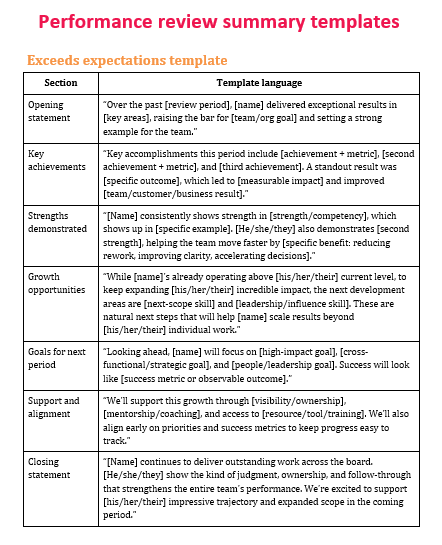
Exceeds expectations template
| Section | Template language |
| Opening statement | “Over the past [review period], [name] delivered exceptional results in [key areas], raising the bar for [team/org goal] and setting a strong example for the team.” |
| Key achievements | “Key accomplishments this period include [achievement + metric], [second achievement + metric], and [third achievement]. A standout result was [specific outcome], which led to [measurable impact] and improved [team/customer/business result].” |
| Strengths demonstrated | “[Name] consistently shows strength in [strength/competency], which shows up in [specific example]. [He/she/they] also demonstrates [second strength], helping the team move faster by [specific benefit: reducing rework, improving clarity, accelerating decisions].” |
| Growth opportunities | “While [name]’s already operating above [his/her/their] current level, to keep expanding [his/her/their] incredible impact, the next development areas are [next-scope skill] and [leadership/influence skill]. These are natural next steps that will help [name] scale results beyond [his/her/their] individual work.” |
| Goals for next period | “Looking ahead, [name] will focus on [high-impact goal], [cross-functional/strategic goal], and [people/leadership goal]. Success will look like [success metric or observable outcome].” |
| Support and alignment | “We’ll support this growth through [visibility/ownership], [mentorship/coaching], and access to [resource/tool/training]. We’ll also align early on priorities and success metrics to keep progress easy to track.” |
| Closing statement | “[Name] continues to deliver outstanding work across the board. [He/she/they] show the kind of judgment, ownership, and follow-through that strengthens the entire team’s performance. We’re excited to support [his/her/their] impressive trajectory and expanded scope in the coming period.” |
Meets expectations template
| Section | Template language |
| Opening statement | “Over the past [review period], [name] delivered consistent results in [key areas], driving [specific initiatives] forward that were instrumental in [increasing revenue/improving retention/hitting targets].” |
| Key achievements | “Key accomplishments this period include [achievement + metric], [second achievement], and [third achievement]. [His/her/their] work on [project] helped the team achieve [result] and supported [stakeholder/customer outcome].” |
| Strengths demonstrated | “[Name] shows consistent strength in [strength], evidenced by [example]. [He/she/they also bring [second strength], which helps the team by [benefit: predictable delivery, clear communication, strong collaboration].” |
| Development opportunities | “To exceed expectations, the next focus areas are [skill to deepen] and [skill to broaden]. Strengthening these will help [name] take on larger, higher-visibility work with more independence.” |
| Goals for next period | “Looking ahead, [name] will focus on [primary goal], [secondary goal], and [development goal]. We’ll measure success through [metric], plus clear delivery milestones and stakeholder feedback.” |
| Support and alignment | “We’ll support progress through [regular check-ins], clear success criteria for larger work, and [coaching/training/resource] to build confidence and consistency.” |
| Closing statement | “[Name] continues to impress and is ready to take on greater ownership next quarter, starting with expanding [his/her/their] scope of work across [teams/projects/initiatives].” |
Developing template
| Section | Template language |
| Opening statement | “Over the past [review period], [name] improved in [key areas] and continues to develop in the role. This summary highlights what’s working and the areas that need further development to strengthen consistency and impact.” |
| Key achievements | “Key accomplishments this period include [achievement], [second achievement], and progress in [area]. A positive example was [specific moment], where [name] achieved [outcome] through [behavior/approach].” |
| Strengths demonstrated | “[Name] shows strength in [strength], particularly when [context], as seen in [example]. [He/she/they] also demonstrate [second strength], which supports growth by [benefit].” |
| Development opportunities | “While [he/she/they] demonstrates [strengths], [he/she/they] still has some work to do in [problem areas] to consistently meet the expectations of this role. The main development priorities are [skill/behavior] and [second skill/behavior]. Improving these will help [name] deliver reliably, especially in situations like [examples: shifting priorities, stakeholder alignment, deadlines].” |
| Goals for next period | “Looking ahead, [name] will focus on [execution goal], [collaboration/communication goal], and [skill-building goal]. Success will look like [measurable outcome], plus fewer escalations and clearer stakeholder alignment.” |
| Support and alignment | “We’ll support this through [structured weekly/biweekly check-ins], clearer prioritization and success criteria, and [training/peer support/mentorship]. We’ll also create space for timely feedback so adjustments happen early.” |
| Closing statement | “[Name] is building the right foundation. With focused practice and consistent support, [he/she/they] can strengthen reliability and meet expectations in the next review cycle.” |
Needs improvement template
| Section | Template language |
| Opening statement | “[Name] shows potential in [skills/qualities], but performance needs improvement in a few key areas. This review sets clear priorities to address gaps and strengthen results.” |
| Areas of strength | “During this review period, [name] demonstrated strength in [area] and contributed through [example]. These are important foundations to build on as we improve consistency and results.” |
| Development focus | “Current priorities are improving [specific skill/behavior] and increasing consistency in [second area], particularly in situations like [example]. These gaps showed up in [missed outcome], [quality issue], and [timeline impact].” |
| Impact and opportunity | “These patterns affected [team/project/customer outcome] by [impact: delays, rework, misalignment]. Addressing them will strengthen trust, predictability, and overall team execution.” |
| Development plan | “To support progress, [name] will [specific action], implement [process/tool/checklist], and complete [training/coaching]. We’ll set milestones for [deliverable], [quality standard], and [communication cadence] to track progress.” |
| Support offered | “We’ll provide [coaching], [tools/resources], and regular feedback sessions [frequency]. We’ll also clarify priorities and success criteria upfront to remove ambiguity and keep progress measurable.” |
| Growth goals | “The goal is measurable improvement in [areas] by [timeframe], with clear indicators such as [on-time delivery rate], [reduced rework], [stakeholder feedback], and consistent progress against agreed milestones.” |
| Closing statement | “With focused effort, clear expectations, and consistent support, we expect [name] to make meaningful improvement in the coming months.” |
Recommended For Further Reading
Best practices for writing a performance review summary
A strong performance review summary reflects the full scope of someone’s work and provides clear context for their progress over the review period. “The more transparent you are about your people’s performance, the more engaged your people will feel,” says Victoria Feldman, Senior Leadership Development Partner, Executive Coach at Amazon.
Core principles for effective performance review summaries include:
- Starting with impact: Open with 1-2 sentences that clearly state the team member’s overall contribution
- Naming the work: Focus on behaviors and outcomes, with references to specific projects, initiatives, or responsibilities
- Quantifying results: Include metrics like revenue generated, costs reduced, engagement improved, and projects completed
- Addressing development clearly and directly: Specify improvement recommendations and the outcomes they could improve
- Covering the full review period: Include early wins, mid-year challenges, and recent performance
- Comparing results to the role: Evaluate performance against stated responsibilities, KPIs, and goals to show where performance met expectations, exceeded targets, or presents an opportunity for further growth
- Setting clear priorities for what comes next: Close the summary by naming 2-3 concrete focus areas for the next review cycle
- Using structured tools: Draft summaries using a standardized performance review templates and performance review checklists to ensure consistency, completeness, and fair evaluation across team members
Use performance review summaries to drive better conversations
Performance review summaries shape how people understand their contributions and what comes next. When they clearly connect results, patterns, and priorities, they turn a routine process into a focused development conversation.
Strong summaries balance honesty with encouragement. They’re direct without being discouraging, and specific without being overwhelming. When HR professionals master this balance, they help build a culture of continuous growth, transparency, and trust. Case in point: Team members who strongly agree they receive valuable performance feedback report engagement levels five times higher than their peers.
Clear examples and structured templates make that level of feedback easier to deliver consistently. Performance review summary examples show what strong, balanced language looks like in practice, while templates provide a repeatable framework that keeps evaluations specific, fair, and aligned to goals.
Tools can help too. HiBob’s Performance Management features make it easier to deliver the kind of structured, meaningful feedback that drives engagement. HiBob brings goals, reviews, check-ins, and feedback into one place, giving managers the visibility they need to write summaries grounded in real performance data.
With built-in performance management review templates and continuous feedback tracking, teams can create consistent, high-quality evaluations that reinforce clarity and support stronger development conversations.
Book a demo to see how HiBob can help you elevate your performance review process.