Contingent workforce management is the strategy and set of processes an organization uses to source, onboard, track, pay, and manage compliance for non-permanent workers.
Most businesses today run on a mix of permanent team members, contractors, freelancers, and temporary staff. But the systems built for one type of worker rarely serve all four well. Non-employee talent already makes up 21 percent of the average organization’s workforce, according to Staffing Industry Analysts research, and that number should keep climbing over the next decade.
Contingent workforce management is the practice of sourcing, onboarding, tracking, paying, and staying compliant for every non-permanent worker a business engages. Done well, it gives HR and Finance leaders one clear view of who is doing the work, what it costs, and where compliance risk is highest, regardless of a person’s employment status.
Getting ahead of it starts with understanding what contingent workforce management actually involves, and where a connected workforce management platform can close the gaps that spreadsheets cannot.
Key insights
- Contingent talent, including contractors, freelancers, temporary staff, and consultants, is becoming a standing part of workforce strategy rather than a stopgap
- Managing it well means sourcing, onboarding, paying, and staying compliant across several worker types and, often, several jurisdictions at once
- Worker classification is one of the biggest risk areas, since rules vary by location and change often
- Bringing contingent talent into the same platform as permanent team members gives HR and Finance leaders one source of truth instead of a patchwork of contracts, invoices, and spreadsheets
What is contingent workforce management?
Contingent workforce management covers every step of working with people who are not on a company’s permanent headcount. That includes sourcing and vetting talent, managing contracts and rates, onboarding, tracking hours and deliverables, processing payment, and monitoring compliance across every jurisdiction involved. It typically spans four main worker types: independent contractors, temporary or agency staff, freelancers, and consultants, each with its own tax treatment, contract structure, and level of oversight.
Managing this well takes more than HR. Procurement negotiates the supplier contracts, Finance tracks the spend, Legal signs off on how you classify each worker, and HR handles onboarding and performance management. Compare that to hiring a single temporary employee directly—you’re the only employer involved, with no agency or contractor business in between. Multiply that complexity across several worker types and a few borders, and it’s easy to see why contingent programs get messy fast.
Why more organizations are using contingent talent
Contingent talent has moved from a stopgap to a standing part of workforce strategy for a straightforward reason: it lets organizations match skills and headcount to demand instead of locking in either. A team that needs a specialist for a six-month project, extra hands during a seasonal peak, or a niche skill it does not plan to hire full time can bring in the right person without changing its permanent structure—one piece of a broader shift toward supporting a flexible workforce.
A few forces are driving the shift:
- Skills scarcity in specific areas: Roles in data science, cybersecurity, and other fast-moving technical fields are hard to fill on a permanent basis, and contingent talent offers a faster path to that expertise
- Budget control: Contingent labor lets Finance and HR align spend with project timelines rather than committing to fixed long-term cost
- Worker preference: A growing share of skilled professionals turn to project-based or freelance work by choice, not necessity, which widens the talent pool available to any single engagement
- Global access to talent: Organizations can now engage specialized contingent talent anywhere in the world
Key challenges and risks of managing contingent employees
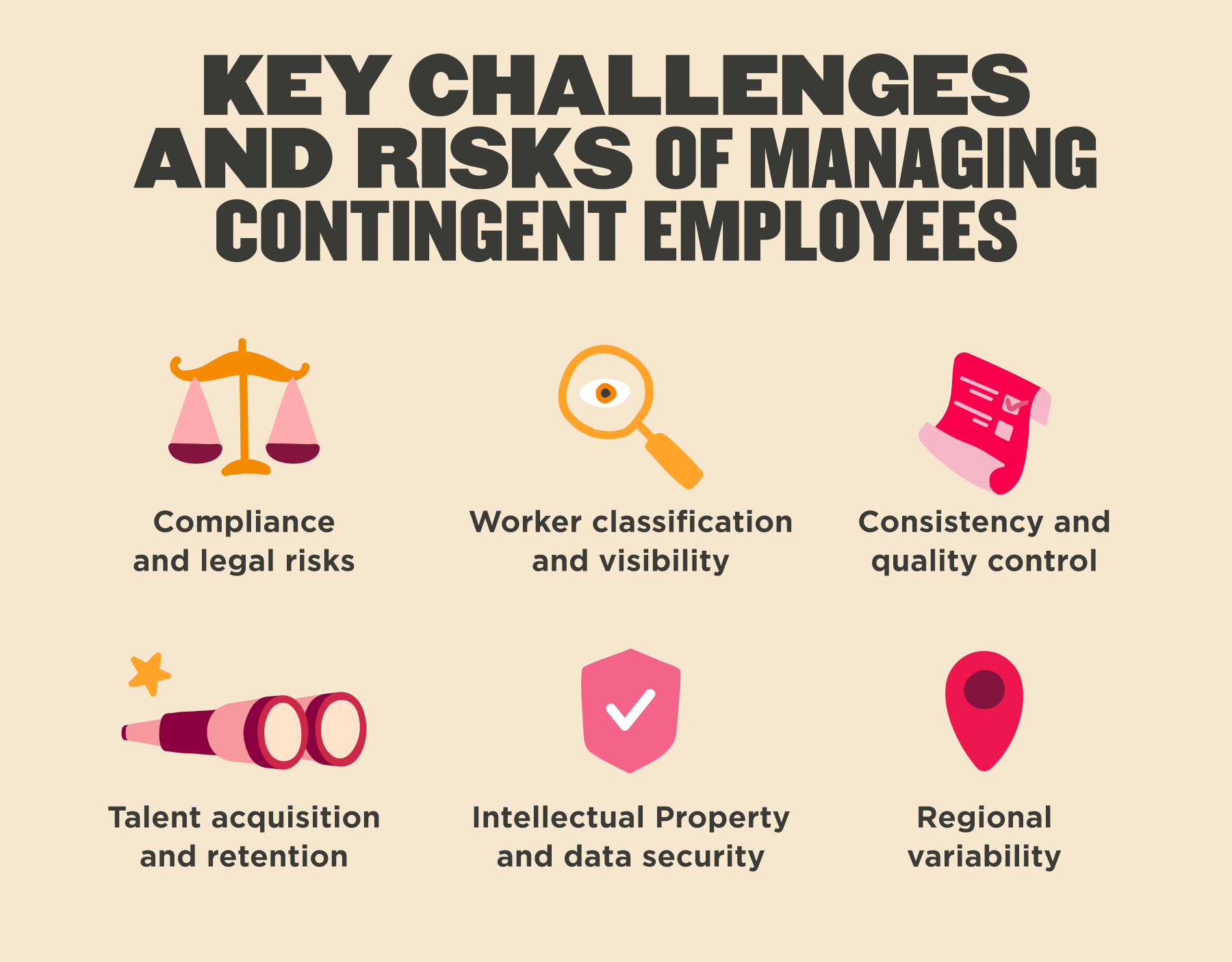
Bringing on contingent talent solves one set of problems and introduces another. The most common challenges fall into six areas:
- Compliance and legal risks: Regulations governing contingent labor change quickly, from pay transparency laws to worker classification rules, and enforcement is intensifying. A $2 million citation against Ritz-Carlton and three janitorial contractors, and an $868,000-plus citation against Costco and two trucking firms, show that even well-resourced organizations get misclassification wrong.
- Worker classification and visibility: Knowing who is working for the business, in what capacity, and under which local rules gets harder once contingent talent spans multiple countries. A connected employee management system that includes non-permanent workers closes much of that gap.
- Consistency and quality control: Without shared standards, onboarding and performance expectations can vary widely between contingent workers and teams. MediaRadar ran into this as it grew across regions, ending up managing what its Chief People Officer called three separate organizations before unifying on one platform.
- Talent acquisition and retention: In-demand contingent talent, especially in technical and creative fields, often has multiple offers on the table, so slow-moving or below-market organizations lose out to competitors.
- Intellectual property and data security: Contingent workers often need access to systems, code, or sensitive data, so IP agreements, access controls, and offboarding need to be as rigorous as they are for permanent team members.
- Regional variability: Labor law, tax treatment, and paperwork for contingent workers differ by country and often by state or province. In HiBob’s research on multinational companies, 37 percent of HR leaders call global payroll administration highly complex and another 48 percent call it moderately complex, and that only grows as a program adds jurisdictions.
Top approaches to contingent workforce management
There’s no single right way to manage contingent talent. Most organizations land on one of the following models, or a combination of them, based on program size, industry, and how centralized their HR function already is.
Centralized management
One team, typically HR or procurement, owns sourcing, contracts, and compliance for all contingent talent across the business. This gives the clearest visibility and the most consistent policy application, though it can slow down local hiring managers who need talent quickly.
Decentralized management
Individual departments or regional offices manage their own contingent hiring. This approach is fast and responsive to local needs, but it makes company-wide visibility and consistent compliance much harder to maintain.
Hybrid management
A central team sets policy, rate cards, and compliance standards, while business units execute hiring within those guardrails. This balances speed with control and is the most common approach for mid-market and enterprise companies.
Managed service providers (outsourcing)
An external managed service provider (MSP) runs some or all of the contingent workforce program, from sourcing through payment. This model suits high-volume programs where the administrative load would otherwise strain internal teams.
Strategic partnering
Organizations build long-term relationships with a small set of trusted staffing agencies or talent platforms rather than sourcing project by project. This speeds up time-to-fill and improves quality, since the partner already understands the business.
Internal talent pools
Some companies build and maintain their own bench of pre-vetted contractors and alumni. Re-engaging people who already know the business cuts sourcing time and preserves institutional knowledge.
How HR software supports contingent workforce management
Spreadsheets and email chains can track a handful of contractors, but they break down fast once a program spans multiple worker types, currencies, and jurisdictions. Cloud-based, AI-powered HR platforms solve this by giving HR and Finance one connected system for contingent and permanent talent, instead of a separate process for each.
That system should answer the same questions leadership already asks about full-time headcount: What does this cost, is it compliant, and is it delivering results. Bob Companion, HiBob’s natural-language AI interface, helps HR teams and managers get those answers fast. That might mean checking a contract renewal date, flagging an upcoming compliance deadline, or pulling spend data for a budget review.
Piab Group, an industrial technology company operating across multiple countries, chose Bob’s HR software for technology companies partly for how quickly it could stand up a global system. That same single system also supports better dynamic workforce planning, since HR and finance can model headcount and contingent spend together instead of in separate tools.
Recommended For Further Reading
What to look for in contingent workforce management tools
Not every HR platform is built to handle non-permanent talent well. When evaluating tools, weigh them against the following capabilities:
| Capability | Why it matters |
| Global talent management | Supports different worker types and local requirements across every country where the business engages contingent talent |
| Scalability | Handles a program that might grow from a handful of contractors to hundreds without a system change |
| Visibility and control | Gives HR, Finance, and hiring managers a single, accurate view of who is working, where, and under what terms |
| Integration with HR and other tech | Connects with payroll, procurement, and Finance systems instead of creating a separate data silo |
| Performance management | Tracks contingent worker output and quality alongside permanent team member performance |
| Analytics | Surfaces cost, headcount, and risk trends through workforce analytics rather than static reports |
| Automation | Reduces manual work in onboarding, contract renewals, and compliance checks |
| Customization | Adapts workflows and approval chains to how the business actually manages its contingent program |
A platform that connects hiring and planning matters here too. HiBob’s approach to connecting hiring and workforce planning reflects the same principle that applies to contingent talent: Decisions made in isolation, without shared data, tend to create the compliance gaps and cost surprises organizations want to avoid.
Manage your contingent workforce with the right HR platform
Contingent talent is a standing part of how modern organizations close skills gaps, manage cost, and stay responsive to changing demand, and it comes with real compliance and visibility challenges that only grow as a program scales. Managing it well means treating contingent workers as part of the same workforce strategy as permanent team members, not a separate process running on spreadsheets and side channels.
HiBob brings HR, payroll, benefits, and performance data together in one people-first platform, and it tracks contractors alongside permanent team members instead of in a separate system. Bob Companion helps teams ask questions in natural language, surface workforce insights faster, reduce repetitive administrative work, and get support in the flow of work, whether they’re managing five contractors or five hundred.
<< Book a demo to see how HiBob supports contingent workforce management >>