Workforce management (WFM) helps organizations schedule, track, and optimize their people to boost productivity, control labor costs, improve forecasting, strengthen compliance and engagement, and support smarter business decisions.
Every organization faces the same core challenge: getting the right people, in the right roles, at the right time, without burning out your team or blowing your labor budget. That’s exactly what workforce management can solve. From scheduling and time tracking to performance monitoring and workforce analytics, workforce management (WFM) ties together the processes that keep operations running smoothly and people working at their best.
Most HR teams are working with tools that weren’t built for the demands they’re facing today. In HiBob’s research on multinational HR complexity, only 26 percent of HR professionals say their current HCM lets them handle the complexity of a global workforce, and 88 percent say their company had to replace tech tools entirely as it expanded. Organizations are responding by spending more to close that gap. The global workforce management market was valued at $10.83 billion in 2024 and is projected to reach $28.38 billion by 2034, an 11.3 percent compound annual growth rate.
But more spending only helps if it goes toward the right things. As Josh Bersin, global HR analyst and CEO of The Josh Bersin Company, has put it, “it’s more complex than pay and benefits: frontline-first companies invest in communications, schedule flexibility, management support, and time.” In other words, the organizations that win on retention and productivity are the ones managing their workforce well rather than just paying more for it, which is exactly the gap workforce management software is built to close.
Key insights
- Effective workforce management reduces manual administrative work, enabling HR and operations teams to focus on higher-value strategic priorities
- Organizations that invest in WFM tools see improvements across productivity, cost control, compliance, and team member satisfaction
- WFM benefits aren’t one-size-fits-all—the impact varies meaningfully by industry, from shift optimization in manufacturing to compliance management in healthcare
- When workforce data connects with business strategy, leaders can make faster, more confident decisions about hiring, capacity, and growth
Key components of workforce management
WFM is an interconnected set of capabilities that, when working together, give organizations full visibility and control over their human capital:
- Time and attendance tracking: Accurate time tracking is the foundation of workforce management. Automatic recording for things like team member hours, breaks, and absences helps organizations reduce costly payroll errors, eliminate buddy punching, and gain real-time visibility into who’s working when. This data also feeds directly into scheduling, compliance, and reporting.
- Scheduling and shift management: Effective shift planning ensures the right coverage at the right time without over-relying on overtime or leaving teams understaffed. Modern WFM tools enable managers to build and adjust schedules based on demand, team member availability, and skills while giving people more flexibility and transparency.
- Task management: WFM systems help managers assign, track, and prioritize work tasks across teams and locations. This visibility helps balance workloads and meet deadlines, building accountability into daily operations.
- Performance monitoring and feedback: Tracking productivity at the individual, team, and departmental level enables continuous improvement. WFM platforms surface performance trends in real time, allowing managers to offer timely coaching, recognize high performers, and address issues before they escalate.
- Training and development: A sustainable workforce knows how to adapt. WFM supports upskilling and readiness by helping organizations identify skill gaps, track training completion, and align learning programs with developing business needs.
- Reporting and analytics: Valuable workforce data turns into insight. WFM reporting tools aggregate data across all functions—attendance, performance, labor costs, scheduling—into clear dashboards that support faster, smarter decisions at every level.
Top benefits of workforce management
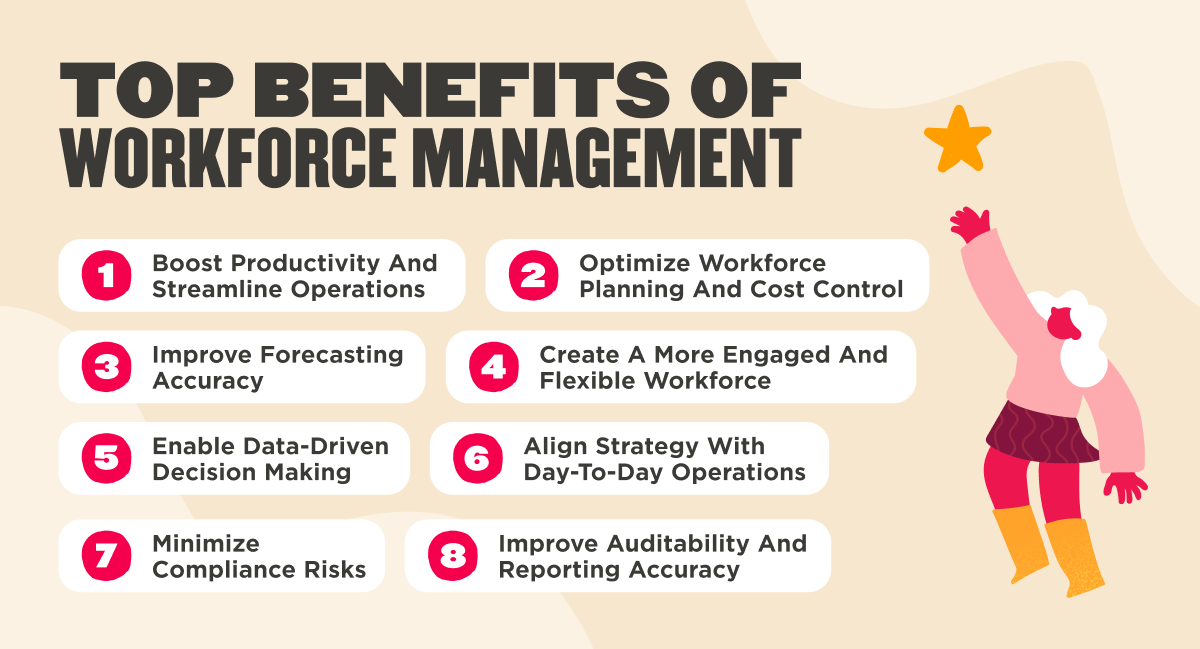
Done well, workforce management creates a compounding effect: Each improvement reinforces the next. Better scheduling reduces overtime costs. Better analytics improve forecasting. Better forecasting supports engagement. Here’s a closer look at the seven core benefits and the real-world evidence behind them.
1. Boost productivity and streamline operations
One of the most immediate benefits of workforce management is the elimination of manual, time-consuming administrative work. When HR teams and managers automate scheduling, time tracking, and task assignments, they reclaim hours every week that would otherwise go to spreadsheets and back-and-forth coordination.
Automation plays a central role here. First-year ROI from workflow automation ranges from 30-200 percent, depending on the processes automated and the implementation approach. For organizations moving from manual to automated workforce processes, the gains can be transformative—standardizing workflows, reducing errors, and freeing teams to focus on work that actually moves the business forward.
With consistent, repeatable operational processes, WFM also reduces the cognitive load on managers. Instead of firefighting daily scheduling conflicts or chasing attendance records, they can focus on leading their teams.
2. Optimize workforce planning and cost control
Labor is typically the largest line item on an organization’s budget. Without the right tools, it’s also one of the hardest to optimize. Workforce management changes that by giving leaders the data they need to balance workloads, match staffing to actual demand, and prevent the twin costs of overstaffing and burnout-driven turnover.
Smart resource allocation means assigning the right people to the right tasks at the right time instead of focusing on just filling shifts. It means identifying where overtime is creeping in unnecessarily, where part-time coverage could replace full-time gaps, and where scheduling imbalances are quietly driving disengagement.
The workforce planning process becomes significantly more effective when supported by real-time WFM data. Managers can proactively adjust headcount to align with project pipelines, seasonal surges, or unexpected demand.
As labor costs rise, companies are increasingly investing in strategies to optimize workforce spending, from data-driven scheduling to automation in repetitive tasks. WFM is the operational backbone that helps execute those strategies.
3. Improve forecasting accuracy
Demand fluctuates. Customer volumes spike, projects ramp up and down, and seasonal patterns create predictable but challenging peaks. Workforce management introduces the data infrastructure needed for accurate, forward-looking staffing decisions.
With WFM tools, teams can analyze historical patterns—foot traffic, transaction volumes, project timelines, customer service call volumes—and translate those into precise staffing plans. The result is fewer situations where teams are scrambling to cover gaps or, conversely, paying for idle time.
The ability to align schedules with labor demand predictions eliminates overstaffing, overtime, and the inefficiencies associated with understaffing—all of which negatively affect the customer experience.
Forecasting accuracy also supports longer-term workforce planning. This enables HR and operations leaders to anticipate future skill needs, recruitment timelines, and budget requirements rather than being perpetually reactive.
4. Create a more engaged and flexible workforce
Team member engagement directly impacts business performance, and workforce management plays an underappreciated role in driving it. When people have visibility into their schedules, can easily request changes, and feel they have a fair workload, they’re more likely to feel respected and less likely to leave.
Gallup’s State of the Global Workplace: 2026 Report found that team member engagement dropped to 20 percent in 2025, a decline Gallup ties to roughly $10 trillion in lost productivity worldwide. That kind of cost makes a strong case for any investment that moves the needle on engagement.
WFM supports a better employee experience by enabling the flexibility modern workers expect. FlexJobs found that 35 percent of workers say flexible working arrangements are the most important element in choosing a new job. Scheduling tools that accommodate hybrid and remote work, allow shift swaps, and surface availability in real time give people a meaningful sense of autonomy without creating chaos for managers.
For HR leaders focused on measuring employee experience, WFM data provides behavioral evidence that complements survey-based sentiment. Attendance patterns, overtime trends, and scheduling fairness metrics all tell part of the engagement story.
5. Enable data-driven decision making
Organizations that manage their workforce based on instinct and anecdote are flying blind. Workforce management systems generate a continuous stream of operational data—who’s working, on what, for how long, and with what output—that transforms decision-making at every level.
Real-time dashboards let managers respond to emerging issues immediately: a spike in absenteeism, a bottleneck in a key production area, or an imbalance in overtime distribution. Over time, that data accumulates into trend intelligence that supports strategic HR planning.
Workforce management metrics like labor utilization rates, schedule adherence, and time-to-fill become actionable levers rather than lagging indicators. Leaders can model the impact of hiring decisions, shift changes, or operational restructuring before committing, reducing costly trial-and-error.
6. Align strategy with day-to-day operations
One of the most overlooked benefits of workforce management is its ability to close the gap between high-level strategy and what actually happens on the ground. An organization’s workforce is where strategy gets executed—or doesn’t. WFM creates the connective tissue between business goals and daily operations.
When HR tech connects to the rest of the business—ERP, CRM, finance platforms—workforce data stops living in its own corner. Leaders can see how staffing levels affect customer satisfaction scores, how overtime costs eat into margin targets, or how turnover on one team slows down a product launch.
This strategic alignment is increasingly central to HR tech consulting strategy conversations. Organizations that build an ideal HR tech stack around connected workforce data can run faster and respond more confidently to change.
When workforce planning connects to business planning, HR moves from a support function to a genuine strategic partner. It’s a partner capable of modeling scenarios, informing board-level decisions, and translating people data into business outcomes.
7. Minimize compliance risks
Labor law compliance is more complex—and more consequential—than ever. In FY 2025 alone, the Department of Labor’s Wage and Hour Division recovered nearly $259 million in back wages tied to FLSA violations, representing nearly 177,000 workers who were shortchanged. Minimum wage increases, overtime regulations, scheduling ordinances, worker classification rules, and documentation requirements vary by jurisdiction. Manual compliance processes are fragile. A single error can trigger investigations, fines, and reputational damage.
Workforce management systems enforce compliance automatically. Scheduling tools flag when someone is approaching overtime thresholds. Time and attendance systems maintain audit-ready records. Alerts surface when you’re at risk of violating local scheduling ordinances like predictive scheduling rules or mandatory rest periods.
8. Improve auditability and reporting accuracy
When something goes wrong—a wage dispute, an audit request, a legal claim—organizations need to produce accurate records quickly. Manual systems create gaps: Timesheets go missing, people write schedules from memory, and payroll discrepancies take weeks to unravel. WFM systems create a permanent, searchable record of the workforce decisions that matter most.
The system records every shift, time entry, schedule change, and approval automatically. That audit trail supports not just legal defense but also internal accountability. Managers have verifiable scheduling standards. Payroll teams can reconcile hours against records in minutes. HR can report on overtime distribution, leave balances, or headcount changes with precision.
Accurate reporting also makes strategic planning more reliable. When leaders can trust the numbers, they can make faster, more confident decisions about hiring, restructuring, or investing.
For organizations operating in regulated industries or across multiple jurisdictions, the ability to generate compliant reports on demand is a business necessity. Automating workforce management through HR tech ensures that reporting infrastructure is always ready when it’s needed most.
Recommended For Further Reading
- Understanding contingent workforce management [2026]
- Hyperautomate workforce management
- How to choose workforce management software: What HR teams need to know
- The biggest workforce challenges in professional services (and why they all come down to visibility)
- Workforce management challenges in IT services companies
How workforce management benefits vary by industry
The case for workforce management is universal, but the specific advantages look different depending on where you operate. The complexity of labor challenges in manufacturing is not the same as in healthcare or retail. Understanding how WFM maps to your industry’s specific pain points helps you prioritize implementation and measure impact.
| Industry | Key challenge | WFM benefit | Business impact |
| Manufacturing | Production downtime, safety incidents, and overtime costs from poor shift coverage | Shift optimization, skills-based scheduling, and certification tracking | Fewer accidents and errors; full capacity without over-reliance on overtime |
| Retail | Misaligned staffing against foot traffic, labor cost overruns, and multi-location consistency | Demand-based forecasting, centralized scheduling, and labor law compliance tools | Higher productivity per labor dollar; fewer compliance issues as wage laws change |
| Healthcare | High turnover, burnout, credentialing complexity, and mandatory staffing ratios | Fair scheduling, credential-based assignment, and automated compliance enforcement | Improved retention; reduced risk from ratio or rest-period violations |
| Technology | Distributed teams, capacity blind spots, and unsustainable project-based overtime | Capacity planning, workload visibility, and real-time analytics across time zones | Faster headcount decisions; better alignment between people capacity and product roadmaps |
Manufacturing
In manufacturing, the stakes of poor workforce management come down to production downtime and safety incidents. Shift optimization ensures full capacity staffing without over-reliance on overtime, which drives up costs and increases the risk of accidents and errors caused by fatigued workers.
WFM supports precise resource allocation. It allows for matching skilled workers to specific machines, ensuring current certifications match shift assignments, and anticipating capacity gaps before they hit the production floor.
Retail
Retail lives and dies by scheduling efficiency. Understaffed floors during peak hours lose sales and damage customer experience. Overstaffed slow periods drain labor budgets. WFM gives retail operators the forecasting tools to align staffing with foot traffic, transaction volumes, and promotional events—down to the hour.
For multi-location retailers, consistency is a major challenge. WFM centralizes scheduling visibility across sites, enforces labor cost targets, and helps managers respond to last-minute changes without creating compliance issues. In the United States, for example, minimum wage increases took effect in several states in recent years, and more will take effect in 2026. As labor costs continue to climb, retail operators need every tool available to maximize productivity per labor dollar.
Healthcare
Healthcare workforce management is as much about patient safety as it is about operational efficiency. Inadequate staffing coverage creates direct risks. Compliance with credentialing requirements, rest period mandates, and overtime restrictions is non-negotiable.
Disengaged people in healthcare are twice as likely to leave as their highly engaged counterparts, and turnover from non-engaged team members can cost an organization an average of $25 million per year. WFM tools that improve scheduling fairness, reduce burnout, and give clinical staff more control over their schedules have a direct impact on this retention challenge. Healthcare also faces some of the most complex compliance requirements of any industry. Automated scheduling and time tracking ensure that nurse-to-patient ratios, mandatory rest requirements, and credential-based assignments happen every shift, every day.
Technology
In tech companies, workforce management is less about shift coverage and more about capacity planning and visibility into productivity. With distributed, hybrid, and remote teams spanning time zones and functions, understanding who is working on what—and whether the organization has the right skills for what’s coming next—requires strong WFM infrastructure.
WFM data helps technology leaders identify when engineering teams are overloaded, flag when project-based overtime is building to an unsustainable level, and make the case for hiring before capacity crunches become crises. For tech companies scaling rapidly, automating workforce management with real-time analytics is a competitive differentiator, enabling faster headcount decisions and better alignment between people capacity and product roadmaps.
Learn how strategic workforce management benefits your business
Managing your workforce well is one of the highest-leverage investments an organization can make. The benefits of strategic workforce management span every corner of the business—from the frontline manager trying to fill a shift, to the CFO modeling labor costs for next quarter, to the CHRO building a case for a better team member experience.
HiBob supports this work directly, with time and attendance tracking, workforce planning and scenario modeling, and real-time people analytics that connect headcount decisions to budget in one place. That means leaders aren’t choosing between speed and accuracy. They can adjust schedules, model labor costs, and spot attrition risk without stitching data together from separate systems.
<< Explore how to automate workforce management with HR tech >>