The real competitive advantage in the AI era won’t belong to companies with the most tools. It will belong to organizations that can turn the information they already have into better decisions. That’s where Organizational Intelligence comes in.
How Organizational Intelligence turns people context into better decisions
Organizational Intelligence is how HiBob uses AI-powered intelligence to turn trusted people context into better decisions, recommendations, and actions across the organization.
For years, businesses have invested in systems designed to capture more information. But leaders are still struggling to find the context they need to act. The problem isn’t a lack of data. It’s the quiet friction created when systems, teams, and organizational structures operate in isolation.
That fragmentation carries a massive price tag. Research from McKinsey links sustained business performance directly to organizational infrastructure through the systems, management practices, and culture that make success repeatable.
When this connected infrastructure is missing, employee engagement suffers. Gallup’s State of the Global Workplace 2026 shows that only 20 percent of employees worldwide are actively engaged, which costs the global economy an estimated $10 trillion in lost productivity.
Finance systems track financial performance, CRM platforms track customer pipelines, and HR platforms track workforce data. Each function may have a detailed view of its own corner of the business, but the full picture remains frustratingly out of reach.
Traditional systems of record can show leaders what happened. But when the relevant data is disconnected, leaders rarely get an explanation about why something happened or what to do next. This is the difference between a system of record and a system of impact.
Bob gives us the foundation for that shift. It provides leaders with the trusted people context they need to understand who people are, how teams are structured, how they’re performing, and how work is changing.
For Organizational Intelligence to be useful, leaders need more than workforce data. They need trusted people context: a connected understanding of people, teams, skills, performance, and organizational relationships.
HiBob MCP securely brings people context and HR actions from Bob into the AI assistants, systems, and conversations where work actually happens, with access and permissions according to what’s in Bob.
Key takeaways: Siloed data and Organizational Intelligence
- Data silos show leaders what happened, but not always why. When information sits in separate systems, it is harder to understand the context behind a result or decide what to do next.
- Trusted people context makes workforce data more useful. It helps leaders consider people, teams, skills, performance, and organizational relationships alongside relevant business information.
- Organizational Intelligence helps people use AI with better context. AI can process information faster, but people still bring judgment and accountability to interpret it fairly.
- A fuller picture helps leaders spot problems earlier. They can identify workload pressure, skills gaps, capacity constraints, and retention risks before they become harder to address.
- HiBob MCP brings people context into the flow of work. It helps people access relevant, permission-governed context in the tools and conversations where they are making decisions.
The why behind the numbers
A sudden drop in regional sales productivity, for example, might be easy to spot in a CRM. But the reasons behind the drop (skills gaps, open roles, changing capacity, or burnout) sit in separate HR systems.
The same thing happens when an organization asks a team to do more with less. A drop in output might look like a performance issue, but it can also point to a skills gap, a change in team structure, or work that has become harder to do efficiently.
In too many cases, leaders react to the numbers without fully investigating why they changed.
AI can process data faster, but it can’t fill in the gaps when data is missing.
Organizational Intelligence helps close the gap by connecting trusted people context with relevant business information. It gives people a better view of their data and the context behind it, so they can make more informed decisions about what to do next.
Bob is where the people context lives.
HiBob MCP brings it directly into the tools and conversations where people work, with the permissions and safeguards set in Bob.
The quiet tax of disconnected systems
This is where it gets practical. Leaders and managers make dozens of people decisions every day:
- Who has the capacity to take on a new project?
- Which teams will be affected by a change?
- Is a request landing at a reasonable time for colleagues across regions?
- Who needs context before a decision is communicated?
Too often, answering these basic questions means navigating between different HR, CRM, finance, collaboration, and reporting tools.
System hopping is more than a minor inconvenience. It slows decisions down, creates communication friction, and makes it harder for managers to act with confidence. It can also damage trust.
As Appspace President Holly Grogan argues in Reworked, organizations can’t claim to operate transparently when important decisions arrive without the context people need to understand them. Nor can people feel genuinely empowered when managers have to second-guess decisions because they lack immediate, relevant details.
How Organizational Intelligence helps
Organizational Intelligence helps leaders see what’s really going on in the business and with their people before they act.
A manager can look at a delivery or performance issue alongside workload, capacity, skills, role changes, and other relevant workforce context, instead of treating it like an isolated outcome.
Slackbot HCM shows what this looks like. Through HiBob MCP, Bob makes approved people data and everyday HR actions available in Slack, governed by the permissions already set in Bob.
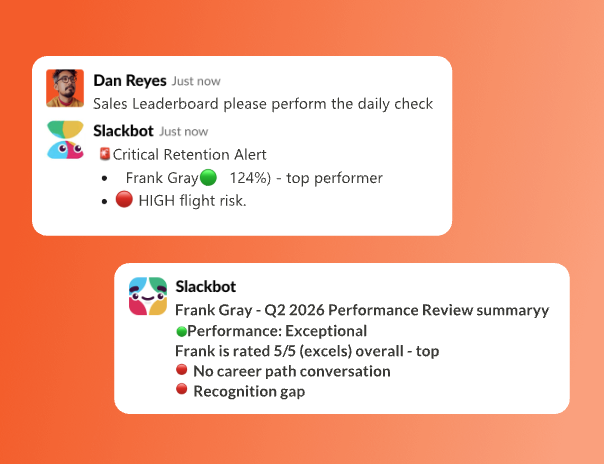
But when decisions carry real consequences, incomplete data isn’t enough. People need an approved, governed context to see the full picture.
The same risk can show up when AI informs high-stakes people decisions without the context to interpret the data fairly. A 2026 lawsuit alleged that Meta used AI tools to score and select people for layoffs using performance and activity data that didn’t account for protected medical or family leave. Meta disputed the allegations and said its workforce decisions were made by people, not AI.
Whatever the outcome of the case, the point is clear. Activity data doesn’t tell the full story of people’s contributions.
The payoff
Leaders can make faster, more confident decisions. They spend less time searching through siloed systems and more time using their judgment, communicating with more care, and reducing avoidable back-and-forth.
The blind spot behind high-performer attrition
By the time a high performer resigns, the organization usually has plenty of data about what happened: exit interview notes, engagement data, compensation history, and performance reviews.
It might not have a clear view of what led there:
- A regional sales team might be carrying an increasingly ambitious target alongside declining capacity
- A manager might be taking on new responsibilities without ample support
- A specialist might be covering a skills gap for months without anyone noticing the pressure they’ve been under
When sales targets, team capacity, feedback, goals, and workforce data all live in separate systems, it’s easy to miss patterns until it’s too late to intervene.
As Jason Averbook recently told HR Executive, traditional workforce tracking can become a rearview mirror: useful for reporting what has already happened, but less useful for understanding what capabilities the org needs or work-design challenges developing right now.
Technology analyst and researcher Mark Smith describes the alternative as a “Workforce Economics” control plane that connects operational targets with human capacity and sentiment to inform decisions about performance and cost.
How Organizational Intelligence helps
Organizations might feel blindsided when top talent leaves. But when clues are scattered across multiple systems, it’s easy to miss the warning signs.
Organizational Intelligence helps leaders spot clues before it’s too late and ask:
- Is demand rising faster than this team’s capacity?
- Are critical skills concentrated in too few people?
- Do performance signals point to burnout, unclear priorities, or an underlying structural problem?
The payoff
The conversation changes from “Why did we lose them?” to “What can we change?”
Organizational Intelligence gives leaders the trusted people context they need to take a closer look at workload, support, development, and team design. That context enables them to have more open conversations and make changes while there’s still time to make a difference.
The cost of looking externally for talent you already have
When the business needs something new, it’s easy to assume the answer lies outside the organization. But the skills you need may already be there, hidden behind job titles, outdated employee profiles, or job descriptions that no longer reflect what people actually do every day.
Research from Indeed Hiring Lab projects that the US labor force could shrink by roughly 1.2 million workers by 2040, while the mismatch between available skills and open roles will grow even harder to solve.
AI is also reshaping the work people do and the capabilities organizations need. A static job description tells you less and less about what someone can contribute today. When leaders can’t see people’s skills alongside the work the business needs to get done, it’s easy to overlook expertise that isn’t visible in someone’s current role.
That’s why a skills-based approach to talent sourcing matters. RedThread Research has explored how organizations can move beyond fixed job architectures toward more dynamic, skills-based approaches. Kyndryl’s “bill of skills” model makes existing capabilities more visible so leaders can see where their in-house talent can be developed, redeployed, or matched with emerging needs.
How Organizational Intelligence helps
Skills often hide in plain sight. Organizational Intelligence helps leaders identify people with relevant experience, adjacent skills, or room to grow before they start looking outside the organization for expertise they already have.
Bob Skills also gives leaders a clearer view of capabilities across the organization, so they can include internal talent in the conversation before an external search begins. This makes it easier to see who has relevant skills, where upskilling can close gaps, and which internal moves could support retention and business performance.

The payoff
Teams can make better decisions about whether to hire externally, develop existing talent, or move someone into a new role.
This can save time and recruiting spend, while giving people more opportunities to grow into the work the business needs done now.
The challenge of numbers-only performance reviews
The stakes aren’t always as high as a layoff decision, but the same blind spot can show up in everyday performance conversations.
Performance data matters, but metrics can’t tell the whole story of someone’s contribution.
A review might show that someone completed fewer tasks, closed fewer tickets, or missed a target. It might not show that they spent the quarter onboarding new team members, supporting a struggling teammate, navigating a major change, or taking on work beyond their official remit.
When this kind of context is missing, people can end up feeling measured rather than understood.
The answer isn’t less accountability. It’s more context. Performance conversations can still be clear and honest while being grounded in a fuller view of someone’s contributions.
The State of Utah offers a great example of putting this into practice. It moved away from annual reviews, increased the frequency of check-ins, and gave people access to their own review data. The result was a rise in participation from 16 percent to more than 88 percent.
How Organizational Intelligence helps
Organizational Intelligence can help managers look beyond single metrics. They can consider performance data alongside project outcomes, goals, peer feedback, team capacity, role history, and business priorities, then assess their people’s performance more fairly.
The payoff
With more context, managers can have better conversations about priorities, support, development, and what success looks like next. That’s not less accountability. It’s a fairer way to practice it.
Recommended For Further Reading
Make your data work together
More dashboards won’t fix a disconnected organization. The real question is whether people have the context to understand what they’re looking at and decide what their next steps are.
Bob provides the trusted people context. HiBob MCP helps bring approved people data and everyday HR actions into the MCP-compatible AI assistants and workflows where people already work, while keeping Bob’s existing permissions in place. Put simply, people can get the context they need without leaving the tools they already use.
This matters because AI can help people work through their information faster, but people still bring the judgment, accountability, and care that decisions about work need.
The organizations that get this right won’t just collect more data. They’ll make it easier for people to use the right context at the right moment to make better decisions.
FAQs about data silos and Organizational Intelligence
Data silos occur when useful information is kept in separate systems, teams, or functions and cannot be easily considered together. A CRM, finance system, and HR platform may each show part of the picture, but none explains the full story on its own.
Data silos can slow decisions because leaders have to search across systems to understand what changed and why. Without the right context, they may spend more time chasing information or act on an incomplete picture.
Organizational Intelligence is HiBob’s approach to using AI-powered intelligence to turn trusted people context into better decisions, recommendations, and actions. It brings workforce data together with relevant business information while keeping human judgment and accountability central.
HiBob MCP brings people context and everyday HR actions from Bob into MCP-compatible AI assistants, systems, and workflows. Access remains governed by the permissions set in Bob, helping people get the context they need without leaving the tools they already use.
Organizational Intelligence can help leaders spot warning signs that scattered data can hide, including rising workload, declining capacity, and skills gaps. It also helps them see relevant experience and room to grow within the organization, giving them more time to adjust workload, support development, or consider internal moves.
Performance metrics matter, but they do not capture every part of someone’s contribution. Organizational Intelligence helps managers consider metrics alongside project outcomes, goals, peer feedback, team capacity, role history, and business priorities, so they can have fairer, more informed conversations.