Over the past decade, enterprise software has become increasingly powerful—and increasingly fragmented. Every system became another destination employees had to visit to find information, complete tasks, or make decisions.
That model made sense when the primary role of software was to store information, organize workflows, and help people retrieve what they needed.
That model is changing. The next generation of SaaS will not be defined by where users log in. It will be defined by which systems can make trusted data useful at the exact moment decisions are made.
AI is accelerating that shift. But AI is only as useful as the context behind it. Business data can show what is happening. People context helps explain why it is happening and what leaders should do next.
That’s why this next chapter of our partnership with Slack matters.
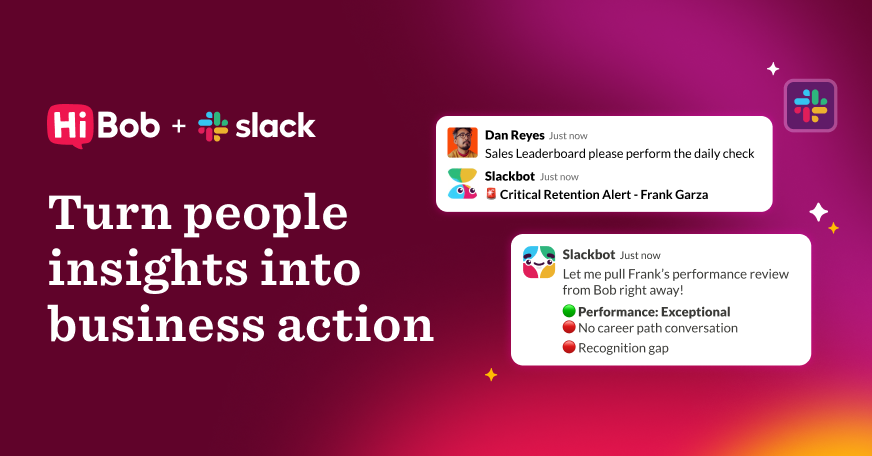
Today, we’re launching Slackbot HCM, a new native integration that brings people context from Bob directly into AI-supported workflows inside Slack. It allows employees, managers, and HR leaders to get answers and take action without leaving the flow of work.
This launch is also part of a broader open platform direction for HiBob. Through capabilities like HiBob MCP, Bob can securely connect people intelligence to the AI agents, assistants, and business systems organizations already use.
But the bigger story is not the integration itself. It is what this launch signals about where work, SaaS, and enterprise AI are headed.
AI is only as smart as its context
AI can summarize meetings, draft messages, analyze forecasts, identify risks, and surface patterns across business systems. But without trusted people context, it cannot fully understand how work actually gets done inside a company.
Business data tells AI what is happening, while people data helps AI understand the human context behind it.
An AI system may know a team missed its target. What it may not understand is whether the team recently experienced attrition, whether the manager is overloaded, whether several employees are new to the organization, or whether important development conversations have not happened in months. Without that context, even the most advanced AI can produce recommendations that are technically accurate but disconnected from how organizations actually work.
This is the gap HCM needs to fill.
That’s where, for example, the org chart becomes much more than a hierarchy. It reflects how work actually moves through an organization: how teams connect, where influence sits, and where friction may be building beneath the surface. It helps explain why one manager may be struggling, why a team may be disconnected, or why certain employees may be overdue for recognition and growth opportunities.
In an AI-powered workplace, people intelligence becomes as important as financial intelligence. Leaders need visibility into how people, teams, and organizations are performing with the same level of confidence they expect from revenue dashboards and operational metrics.
This is why the next generation of HCM platforms will do more than manage HR tasks and records. They will help enterprise AI understand the workforce behind the business.
Business performance already lives in systems like Salesforce, where leaders can see pipeline, revenue, and customer signals with increasing clarity. Now, organizations will expect the same visibility into people performance from their HCM, like Bob.
That connection between the business context from Salesforce and the people context from Bob enables organizations to make faster, smarter, and more human decisions.
What trusted context looks like in practice
Imagine a sales leader reviewing quarterly performance data from Salesforce inside Slack.
One of the company’s top-performing reps has just closed a major deal. The Salesforce data looks strong: quota exceeded, high delivery rates, and strong performance across the quarter.
Then the manager asks Slackbot HCM for additional context from Bob.
Because that manager already has the right permissions in Bob, Slackbot HCM can surface the people signals they are allowed to see: no promotion in two years, compensation below market median, and delayed development conversations. For someone without that visibility in Bob, those details would not appear in Slack.
That distinction matters. Slack is not exposing new people data. Bob is bringing approved, permission-based context into Slack for the people who are already authorized to access it.
The business data surfaces the performance signal. Bob helps explain the workforce risk.
The manager schedules a one-on-one conversation directly inside Slack, and Bob recommends a mentor. The intervention happens before the employee walks out the door.
Each system contributes what it knows best: Salesforce shows performance, Slack supports collaboration, and Bob adds workforce insight governed by the permissions already defined in Bob.
This is not about replacing managers with AI. It is about helping managers act faster and more thoughtfully with the context they are already trusted to use.
The same principle applies across everyday work:
- Employees checking their own leave balances
- Managers accessing team insights they have permission to view
- HR teams automating onboarding workflows across departments
- Leaders connecting workforce dynamics with operational performance
Together, these examples point to the same shift: people intelligence should be available at the point of action, without creating new risk or moving sensitive data outside the controls that protect it.
Building for an open AI ecosystem
Enterprise AI is moving beyond single applications. The question is no longer whether a system has AI, but whether its data can safely reach where decisions happen. Slackbot HCM brings people intelligence into Slack, where work already happens. HiBob MCP extends that reach across the broader AI ecosystem.
With HiBob MCP, Bob can securely make approved people data and HR actions available to MCP-compatible AI agents and assistants. Organizations can retrieve employee context or complete everyday HR actions through natural language, with access governed by Bob’s existing permissions.
For HiBob, that is what openness means: not less control, but a secure, permission-based foundation for bringing people intelligence into more decisions.
Recommended For Further Reading
What enterprise AI needs next
The shift toward AI-supported work is already underway. AI is becoming part of how leaders evaluate performance, plan teams, identify risks, and support employees. But its value will depend less on how many AI features sit inside each application and more on whether those features can draw on the right organizational intelligence.
For AI to be useful in business, it needs to understand more than transactions, workflows, and outputs. It needs to understand how teams are built, how managers support their people, where growth is happening, where risk is emerging, and how workforce dynamics affect business performance.
That changes what organizations should expect from their technology platforms. The most valuable systems will not simply store data or automate tasks. They will help the business act on trusted intelligence in ways that support better decisions and stronger employee experiences.
I believe people intelligence will become one of the defining foundations of enterprise AI.
The organizations that succeed in this next era will not be the ones with the most AI features. They will be the ones that connect technology, people, and work in ways that help leaders act with more clarity and help employees do their best work.
That is where HiBob is headed. Our partnership with Slack, together with HiBob MCP and our broader open platform approach, is one step toward a future where people intelligence is not locked inside HR systems. It becomes part of how the business understands itself and takes action.
Because the future of work is not about putting AI at the center of the organization. It is about giving people the insight they need to make better, more human decisions.
Key takeaways
- The future of SaaS is moving from destinations to decision points: Employees increasingly expect information, actions, and insights to surface inside the tools they already use.
- AI needs people context to create meaningful impact: Business data can explain what is happening. People intelligence helps organizations understand the human dynamics behind it.
- Slackbot HCM brings Bob into everyday collaboration: HiBob’s expanded partnership with Slack helps managers, employees, and HR leaders access people insights and take action inside Slack.
- HiBob MCP extends this vision across the AI ecosystem: Bob can securely make approved people data and HR actions available to MCP-compatible AI agents and assistants.
- Openness must be built on trust and governance: Secure, permission-based access is essential when AI connects to sensitive people data.
- Managers remain central in an AI-powered workplace: AI can surface insights and recommendations, but human judgment, empathy, and meaningful conversations still matter.
- People intelligence is becoming foundational infrastructure: The next generation of organizations will connect technology, people, and workflows to operate more intelligently and more humanely.