
A bereavement leave policy defines who is eligible for time off after losing a loved one, how to request it, how many paid or unpaid days they can get, and what other support people can access.
No one wants to receive news from a team member that they’ve lost a parent, partner, or child, but the day will come. Companies that prepare well for this moment can make a big difference in their people’s lives by offering clear, compassionate support. Without a bereavement leave policy in place, HR ends up making decisions about pay, timing, and eligibility in the middle of someone else’s worst week, and that can often lead to inconsistencies from one case to the next.
A bereavement leave policy is one of the more values-revealing documents within a company. 95 percent of workers in North America and the United Kingdom place high value on bereavement benefits, yet many organizations still handle each loss case by case instead of putting a policy in writing. That gap between what people need and what companies formalize is exactly what a clear bereavement leave policy closes.
Here you’ll find a free, ready-to-use bereavement leave policy template you can download and adapt. This article covers state law requirements, sample policy language, and real company examples for building or refreshing your own bereavement leave of absence policy. Whether you’re writing a bereavement leave policy from scratch or updating one that’s not quite up to speed with how a multi-state or global workforce actually experiences loss, the template below gives you a starting point.
<< Download the free bereavement leave policy template >>
Key insights
- A bereavement leave policy should define eligibility, covered relationships, leave duration, pay, and return-to-work support in a single document
- There is no federal requirement for bereavement leave in the US, but California, Oregon, and Illinois mandate specific minimums
- Many companies offer three to seven paid workdays of bereavement leave for immediate family
- Modern policies increasingly cover the loss of pregnancies, chosen family, and pet bereavement to reflect how people actually experience grief beyond traditional family roles
- HR teams building a policy for a multi-state workforce get the best results by defaulting to the most generous state requirement rather than managing separate minimums by location
What is a bereavement leave policy?
A bereavement leave policy is a written HR policy that spells out how much time off people can take, whether that time is paid, and what support is available when someone experiences the death of a family member, partner, friend, or other significant person. It sits alongside other leave of absence types in an employee handbook, but it deserves its own dedicated policy because grief timelines, family definitions, and pay expectations vary widely.
In the US, “bereavement leave” is the standard term. In the UK and Australia, employers more commonly call this benefit “compassionate leave,” and most HR contexts use the two terms interchangeably. Some organizations draw a finer distinction: Bereavement leave applies specifically to a death, while compassionate leave covers a broader range of personal crises. This can include caring for a family member with a serious illness or supporting a partner through a sudden medical emergency.
If your organization operates across regions, define both terms in your policy so people know exactly what applies to their situation. Consider using “compassionate leave” as the umbrella term if your handbook already covers non-death events under that heading.
Why organizations should create a written policy
A written bereavement leave policy goes a long way toward supporting your people during their darkest moments. Here are a few reasons to draft one:
- Reduces confusion during an already stressful time by giving people a clear answer instead of a manager’s best guess
- Ensures consistent treatment across teams and locations, so leave decisions don’t depend on who someone happens to report to
- Helps HR stay compliant with state and local laws that set minimum bereavement leave requirements
- Signals that the company values team member wellbeing, which shows up in better retention: More than 80 percent of employees say more supportive benefits would make them more likely to stay with their organization
Free bereavement leave policy template
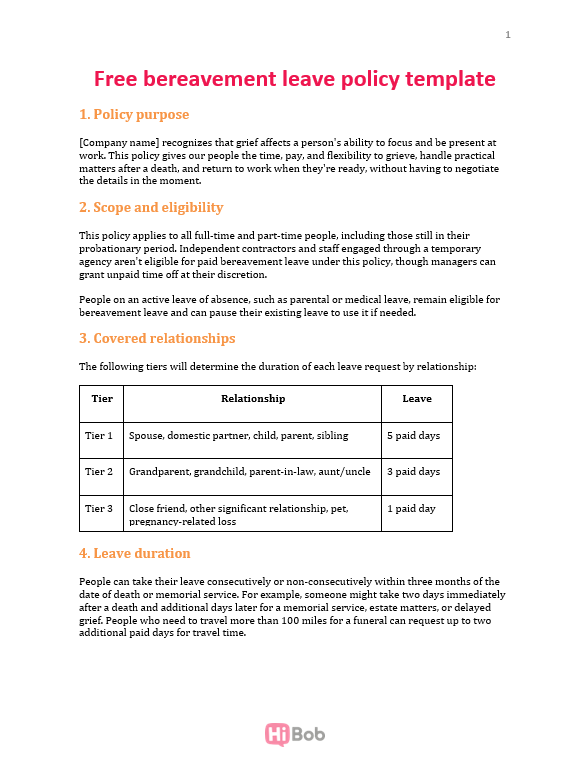
This is a sample template. Treat it as a starting point: Adapt the day counts, pay terms, and covered relationships to your company’s size, budget, and the state or country laws that apply to your workforce.
1. Policy purpose
[Company name] recognizes that grief affects a person’s ability to focus and be present at work. This policy gives our people the time, pay, and flexibility to grieve, handle practical matters after a death, and return to work when they’re ready, without having to negotiate the details in the moment.
2. Scope and eligibility
This policy applies to all full-time and part-time people, including those still in their probationary period. Independent contractors and staff engaged through a temporary agency aren’t eligible for paid bereavement leave under this policy, though managers can grant unpaid time off at their discretion.
People on an active leave of absence, such as parental or medical leave, remain eligible for bereavement leave and can pause their existing leave to use it if needed.
3. Covered relationships
The following tiers will determine the duration of each leave request by relationship:
| Tier | Relationship | Leave |
| Tier 1 | Spouse, domestic partner, child, parent, sibling | 5 paid days |
| Tier 2 | Grandparent, grandchild, parent-in-law, aunt/uncle | 3 paid days |
| Tier 3 | Close friend, other significant relationship, pet, pregnancy-related loss | 1 paid day |
4. Leave duration
People can take their leave consecutively or non-consecutively within three months of the date of death or memorial service. For example, someone might take two days immediately after a death and additional days later for a memorial service, estate matters, or delayed grief. People who need to travel more than 100 miles for a funeral can request up to two additional paid days for travel time.
5. Pay during leave
Leave under Tier 1 and Tier 2 is paid at the person’s regular rate. Tier 3 leave is unpaid unless a manager approves paid time off or discretionary paid leave. Bereavement pay doesn’t count toward overtime calculations.
6. Notification process
People notify their manager and HR as soon as reasonably possible, ideally before the leave starts or on the first day of absence. Managers acknowledge the request within one business day and loop in HR to confirm dates and pay.
7. Documentation
[Company name] doesn’t require a death certificate to approve bereavement leave. HR may ask for a copy of an obituary, a funeral program, or a brief written statement confirming the relationship and date of death.
8. Counseling and support resources
People and their household members can access free counseling sessions through the company’s employee assistance program (EAP). HR can also provide referrals to grief support groups and temporarily adjust workload or deadlines on request. Managers should not expect a person to disclose details about their loss to receive this support; a request for flexibility is enough.
9. Interaction with other leave types
Bereavement leave runs separately from a person’s paid time off (PTO) bank, though people can use PTO once bereavement days run out. It’s distinct from other types of time away from work, including unpaid leave, time in lieu, and garden leave.
10. Signature
[Company name] reviews this policy annually and reserves the right to update it.
I have read and understand this bereavement leave policy.
Signature: _________________________ Date: _____________
What to include in a modern bereavement leave policy
A modern bereavement leave policy clearly defines who qualifies, what situations it covers, how much time people can take, and what support they can expect before, during, and after their leave.
1. Eligibility criteria
Decide upfront whether full-time, part-time, and probationary people qualify for the same leave, and whether you provide it for contractors at all. Most companies extend full bereavement benefits to full-time and part-time people from day one and handle contractors separately through their engagement terms.
If your company operates in a state with its own bereavement leave law, check the eligibility thresholds closely. Some laws only apply once a business reaches a minimum headcount, and others require a minimum number of hours worked before a person qualifies.
Two ways to word it:
- Day-one eligibility (most common): “All full-time and part-time team members are eligible for bereavement leave from their first day. Contractors and temporary staff are not eligible for paid bereavement leave under this policy.”
- Waiting period (where budget or headcount is tight): “Team members become eligible for paid bereavement leave after 90 days of continuous service. Before that, they can take up to five unpaid days with manager approval.”
If you have people in Illinois, check your wording against the Family Bereavement Leave Act thresholds first: it applies at 50 or more people on staff and requires 1,250 hours worked in the prior year.
2. Covered relationships and leave tiers
A tiered structure is the clearest way to define who counts as family. Here’s where many companies land at each tier, and the decision each one asks you to make:
| Tier | Who it usually covers | Common market range | The call you’re making |
| Tier 1: Immediate family | Spouse or domestic partner, child, parent, sibling | 3–5 paid days | Whether to sit at the top of the range to stay competitive on benefits |
| Tier 2: Extended family | Grandparent, grandchild, in-law, aunt or uncle | 1–3 paid days | Which relationships belong here instead of Tier 1 for your workforce |
| Tier 3: Significant relationships | Close friend, chosen family, pet, pregnancy-related loss | 1–2 days, often discretionary | Whether days off for these relationships are paid, and who signs off |
Modern policies expand beyond legal and biological definitions of family to include chosen family, domestic partners, and close friends. This better reflects how many people actually structure their support systems.
It’s worth naming pregnancy-related loss (miscarriage, stillbirth, a failed IVF transfer) as a covered event rather than leaving people to describe it under a generic “personal leave” category. Pet bereavement is a growing addition as more people consider pets part of their families.
If your workforce spans multiple cultures, ask people what “immediate family” means to them before finalizing your tiers. Multigenerational households are the norm in many cultures, so a grandparent who helped raise someone belongs in Tier 1, not Tier 2. The same goes for in-laws, cousins, and godparents in close-knit families.
One practical option: Keep the tiers as written, then add a line allowing people to request a tier reassignment for a specific relationship. HR approves it without asking anyone to explain their family structure.
3. Duration and flexibility
Decide whether leave has to be taken consecutively or if it can be spread out. California requires that bereavement leave be available on a non-consecutive basis within three months of the death. This is a practical standard even for companies outside the state, since people often need time weeks later for estate matters or a delayed memorial.
Oregon takes a different approach, allowing up to two weeks per family member and up to four weeks total in a leave year. This gives people room to handle a death that involves travel, extended family responsibilities, or multiple losses close together.
Consider offering an unpaid or PTO bridge once paid bereavement days run out, and add one to two extra paid days for people traveling to an out-of-area funeral. Many companies offer three to seven paid workdays of bereavement leave for immediate family, which is a reasonable benchmark if you’re setting a baseline from scratch.
Two ways to word it:
- Fixed window (mirrors California law): “Bereavement leave can be taken consecutively or non-consecutively, as long as the team member uses all of that leave within three months of the date of death.”
- Open window (better for global teams and delayed memorials): “Bereavement leave can be taken consecutively or non-consecutively within 12 months of the date of death. Team members traveling more than 100 miles for a funeral can request up to two additional paid travel days.”
4. Notification and documentation requirements
Define how and when people should tell their manager and HR, and keep the process light. The modern trend is moving away from requiring a death certificate, which can take time—up to weeks—to procure. An obituary, funeral program, or simple self-attestation is enough for most companies, and it avoids putting people in the position of hunting down paperwork while grieving.
Two ways to word it:
- Self-attestation (lightest touch): “Team members confirm the relationship and date of death in writing to HR. They’re not required submit any other documentation.”
- Light documentation: “HR can request an obituary, funeral program, or brief written statement. They will never require a death certificate.”
Either way, put the choice in writing. The point is that nobody has to ask what proof they owe you while planning a funeral.
5. Return-to-work process and support
Build in flexible return options: a phased return, temporary remote work, or an adjusted schedule for the first week or two back. Point people toward your EAP and any grief counseling benefits.
Give managers simple guidance for check-ins, such as asking directly what workload adjustments would help rather than assuming someone is ready to pick up where they left off. A short private conversation before someone’s first day back, covering what colleagues know and the status of current projects, lowers the mental load and maintains some privacy on a person’s first day back.
Bereavement leave policy examples
Most companies land in one of three general approaches, depending on budget, headcount, and how competitive their benefits need to be to attract talent.
| Policy type | Typical duration | Best for |
| Standard | 3–5 paid days, immediate family only | Small and mid-size companies setting a compliant baseline |
| Flexible | Non-consecutive days, expanded relationship tiers, pregnancy loss and pet bereavement included | Companies competing for talent on benefits |
| Extended | 2–4+ weeks paid, broad family definitions | Large employers with more budget flexibility |
1. Standard bereavement leave policy
A standard policy offers three to five paid days for the death of an immediate family member and little to no coverage beyond that. It’s the most common approach among small and mid-size employers, and it aligns closely with the three-to-seven-day benchmark SHRM cites as typical across U.S. companies.
2. Flexible bereavement leave policy
A flexible policy keeps the day count similar to a standard policy but removes rules about timing and relationships. Pinterest offers four weeks of paid leave to parents who experience pregnancy loss. Rover offers several days of paid leave when a person’s pet dies, recognizing that grief arises from many kinds of loss—not just human ones.
3. Extended leave policy
An extended policy offers several weeks of paid leave, usually reserved for larger employers with more budget flexibility. Johnson & Johnson increased its bereavement leave from five to 30 business days for the loss of an immediate family member, and Goldman Sachs added 20 days of paid leave for a miscarriage or stillbirth affecting an employee, spouse, or surrogate.
Recommended For Further Reading
Manage bereavement leave for global teams
Bereavement norms vary considerably by country, which makes a single global policy risky if it isn’t built with local law in mind. In the UK, parents are entitled to statutory parental bereavement leave (known as Jack’s Law) if a child under 18 dies. The Employment Rights Act 2025 will extend a new statutory right to at least one week of unpaid bereavement leave to all employees starting in 2027, regardless of relationship or length of service. Requirements across the world vary just as widely: Some countries mandate paid compassionate leave by law, while others leave it entirely to employer discretion.
For HR teams managing bereavement leave across borders, the practical answer is building one policy framework with country-specific addenda rather than separate policies for every location. HR software like HiBob that tracks eligibility rules, leave balances, and local compliance requirements by country takes the manual tracking out of that process. This matters when a policy has to account for both a five-day California minimum and a one-week UK statutory right in the same handbook.
Consistency is key: A person in your Sydney office and someone in your Chicago office should get a comparable experience of support even if the legal minimum behind each one looks different. Pairing bereavement leave with the rest of your employee benefits package helps people see it as part of a coherent whole rather than a standalone perk buried in a regional addendum.
Bereavement leave template FAQs
What is a good bereavement leave policy?
A good bereavement leave policy is specific enough that people don’t have to guess what applies to them, and generous enough to keep them financially solvent as they grieve. At a minimum, that means:
- Clear eligibility rules
- A tiered definition of covered relationships that includes more than immediate legal family
- Paid leave of at least three to five days
- A light-touch documentation process
- A plan for how someone transitions back to work
Ultimately, a strong bereavement leave policy gives people the clarity, time, and support they need to grieve without adding unnecessary job-related stress.
What does HR need for bereavement leave?
HR needs a written policy that covers eligibility, covered relationships, leave duration, pay, notification steps, documentation requirements, and return-to-work support. HR team members benefit from a clear understanding of the bereavement leave laws in every state or country where the company has people. Beyond the policy itself, HR can keep a simple process for managers to follow and a system for tracking leave balances for consistency.
Is bereavement leave paid?
There’s no federal law in the US requiring paid bereavement leave, so it comes down to company policy. Most employers that offer bereavement leave provide three to five paid days for immediate family, but a handful of states set their own minimums. Because there’s no federal paid leave mandate, paid bereavement leave has become an increasingly competitive benefit that companies use to stand out.
Are there any restrictions on who qualifies for bereavement leave?
Most policies restrict paid bereavement leave to full-time and part-time people, sometimes with a short waiting period before probationary staff qualify, and typically exclude contractors and temporary staff from paid leave entirely. Some state laws add their own restrictions: Illinois, for example, requires employers to have at least 50 people on staff and requires the person requesting leave to have worked 1,250 hours in the prior year before the Family Bereavement Leave Act applies.
Does bereavement leave have to be consecutive days?
Not necessarily. Many company policies and some state laws allow bereavement leave to be taken non-consecutively, usually within a window of a few months from the date of death. That flexibility matters because grief and its practical fallout don’t end after the funeral. People often need additional time weeks later to handle estate matters, travel for a delayed memorial, or simply cope with a wave of grief that shows up later than expected.