
Bereavement leave is one line in a broader benefits package, but how you handle it when someone actually needs it says a lot about what your company values. Ninety-one percent of United States employers offer paid bereavement leave, and more than a third of those now extend it to loss from a failed pregnancy, surrogacy, or adoption, according to SHRM’s 2024 Employee Benefits Survey. But offering leave and having a clear policy aren’t the same thing. That gap matters most on the day a team member calls to say a parent has died and needs to know how many days they can take and whether they’ll get paid.
A clear bereavement leave policy answers those questions before grief does. In this guide, we’ll cover what bereavement leave includes, how many days is typical, which states require it, and how to write a policy that holds up under both compliance and compassion.
<< Download the free bereavement leave policy template >>
Key insights
- No federal law requires bereavement leave, and FMLA doesn’t cover grief on its own unless it triggers a diagnosed health condition
- Six states (California, Illinois, Maryland, Oregon, Vermont, and Washington) mandate some form of bereavement leave; Colorado and Minnesota let people use existing paid sick leave for it instead
- Most companies offer three to five days for immediate family and one to three days for extended family, though some offer up to two weeks
- 91 percent of employers pay for at least part of bereavement leave, but full pay for the entire period isn’t guaranteed everywhere
- A strong policy defines qualifying relationships, sets pay and notice expectations clearly, and coordinates with PTO, FMLA, and other leave types
What is bereavement leave?
Bereavement leave gives people time away from work to grieve, arrange a funeral, or settle a loved one’s affairs without also managing their day-to-day work responsibilities. It’s one specific type of leave of absence, a broader category that also covers medical leave, sabbaticals, and military service.
Most policies define bereavement leave narrowly: a short, set stretch of days tied to the death of a family member or someone close to the person taking leave. Some companies call it compassionate leave, grief leave, or funeral leave instead, though the terms aren’t always interchangeable.
Is bereavement leave required by law?
In the United States, whether someone gets bereavement leave often depends entirely on where they work and what their employer decides to offer. There’s no blanket national requirement, and state rules vary widely in who’s covered, how many days apply, and whether time off has to be paid.
Federal law and bereavement leave
No federal law requires U.S. employers to provide bereavement leave, whether paid or unpaid. The Family and Medical Leave Act (FMLA) doesn’t cover grief on its own: It grants up to 12 weeks of unpaid, job-protected leave, but only for a serious health condition, the birth or adoption of a child, or qualifying military duty (or a family member’s deployment).
Grief can qualify indirectly. If bereavement triggers a diagnosed health condition, such as depression, that a doctor documents, an eligible person may be able to use FMLA leave to recover. Otherwise, bereavement leave is a matter of employer policy or state law (when applicable).
States with bereavement leave laws
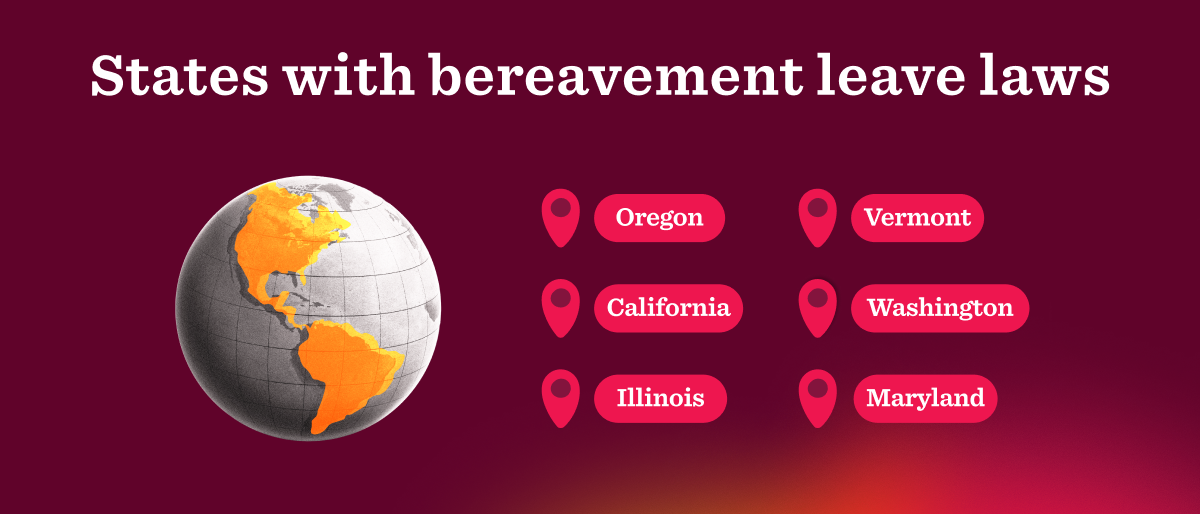
As of 2026, six states require some form of bereavement leave, and two more give people the right to use existing paid sick leave for it:
- California: Employers with five or more people must provide up to five days of unpaid, job-protected bereavement leave to anyone who has worked at least 30 days, covering a spouse, domestic partner, child, parent, sibling, grandparent, grandchild, or parent-in-law.
- Illinois: The Family Bereavement Leave Act requires unpaid, job-protected leave for employers generally subject to FMLA, extending beyond the death of a relative to pregnancy loss, a failed adoption, or a failed surrogacy.
- Maryland: Under the Maryland Flexible Leave Act (15 or more employees), people can apply existing accrued paid leave, such as sick or vacation time, to bereavement. The law doesn’t create a new leave bank: if an employer doesn’t already offer paid leave, it isn’t required to add any.
- Oregon: Under the Oregon Family Leave Act, employers with 25 or more people must provide up to two weeks of unpaid, job-protected leave per family member’s death, capped at four weeks a year and used within 60 days of the death.
- Vermont: Employers with 10 or more people must provide up to two weeks (10 workdays, no more than 5 consecutive) of unpaid, job-protected bereavement leave for the death of a family member or to settle an estate, taken within a year of the death. It covers a broad family definition, including domestic partners and step, foster, and in loco parentis relationships.
- Washington: WAC 357-31-250 gives Washington’s own state government (civil service) employees five days of paid bereavement leave for the death of a family or household member, or loss of pregnancy, effective July 2025, plus the option to layer on other accrued paid leave. There’s no equivalent mandate for private employers in Washington; private-sector people generally rely on the state’s paid sick leave law, which allows sick leave to be used for a family member’s death but isn’t a dedicated bereavement statute.
Colorado and Minnesota don’t have standalone bereavement statutes, but both let people apply state-mandated paid sick leave to bereavement needs.
Requirements change often, so confirm current thresholds with legal counsel before finalizing a policy, especially for companies with people in more than one state.
How many days of bereavement leave is normal?
Outside the handful of states with legal minimums, most companies set their own duration, often based on how close the relationship was to the person who died.
Immediate family
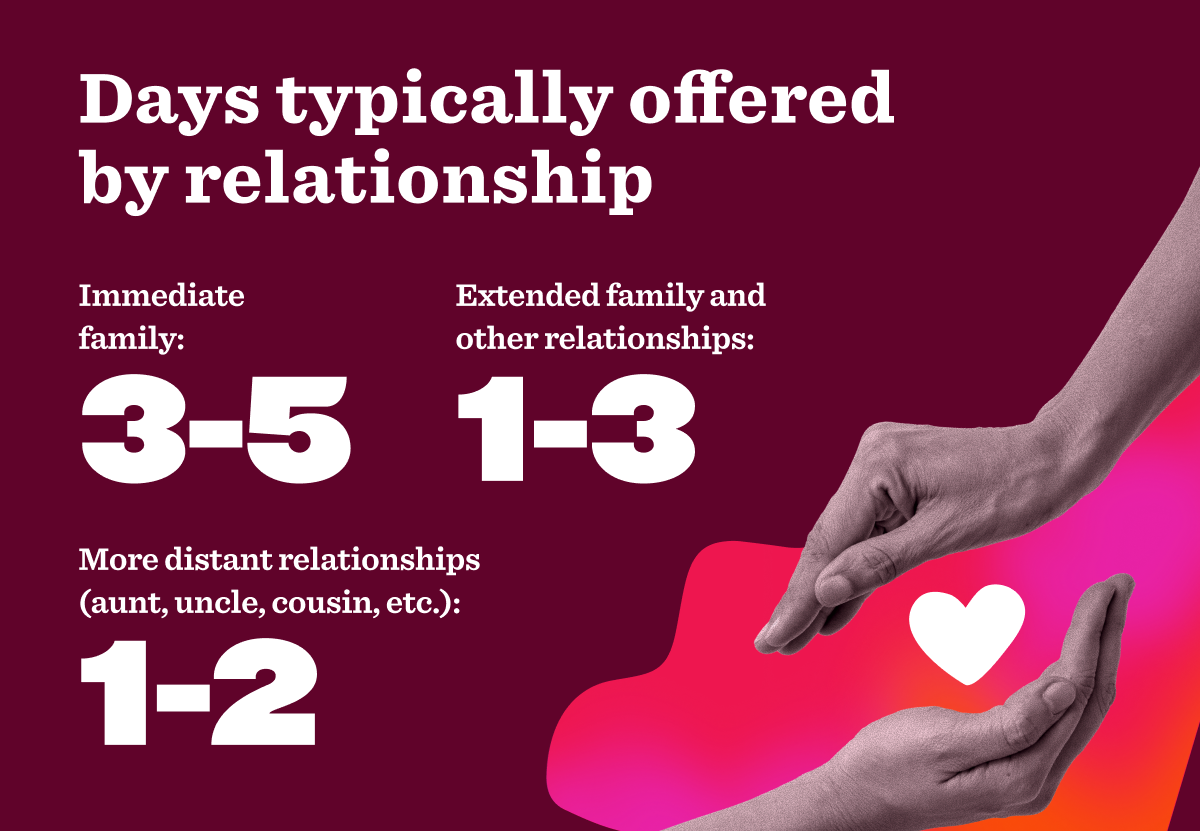
For an immediate family member, such as a spouse, domestic partner, child, or parent, three to five days is the norm. Some companies offer a full week for the death of a spouse or child, recognizing that travel, funeral planning, and estate matters take longer than a few days to manage. A smaller number offer flexible bereavement leave, letting people spread the allotment across several weeks to handle memorial services, paperwork, or a gradual return to a full workload.
Extended family and other relationships
For a grandparent, grandchild, sibling, or in-law, one to three days is typical. More distant relationships, such as an aunt, uncle, cousin, or other close relationships, often get a day or two, if they’re covered at all.
Is bereavement leave paid or unpaid?
Although bereavement leave isn’t legally required in the US, the vast majority of employers offer some form of it because 94 percent of grieving workers report difficulty concentrating at work after their loss when their company has no effective bereavement leave policy.
Some employers do offer paid bereavement leave, but “paid” doesn’t always mean fully paid or unlimited. Common approaches include:
- Fully paid, for a set number of days, at the person’s regular rate
- Paid up to a cap, with additional days unpaid or drawn from PTO
- Unpaid by default, with the option to apply accrued PTO or sick leave
- A blend, such as paid time for immediate family and unpaid time for extended relationships
Where state law mandates bereavement leave, the leave itself is often unpaid (Oregon and Illinois, for example), though people can typically apply their own accrued paid leave to cover it. If your company already has a strong paid time off (PTO) policy, decide clearly whether bereavement leave draws from that same bank or sits separately. Mixing the two without a clear rule creates confusion right when people can least handle it.
What should a bereavement leave policy include?
A good policy answers the practical questions before someone needs to ask them, covering four things.
Defining qualifying relationships
List the relationships covered, such as spouse, domestic partner, child, parent, sibling, grandparent, and in-laws, and decide early whether the list is fixed or flexible. A rigid list can exclude chosen family or non-traditional relationships that matter just as much to the person grieving (some companies may include the loss of a pet in their bereavement leave policies, for example). Consider adding a broader category, such as “a person the team member considers family,” and default to approving it on the person’s word. That keeps managers from having to weigh evidence, and it keeps grieving people from having to make a case during one of the hardest weeks of their life.
Paid vs. unpaid time, and how much
State clearly how many days are available, whether pay continues, and whether the amount varies by relationship. If leave is unpaid past a certain point, say so plainly, and explain how it interacts with PTO, sick leave, or short-term disability, where those options apply. Build in flexibility for circumstances that don’t fit a standard timeline, such as a funeral scheduled weeks after a death, a service overseas, or ongoing estate matters.
Notice, documentation, and proof of loss
Explain how people notify their manager or HR and how much advance notice is realistic given that bereavement is usually unplanned. Keep documentation requests light: a death certificate, obituary, or funeral program is standard, but ask only when necessary, and never as a condition of taking the leave itself. Some companies request documentation only for extended leave or relationships outside the immediate family, treating close-family losses as self-evident.
Coordinating with FMLA, PTO, and other leave types
Bereavement leave rarely operates alone. Clarify whether it runs alongside other leave types or only after they’re exhausted, and note the case where grief triggers a diagnosed health condition that could qualify for FMLA leave separately. If your company offers extended leave for major life events, point bereavement leave back to those policies rather than duplicating them.
<< Download the free bereavement leave policy template >>
Bereavement leave vs. other types of leave
Bereavement leave is one entry among many types of leave of absence, and the differences matter when people, and HR, are deciding what applies.
| Leave type | Paid? | Legally required? | Typical duration | When it’s used |
|---|---|---|---|---|
| Bereavement leave | Often, but varies by employer and state | Only in a handful of states | One to five days, sometimes up to two weeks | Death of a family member or someone close to the person |
| Leave of absence | Depends on the type and company policy | Yes, for FMLA-qualifying reasons | Days to several months | Extended absence for medical, family, or personal reasons |
| Time in lieu | Yes, exchanged for hours already worked | No | Hours to days | Compensating extra hours worked with time off instead of pay |
| Unpaid leave | No | Sometimes, such as under FMLA | Varies widely | When paid leave is unavailable or exhausted |
| Garden leave | Yes, typically full pay | No | Weeks to months | Keeping a departing employee away from work and competitors during a notice period |
How HR can support team members through grief and loss
Policy sets the stage, but how a manager shows up during someone’s worst week is what truly makes a difference. Here are a few practical ways HR can help managers get this right:
- Give managers a simple script for the first conversation. Express condolences briefly, confirm the leave and pay details, and ask what support would help.
- Remind them to take logistics off the team members’ plate. Loop in the team, reassign urgent work, and set an out-of-office message so the grieving person isn’t coordinating their own coverage.
- Encourage them to build in a soft landing for the return. A short check-in on the first day back, and permission to ease into a full workload, matters more than people expect.
- Watch for grief that doesn’t resolve on the policy’s timeline. Point people toward an employee assistance program (EAP) or extended unpaid leave if a few days isn’t enough.
- Train managers. Remind them to treat every loss with equal seriousness, regardless of the relationship named in the policy. A formal definition can’t define what someone needs after a miscarriage or the loss of a pet that functioned as family.
This is where a company’s culture can shine—supporting their people rather than simply aiming for compliance.
Managing bereavement leave requests with HR software
Bereavement often arrives without warning: mid-sprint, mid-quarter, or sometimes mid-meeting. HR software won’t soften the loss, but it can remove friction from the request itself: approving the leave, notifying the manager, and calculating pay against whatever mix of bereavement days and PTO applies.
With a leave and attendance system that lets you track time off in one place, a bereavement leave request follows the same clear approval flow as every other leave type, so nobody has to explain their situation twice while arranging a funeral.
With HiBob, HR can build a dedicated bereavement leave policy (with its own rules by location, department, or team) alongside PTO and sick leave, so the team member can learn the correct amount of paid and unpaid time automatically instead of waiting for HR to calculate it by hand. People can also ask Bob’s Time Off Agent how many bereavement days they have left or how to submit the request, rather than tracking someone down in HR during an already hard week.
<< Learn more about how HiBob can help >>
Recommended For Further Reading
Build a bereavement leave policy your people can rely on
A policy only helps if people can find it, understand it, and trust that it applies the same way to everyone. Too vague, and managers improvise inconsistently. Too rigid, and it fails the exact situations people need it for most.
Use our free bereavement leave policy template as a starting point. It covers qualifying relationships, paid and unpaid time, notice and documentation, and how bereavement leave coordinates with PTO and FMLA, so you can adapt it to your own structure rather than build one from a blank page.
<< Download the free bereavement leave policy template >>
Bereavement leave FAQs
What’s the difference between bereavement leave and compassionate leave?
The terms are often used interchangeably, but some companies draw a distinction. Bereavement leave typically applies specifically to a death, while compassionate leave sometimes covers a wider range of situations, such as caring for a seriously ill family member or supporting a partner through a miscarriage. Check how your company defines each term, since the difference determines who qualifies.
How many days of bereavement leave do you get for a parent, sibling, or grandparent?
There’s no universal number. For a parent, most companies offer three to five days; for a sibling or grandparent, two to three days is typical. State law adds a minimum or maximum in a handful of places: California requires up to five days for a defined list of relationships, while Oregon allows up to two weeks per relative under the Oregon Family Leave Act.
Do part-time and contract employees get bereavement leave?
It depends on the company and, in states with bereavement leave laws, on the eligibility rules in the statute. California’s law, for example, applies to anyone who has worked at least 30 days, regardless of full-time or part-time status. Independent contractors generally fall outside bereavement leave laws, since those laws apply specifically to employment relationships. Many companies extend at least unpaid bereavement leave to part-time team members even where it isn’t required.
Can an employer ask for proof of a death?
Yes, in most cases. Employers can typically request reasonable documentation, such as a death certificate, obituary, or funeral program, particularly for longer requests or relationships outside the immediate family. The better practice is to ask only when necessary: a grieving person shouldn’t have to navigate a bureaucratic process to prove a loss. A few states limit what documentation employers can require.
Does bereavement leave count against FMLA leave?
Not directly. FMLA doesn’t cover grief on its own, so standard bereavement leave and FMLA leave are separate entitlements that don’t draw from the same bank. The overlap only happens if grief leads to a diagnosed health condition, such as depression, that qualifies for FMLA leave in its own right, applied to the health condition rather than the bereavement itself.