Paternity leave is job-protected time off for fathers to bond with a new child, with up to 12 weeks of unpaid leave available under the Family and Medical Leave Act (FMLA) and paid leave varying by state law or employer policy.
A new child changes a family’s routine overnight, and paternity leave gives fathers time to bond with the child, support a partner’s recovery, and settle in before returning to work. How much of that time a father actually gets varies widely. The United States has no federal law requiring paid leave, so whether a father gets paid leave, unpaid time only, or nothing at all often depends on which state he lives in and which employer he works for.
For HR teams, paternity leave sits alongside other types of leave of absence as one of the more visible ways a company backs up what it says about supporting families. Coverage in the US remains inconsistent: The average American father takes just one week off, and available time off varies widely by company and state. As more states pass paid leave laws, more employers are setting clear paternity leave policies to keep pace with the law and with competitors for talent.
This guide covers the laws, benefits, and steps to build a paternity leave policy that supports every family.
Key insights
- The US has no federal paid paternity leave law, but a growing number of states and DC now require paid family leave programs
- The average US paternity leave is one week, though company policies vary
- HR teams that implement inclusive parental leave policies see measurable improvements in retention, recruitment, and engagement
- Many employers now fold paternity leave into a gender-neutral parental leave policy that covers every family structure, including adoption, foster care, and surrogacy
What is paternity leave?
Paternity leave is time off work granted to a father following the birth, adoption, or foster placement of a child. It typically includes job protection, and in some cases pay, so the parent can bond with the child and support their partner during recovery.
Paternity leave belongs to a wider category of leave of absence types that HR teams manage, from parental and maternity leave to less common categories like time in lieu and garden leave.
Paternity leave vs. parental leave vs. maternity leave
These three terms overlap but describe different entitlements:
- Paternity leave: For fathers; typically shorter and less consistently paid than maternity leave.
- Maternity leave: For the birthing parent; usually longer and includes recovery time.
- Parental leave: A gender-neutral term for leave any parent can take, including adoptive parents and non-birthing partners of any gender. Many employers use it as the umbrella policy and add extra recovery time for the birthing parent.
The average US paternity leave runs about one week, while companies recognized among the Best Workplaces for Parents offer close to 12 weeks paid, underscoring how far behind most policies are.
Who qualifies for paternity leave?
Eligibility depends on federal law, state law, and company policy. Nationally, only 27 percent of US private sector workers have access to paid family leave through an employer.
Common eligibility criteria include:
- Working for a covered employer under the FMLA, generally one with 50 or more employees within 75 miles
- Working at least 1,250 hours over the prior 12 months
- Having at least 12 months of tenure with the employer
- Meeting any additional thresholds set by state paid leave programs, which can differ from federal requirements
How long is paternity leave?
The average paternity leave in the US is one week, though companies competing for talent often offer far more. SHRM’s 2024 Benefits Survey found that 40 percent of employers offer paid parental leave.
Entitlement and actual use still tell different stories for fathers. U.S. Census Bureau research published in 2025 found that the share of first-time fathers taking no leave at all dropped from 77 percent before 1994 to 35 percent in the 2014–2022 cohort.
Career concerns help explain the gap. HiBob’s 2026 Women Professionals in the Workplace research found that four in ten men believe that taking even a short leave of absence could negatively affect their career. The support gap also extends past the leave itself: 42 percent of US professionals say their company offers no formal re-entry program for caregivers returning to work.
Recommended For Further Reading
Is paternity leave paid?
Paternity leave can be paid or unpaid. Federal law under the FMLA guarantees only unpaid, job-protected leave, but some states mandate paid leave. Pay can come from three sources: state paid family leave programs, employer policy, or a combination of both. Some organizations also let people supplement unpaid leave with paid time off (PTO) or treat part of it as general unpaid leave once other benefits run out.
As you draft your company policy, document clearly which portion of leave is paid, unpaid, or supplemented, so people know what to expect.
Paternity leave laws: Federal and state requirements
Federal law sets the baseline for job protection, and state law often decides whether that time is paid. Here’s what HR teams need to know about each to build a compliant, competitive policy.
Federal protections under FMLA
The FMLA guarantees eligible workers up to 12 weeks of unpaid, job-protected leave for the birth, adoption, or foster placement of a child. It applies to employers with 50 or more team members within a 75-mile radius, and it requires continued group health coverage during leave. The entitlement is the same for mothers and fathers, though spouses who work for the same employer may be limited to 12 weeks combined for a new child.
Key FMLA provisions include:
- Up to 12 workweeks of unpaid leave in a 12-month period
- Job protection, meaning the person returns to the same or an equivalent position
- Continued group health insurance coverage under the same terms as active employment
- Eligibility tied to 12 months of tenure and 1,250 hours worked in the prior year
Coverage has limits. Only an estimated 56 percent of US workers are eligible for FMLA leave based on employer size and tenure, leaving a substantial share of the workforce without federal job protection.
State paid family leave programs
Because FMLA leave is unpaid, state programs fill much of the gap. According to state paid leave trackers referencing National Conference of State Legislatures (NCSL) data, coverage today breaks down as follows.
States with mandatory paid family leave programs:
- California
- Colorado
- Connecticut
- Delaware
- Maine
- Maryland
- Massachusetts
- Minnesota
- New Jersey
- New York
- Oregon
- Rhode Island
- Virginia (effective 2028)
- Washington
- District of Columbia
States with voluntary paid family leave programs (typically through private insurance markets):
- Alabama
- Arkansas
- Florida
- Kentucky
- New Hampshire
- South Carolina
- Tennessee
- Texas
- Vermont
Benefit amounts, wage replacement rates, and program start dates vary widely. HR teams should confirm requirements in each state where they employ people before finalizing policy language, as these lists are subject to change.
How paternity leave laws differ globally
Multinational HR teams face a patchwork of entitlements more generous than US federal law:
- United Kingdom: Eligible workers can take one or two weeks of statutory paternity leave, paid at a fixed statutory rate or 90 percent of average weekly earnings if lower
- European Union: The Work-Life Balance Directive (2019/1158) guarantees at least 10 working days of paternity leave across all member states, paid at least the national sick-pay level
- Nordic countries: Finland offers fathers several weeks of dedicated, paid leave within a broader parental leave system, and countries like Norway and Sweden use non-transferable “use it or lose it” quotas to encourage fathers to take leave, according to the OECD Family Database
- Japan: Fathers can take up to four weeks of paid leave within eight weeks of birth and receive 67 percent of their salary
Benefits of offering fair paternity leave
A generous, inclusive paternity leave policy is as much a business decision as a people decision. It shapes retention, recruitment, and how well an organization lives up to its employee wellbeing and equity goals:
- Retention and recruitment: Family leave is a deciding factor for a large portion of the talent pool. 87 percent of working parents in the United Kingdom said family leave was a major factor when choosing an employer, and 85 percent said it mattered for staying.
- Father-child involvement and wellbeing: Paid paternity leave is linked to greater father-child involvement and better child outcomes, and fathers who take leave report less burnout and stronger engagement when they return.
- DEI and career equity: Equal leave policies reduce gender bias in caregiving expectations. When paternity leave matches maternity leave in flexibility, caregiving penalties fall more evenly across genders instead of landing disproportionately on women, supporting broader employee benefits and equity goals.
How to create a paternity leave policy
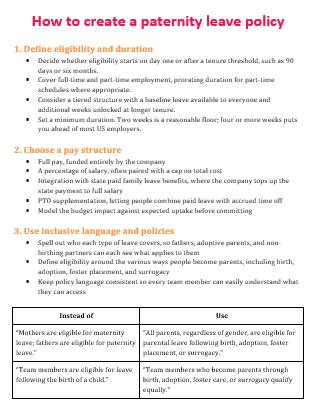
Building or refreshing a paternity leave policy comes down to three decisions: eligibility, pay, and language. Here are some criteria to keep in mind as you draft your policy:
1. Define eligibility and duration
Start by deciding who qualifies for paternity leave and how much time they can take.
- Decide whether eligibility starts on day one or after a tenure threshold, such as 90 days or six months.
- Cover full-time and part-time employment, prorating duration for part-time schedules where appropriate.
- Consider a tiered structure with a baseline leave available to everyone and additional weeks unlocked at longer tenure.
- Set a minimum duration. Two weeks is a reasonable floor; four or more weeks puts you ahead of most US employers.
2. Choose a pay structure
Determine how you’ll compensate people during leave while balancing meaningful support with your organization’s budget.
- Full pay, funded entirely by the company
- A percentage of salary, often paired with a cap on total cost
- Integration with state paid family leave benefits, where the company tops up the state payment to full salary
- PTO supplementation, letting people combine paid leave with accrued time off
- Model the budget impact against expected uptake before committing
3. Use inclusive language and policies
Create a parental leave policy that works for every type of family. Use inclusive language that focuses on becoming a parent rather than gender, biology, or traditional family structures.
- Spell out who each type of leave covers, so fathers, adoptive parents, and non-birthing partners can each see what applies to them
- Define eligibility around the various ways people become parents, including birth, adoption, foster placement, and surrogacy
- Keep policy language consistent so every team member can easily understand what they can access
Here’s what that looks like in practice. Small changes to policy language can clarify eligibility, remove unnecessary assumptions, and help every team member understand how parental leave applies to their family.
Instead of: “Mothers are eligible for maternity leave; fathers are eligible for paternity leave.”
Use: “All parents, regardless of gender, are eligible for parental leave following birth, adoption, foster placement, or surrogacy.”
Instead of: “Team members are eligible for leave following the birth of a child.”
Use: “Team members who become parents through birth, adoption, foster care, or surrogacy qualify equally.”
Offer fair paternity leave for your people
A strong paternity leave policy is a practical way to support people through a major life transition while creating greater clarity, consistency, and fairness across your organization.
For HR teams, that means building a policy that is easy to understand, inclusive of different paths to parenthood, and simple for people and managers to navigate. Clear eligibility, leave entitlements, pay, and return-to-work expectations can reduce uncertainty and help everyone plan with confidence.
The right approach will depend on your organization, your people, and local requirements. But the goal stays the same: Create a policy that gives new parents meaningful support while helping your organization build a consistent and equitable team member experience.
Paternity leave FAQs
Do most companies have paternity leave?
The FMLA requires coverage for unpaid leave, but paid leave is far from universal. Most employers still don’t offer this kind of leave, leaving many new fathers to rely on unpaid FMLA leave or accrued PTO.
Do men get paternity leave?
Yes. Fathers can take paternity leave under company policy, state paid leave programs, or the unpaid protections of the FMLA, depending on eligibility. Access and use still fall behind that of maternity leave, but U.S. Census Bureau data shows more first-time fathers taking leave than in past decades.
Is paternity leave mandatory for employers?
It depends on where the employer operates. The FMLA requires covered employers, generally those with 50 or more people, to provide up to 12 weeks of unpaid, job-protected leave. Paid leave is only mandatory in states with their own paid family leave laws; elsewhere, it’s voluntary. HR teams operating across multiple states need to track both federal FMLA obligations and state-specific paid leave mandates to stay compliant.