
Introduction
The competitive advantage in today’s market is no longer just having access to AI tools. It’s having a workforce that can use them.
Your people know the landscape is changing. With 75 percent of leaders expecting moderate AI proficiency to become a standard requirement in most roles over the next two years, modern professionals are eager to grow their careers alongside this technology, but we can’t leave professional development up to chance.
We’re in the midst of an AI transformation, but it’s a transformation that can’t be bought. We need to build it. Now is the moment for organizations to take charge and lead the way.
An AI skills professional development plan bridges the gap between haphazard tool experimentation and governed, measurable capability. It provides HR teams and managers with the exact structure they need to define clear expectations based on skill levels, guide meaningful career conversations, and upskill their teams with a purpose.
This guide gives you practical templates to help your people build AI skills according to a defined, business-aligned plan.
Inside you’ll find:
- Ready-to-use AI skills development plan templates
- Example goals, action steps, and success metrics for key AI competencies
- Practical guidance to help managers turn AI skills assessments into focused career development conversations
Key insights
- AI skills are the new baseline. AI is no longer a specialization or on the fringe of tech development. In today’s work environment, it’s a core performance requirement that directly influences career growth and promotion readiness.
- Assessment is only step one. Using a development plan connects your team’s baseline AI scores (Developing, Proficient, Advanced) to concrete, actionable learning goals.
- Focus on judgment, not just tools. Effective AI development plans prioritize critical thinking, output verification, and risk management over basic coding capabilities.
- HR teams and managers need structure. Using standardized templates can help organizations guide their teams from fragmented experimentation to governed, high-value AI execution.
What is an AI skills professional development plan?
A standard professional development plan helps people define and work toward career growth goals. An AI skills professional development plan focuses specifically on building the judgment, confidence, and accountability people need to use AI safely and effectively.
We already know the stakes are high. When companies tie AI skills directly to pay and promotions, evaluating whether a team member uses AI is only the first step. The second critical step is coaching them on how to use it to create actual business value.
An AI skills professional development plan moves the focus away from activity metrics (like how often someone logs into a chatbot) and centers it on capability. It’s a structured roadmap that defines exactly where a team member’s skills stand today—scoring them as Developing, Proficient, or Advanced—and provides the practical steps they need to move from piecemeal experimentation to aligned and governed, high-value execution.
Recommended For Further Reading
AI skills professional development plan templates
AI transformation can’t be improvised. A shared standard for AI skills development gives managers and people teams the structure they need to evaluate people fairly, guide meaningful career conversations, and support AI skill-building with purpose.
How to use these templates
These templates align with the HiBob AI Skills Framework to give your managers and people teams the structure they need to guide team members from Developing to Proficient and Advanced with clear, role-based development plans.
Use them to assess your teams’ current AI skills, identify which skill sets and competencies match their responsibilities, set professional development goals, and build clear learning paths to meet those goals.
- Identify core competencies for each role. Start by thinking about each person’s role and their core responsibilities. Use the Role context field to list how they could leverage AI in their day-to-day work.
- Set clear goals. What goals make sense for the team member and their responsibilities? Use the Goal fields to pinpoint what success looks like for each competency.
- Build learning paths to help them meet their goals. Use the Action steps field to define specific, hands-on learning experiences—like role-based workshops, structured courses, or best practices—that the team member can apply in their natural flow of work to develop each skill.
- List the resources you can provide to support their development. Use the Support and resources field to list any technologies, tools, training resources, or other modes of support you can provide to help them make progress.
- Determine how to measure their progress. Use the Success metrics field to list KPIs, measurable outcomes, and how you’ll track their progress over time.
Keep your development plans flexible. AI tools and best practices change fast, so revisit each plan regularly (quarterly, semi-annually, or annually) to turn AI upskilling from a one-off exercise into a continuous, repeatable process.
These templates are built to help you adjust quickly and apply AI development plans across your teams as your people’s goals and learning paths change with business needs. Customize them to fit your people’s evolving roles and responsibilities.
Start with AI Readiness to establish each team member’s baseline before building towards more advanced, role-specific AI usage.
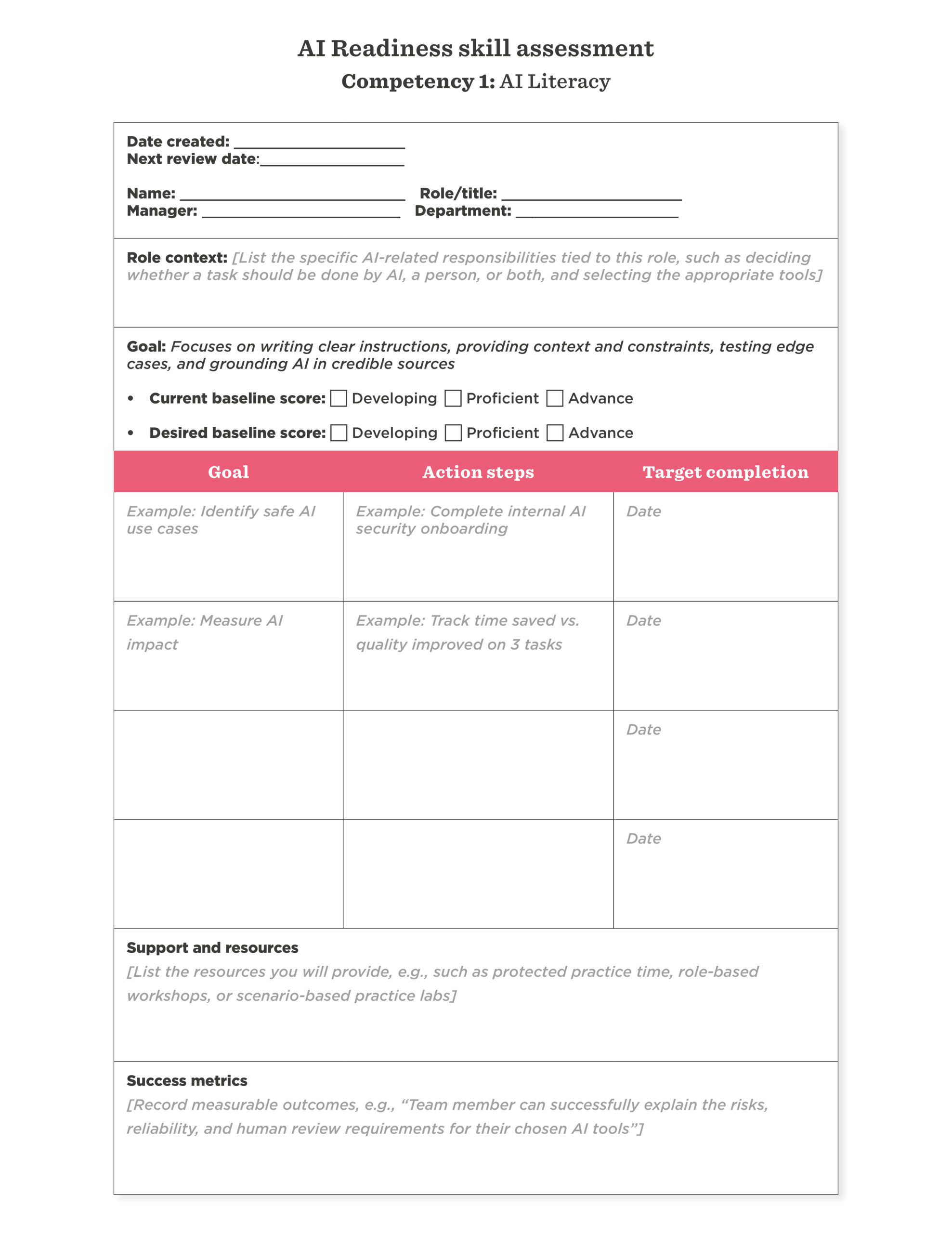
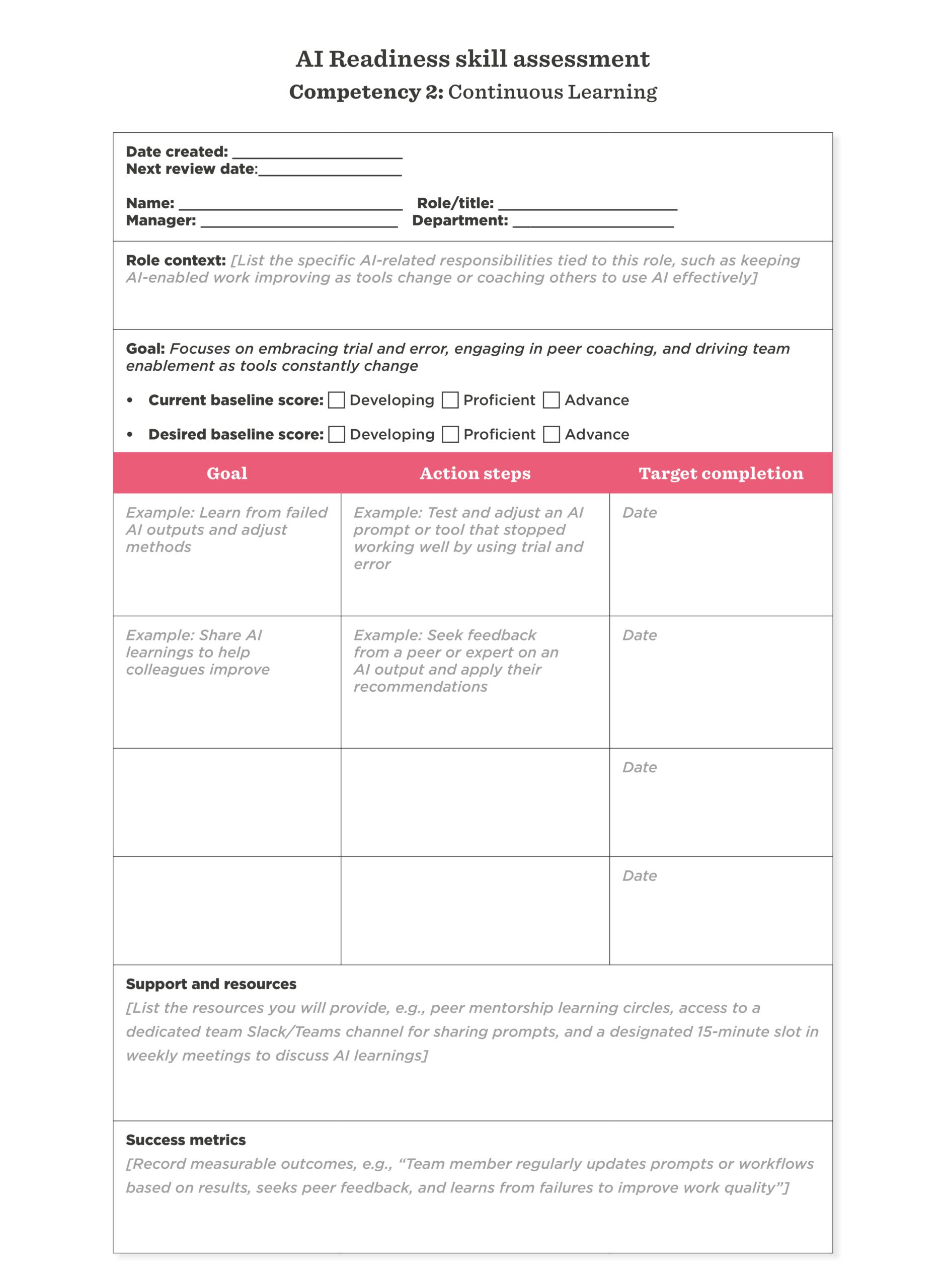
1. AI Readiness development plan template
Rather than more experimentation, organizations need a repeatable operating model that helps them understand team members’ baseline judgment around when AI should (and shouldn’t) be used.
These templates focus on the AI Literacy and Continuous Learning competencies within the AI Readiness skill set.
<<Development plans are the start. See how Bob helps you scale AI skills across your organization.>>
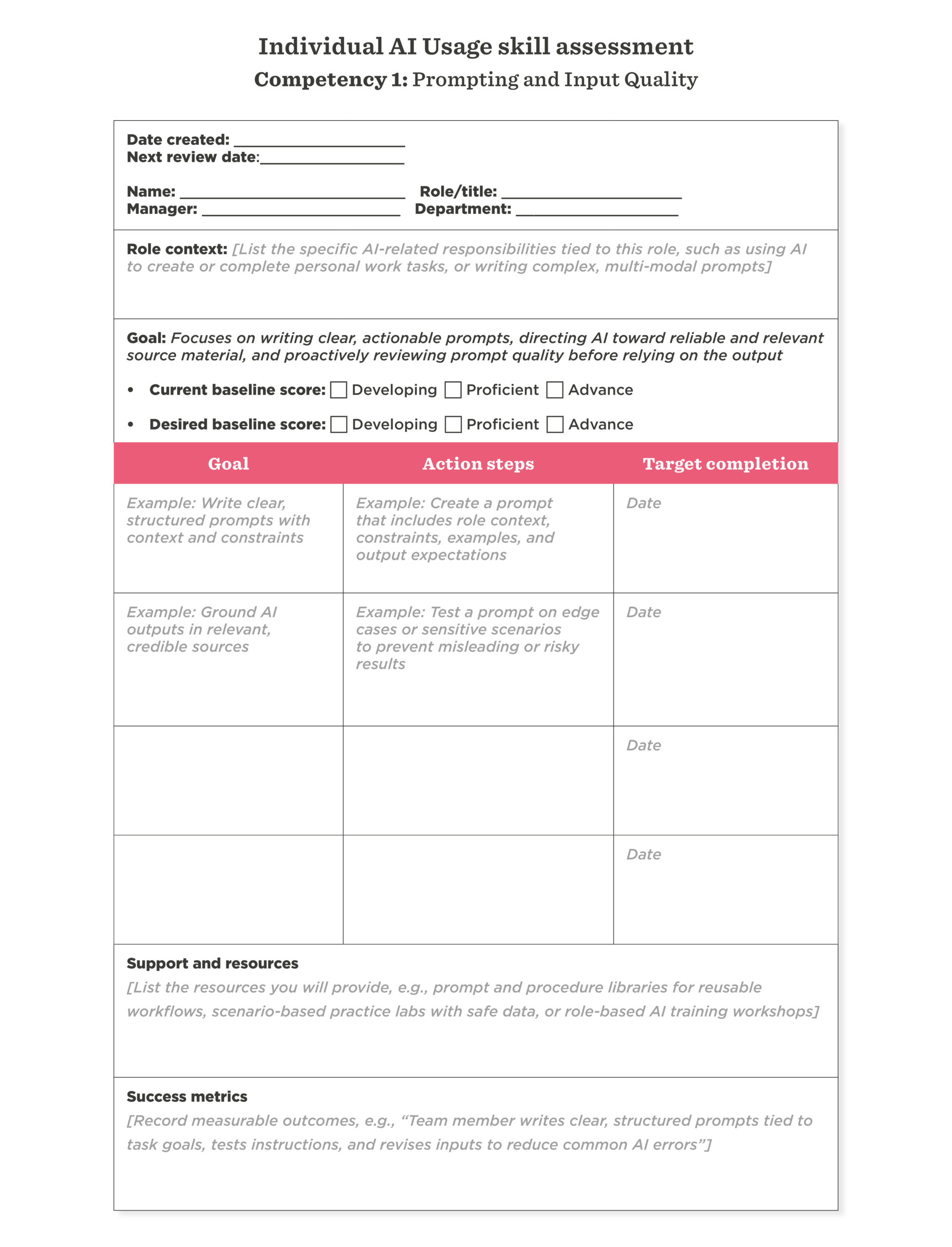
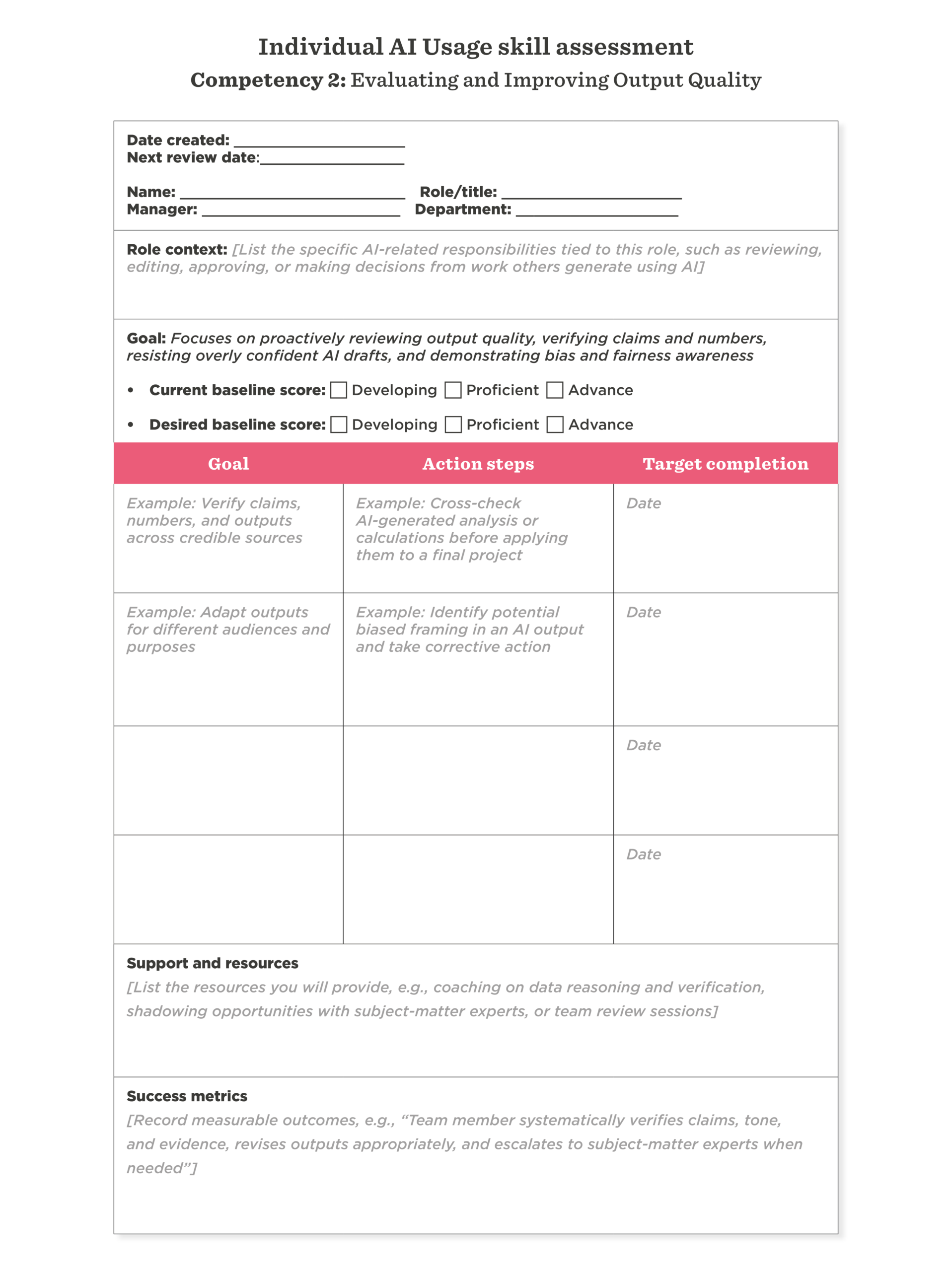
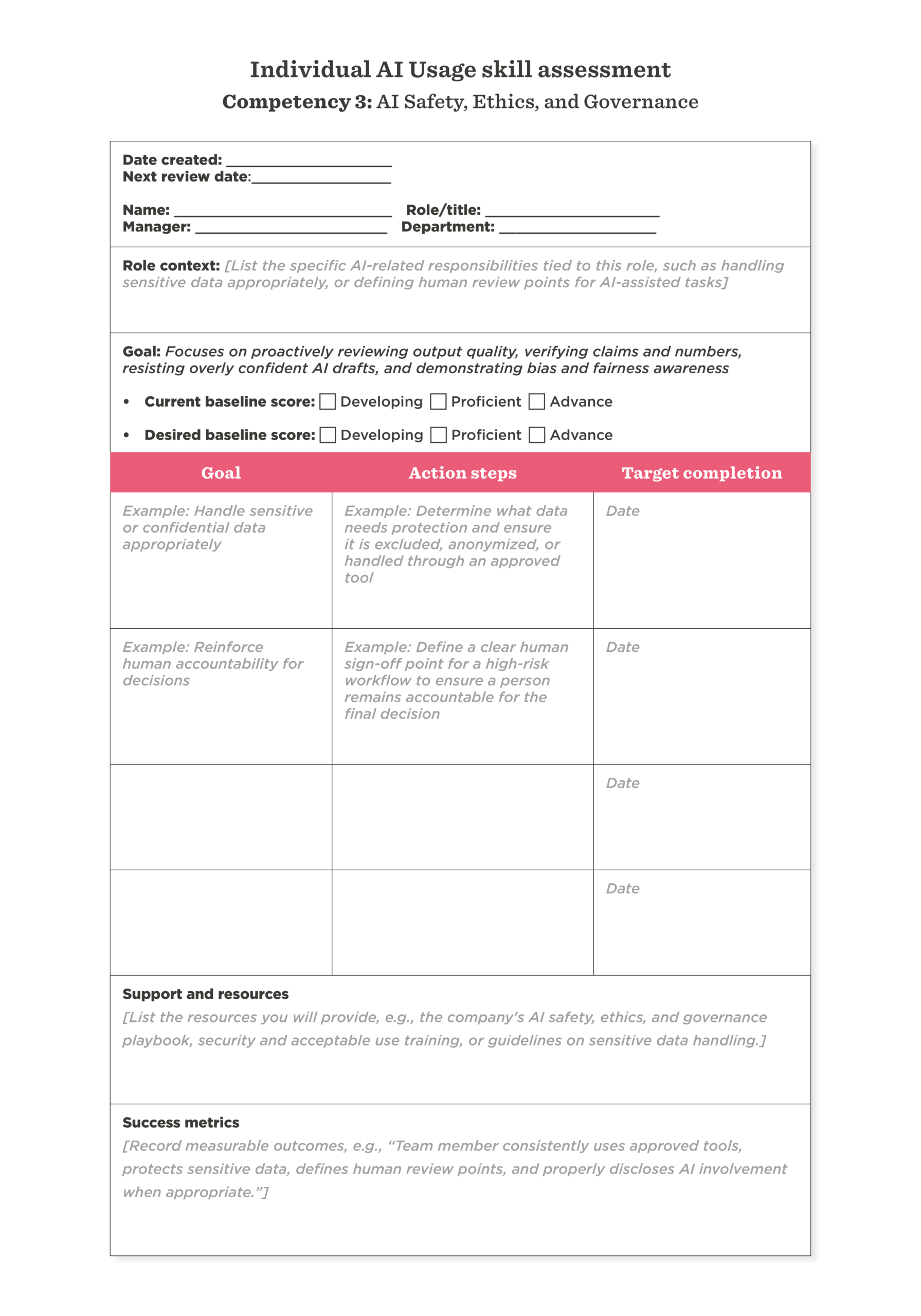
2. Individual AI Usage development plan template
AI usage alone doesn’t drive value. People need to know how to use the tools optimally and apply their judgment. This means providing team members with robust training in effective prompt writing, proactively verifying output accuracy, and responsibly navigating safety and governance in their day-to-day work.
These templates focus on the Prompting and Input Quality, Evaluating and Improving Output Quality, and AI Safety, Ethics, and Governance competencies within the Individual AI Usage skill set.
<<Turn AI governance into everyday practice with one connected skills strategy. See how Bob helps.>>
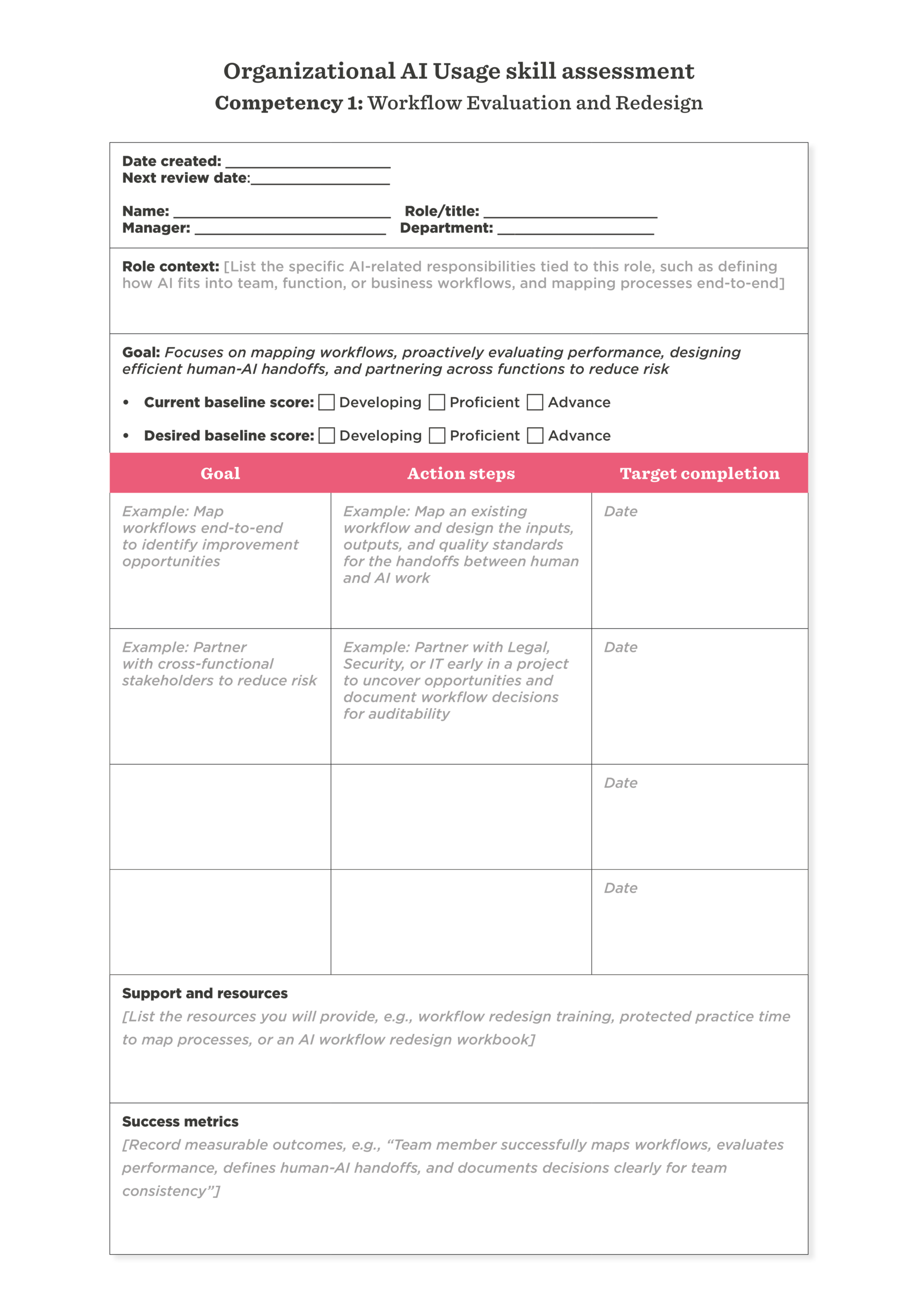
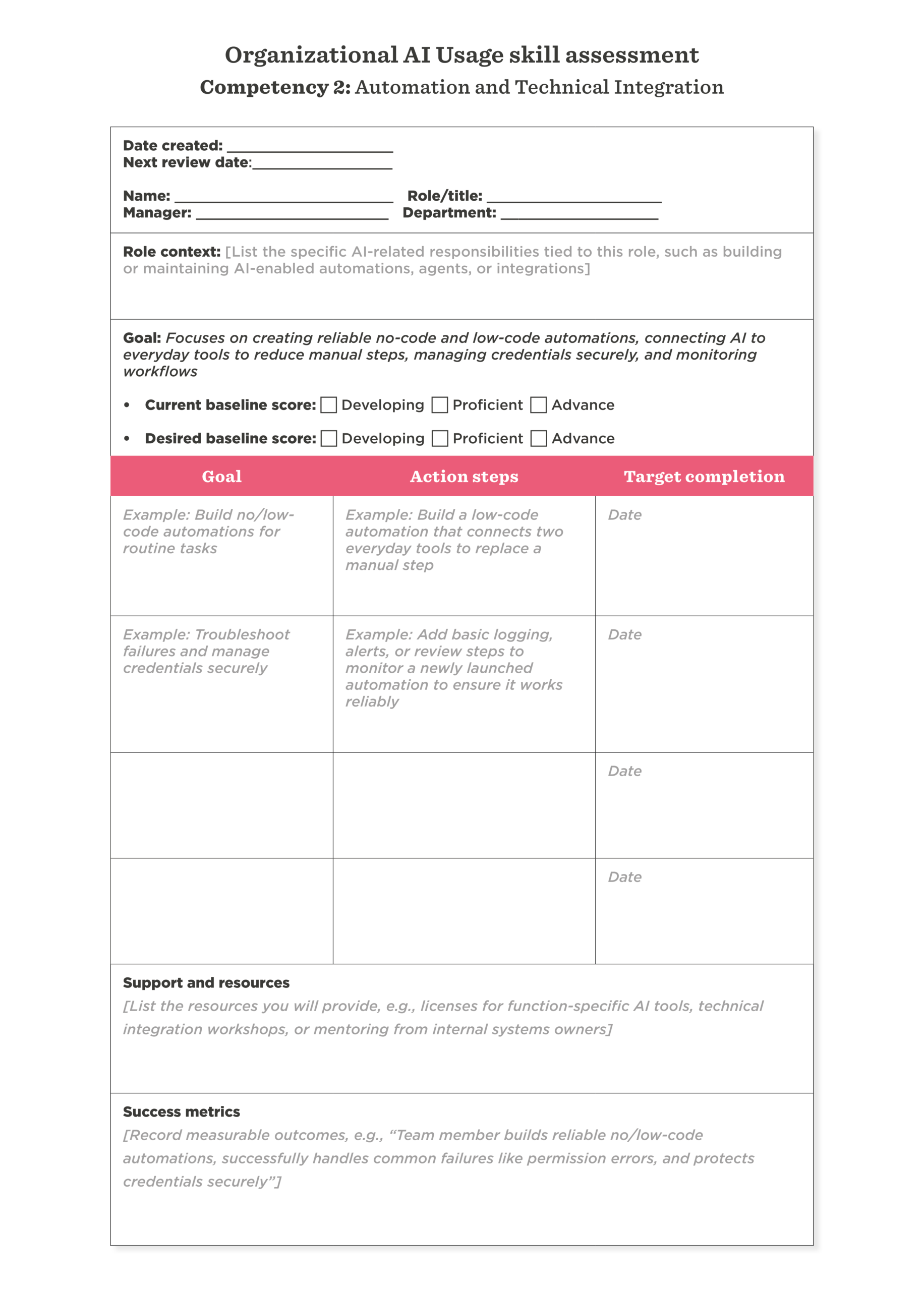
3. Organizational AI Usage development plan template
Genuine AI transformation is an operating model challenge, not a tool adoption race. Getting it right requires helping your people look beyond individual tasks so they can map end-to-end workflows, design effective human–AI handoffs at the right points, and securely build automations that scale value across the business.
These templates focus on the Workflow Evaluation and Redesign and Automation and Technical Integration competencies within the Organizational AI Usage skill set.
Make AI competencies a part of how your business works
Professional development plans do so much more than simply outline career goals. They help people turn those goals into action.
When it comes to AI, shared behavioral standards remove the guesswork. They give managers a clearer way to evaluate performance fairly and give every team member a practical roadmap for building AI skills and advancing their career.
As AI skills become a baseline capability across nearly every industry, consistency matters more and more. These templates help you move beyond surface-level metrics, like who’s using AI and how often, and focus instead on how people apply judgment, creativity, and critical thinking to create real business value.
<<Templates help people grow. Bob helps your entire workforce grow together. Explore the platform.>>