AI is no longer just dominating the conversation. It’s reshaping the way we work. For HR, the responsibility to understand and guide this transformation has never been greater.
It’s helping people move faster, reduce manual effort, and make more informed decisions in the flow of work. For HR, that shift is happening in real time.
Research from PeopleScout and Spotted Zebra shows that 90 percent of HR leaders believe up to half their workforce will need reskilling by 2030. The question is, how prepared are your people to work with AI?
HR industry analyst Josh Bersin provides a roadmap for this shift in The Rise of the Superworker, highlighting how AI upskilling can help businesses become “Superworker” companies—organizations where professionals don’t compete with AI but use it to enhance their productivity, value, and impact.
As we say at HiBob, it’s about doing more with more. AI isn’t here to replace people. It’s here to empower them.
Making this shift requires strong leadership, and that’s where HR steps in. By helping people understand how AI fits into their work, HR can accelerate adoption and create meaningful value across the organization.
This article explores best practices for AI upskilling programs that empower your people, build workforce readiness, and position HR as a strategic partner in building a more adaptable, AI-ready workforce.
Key takeaways: AI upskilling in the workplace
- AI upskilling helps people adapt to changing roles. As AI reshapes how work gets done, HR can help people build the skills they need to work confidently alongside AI.
- HR plays a strategic role in AI workforce transformation. By leading AI skills training, HR can reduce uncertainty, support adoption, and align upskilling with business goals.
- AI skills training works best when it’s practical. Hands-on learning helps people apply AI in their regular flow of work, making adoption more useful and sustainable.
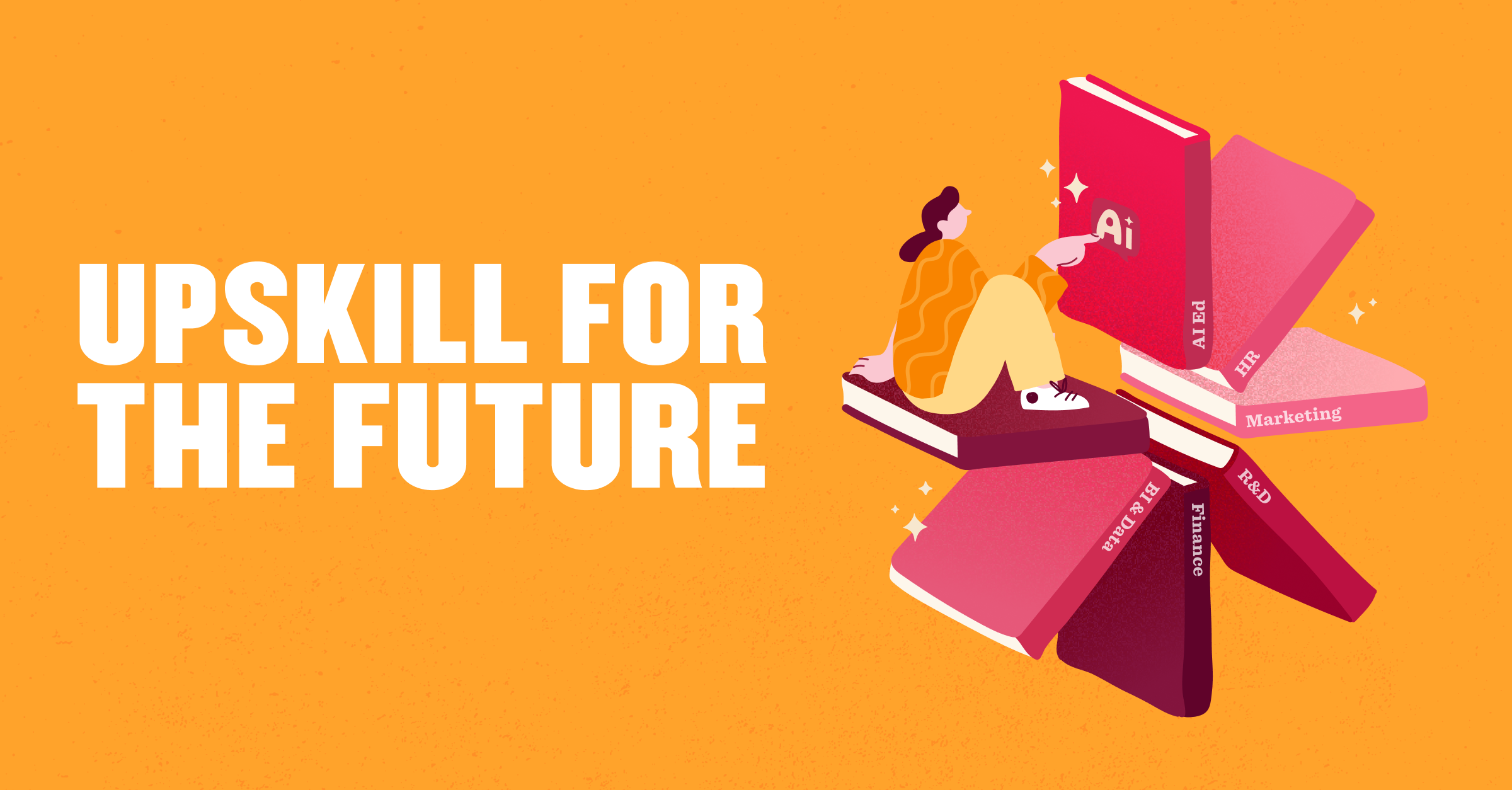
- Different teams need different AI skills. Role-specific AI upskilling helps HR, Marketing, R&D, Finance, and Data teams use AI in ways that match their workflows and priorities.
- The best AI strategies keep people at the center. AI creates the most value when it augments human expertise, helping people focus on creativity, strategy, problem-solving, and relationship-building.
Champion a new way of working with AI
AI workforce transformation isn’t just about adopting new tools—it’s about shifting how your people think and work.
As AI becomes embedded in workflows, upskilling helps teams use it with confidence and purpose. That confidence starts when people understand not only what AI can do, but how it can support the work they already do.
Making that shift starts with HR leading the charge. HR professionals are more than just facilitators of AI adoption: They’re the ones who provide the clarity to shape the mindset, structure the training, and secure buy-in across the organization so teams can integrate AI into their daily workflows.
To make AI adoption successful, HR plays a pivotal role in championing AI skills-building as a strategic priority, ensuring decision-makers, managers, and individual contributors embrace AI as a tool that enhances, rather than replaces, human work.
When learning connects directly to real work, adoption gains momentum.
Rethink AI as a tool to use, not a human replacement
Naturally, some may feel hesitant about AI adoption. But AI has already become part of how we get work done, and HR is integral to reinforcing AI’s role as a tool for support, not displacement.
Shifting mindsets is just as important as building skills. AI isn’t here to take over. It’s here to help people brainstorm, generate ideas, and make more informed decisions. Treat it like a superassistant that enhances rather than replaces human capabilities.
As HiBob CEO Ronni Zehavi puts it, “GenAI and automation tech are not only here to help us improve efficiency. They’re also here to help take the pressure off our people and avoid burnout.”
By thoughtfully integrating AI, businesses can empower their people, support innovation, and create a workplace where people do more with more—without feeling displaced by new technology.
When people see AI improving their work, confidence builds quickly.
Identify the key AI skills your workforce needs
Not all AI skills hold the same weight. Different roles require different proficiency levels.
That’s why HR plays a fundamental role in building strategic upskilling programs rooted in assessing skill gaps and aligning training with business priorities.
Because AI literacy is only the starting point, turning your people’s AI knowledge into real impact depends on giving them hands-on experience with the tech within their regular flow of work.
As AI becomes more embedded in daily workflows, practical skills become even more important. When HR professionals take a structured, strategic approach to proactive workforce planning through upskilling, they can create training programs that build confidence in AI adoption and directly address long-term business needs.
Instead of reacting to technological change with ad hoc training, HR can ensure people gain the right skills at the right time—keeping their people and the business competitive in a changing world.
The first step is analyzing workforce capabilities to determine which roles need foundational AI literacy versus deeper technical expertise. From there, HR teams can develop targeted, hands-on training that makes AI a practical, integrated tool rather than just a concept.
Here are some of the most critical AI skills you can help your workforce build:
- AI literacy. Understanding AI fundamentals, capabilities, and limitations to work effectively with AI-powered tools.
- Prompt engineering. Crafting effective AI queries to generate precise, relevant, and high-quality results.
- Continuous learning. Making testing, refining, learning from imperfect outputs, seeking and applying feedback, and sharing best practices a core part of your culture.
- Data fluency. AI can process large datasets quickly, but people play a key role in contextualizing and interpreting insights, spotting patterns, and making informed decisions.
- AI-driven process automation. Using AI to simplify workflows, reduce repetitive tasks, and enhance efficiency across different departments.
- AI safety, ethics, and governance. Training people on secure AI implementation, responsible use, and accountability to ensure AI is fair, unbiased, and aligned with ethical standards—protecting your people and customers.
- AI-augmented creativity. Leveraging AI as a powerful assistant to enhance innovation, generate ideas, and improve creative work in marketing, product development, and beyond.
Identifying the right AI skills is just the beginning. To create a truly AI-ready workforce, AI training needs to reach the right people—across all departments, not just technical roles.
In the next section, we’ll explore how AI upskilling supports teams across the organization.
AI in action: How different teams benefit
AI integration looks different across teams, depending on their needs. But the goal is the same: Help people move faster, make better decisions, and focus on higher-value work.
With the right skills in place, teams can start applying AI in practical ways across the business:
- HR. Use AI to surface people insights faster. From recruitment screening (where regulations allow) to engagement trends and performance insights, AI helps HR teams move from information to action more quickly.
- Marketing. Use AI to explore ideas, refine messaging, and move campaigns forward faster. This helps marketing teams focus more on strategy and creative direction.
- R&D. Use AI for predictive modeling, prototyping, and trend analysis to accelerate innovation and strengthen your competitive edge.
- Business intelligence and data. Use AI to process data faster and surface meaningful insights. This helps teams make more informed decisions without getting stuck in manual reporting.
- Finance. Give your Finance team greater peace of mind and an extra layer of security with AI-supported risk assessment, financial forecasting, fraud detection, and compliance automation.
Encouraging experimentation helps teams understand where AI adds value. As people test and refine how they use AI, it becomes part of everyday work rather than a separate initiative.
How to tailor AI upskilling programs for different teams
As AI reshapes how teams work, a one-size-fits-all approach quickly falls short. While company-wide AI literacy is essential, the best upskilling programs equip everyone to work alongside AI while tailoring training to each team’s specific needs, workflows, and level of AI integration.
A phased approach helps teams build confidence before applying AI in real scenarios.
An AI upskilling program framework for modern businesses
A structured approach helps organizations build capability over time, starting with awareness and moving toward practical application.
Phase 1: AI awareness and literacy for everyone
Start by building a shared understanding of AI across your organization. This helps reduce uncertainty and makes adoption more approachable with:
- Company-wide workshops on AI fundamentals, helping teams understand its capabilities, limitations, ethical considerations, and responsible use
- Interactive sessions and self-paced courses to familiarize people with AI-powered tools
- Hands-on experimentation with AI assistants and automation to build confidence in using AI
Phase 2: Role-specific AI training paths
Align AI skills training to how each team can best integrate AI into their daily workflows.
- Assess skill gaps and determine the level of AI proficiency different roles need
- Develop specialized training modules that reflect how teams interact with AI, whether it’s AI-powered analytics for HR, content automation for Marketing, or predictive modeling for R&D
- Embed AI into existing learning programs to make training part of people’s current roles
Phase 3: Hands-on AI application
AI upskilling is most effective when people actively engage with AI tools in real-world scenarios. Focus on hands-on learning, showing teams how to apply AI in their workflows—whether it’s HR using AI for engagement analysis, marketers refining AI-generated content, or Finance teams leveraging AI for risk assessment.
Have your teams:
- Work on AI-focused projects that align with their roles
- Refine AI outputs by testing different prompts, adjusting parameters, and optimizing results for accuracy and relevance
- Collaborate cross-functionally to explore AI-driven solutions that span multiple teams
Phase 4: Continuous AI upskilling, integration, and certification
AI is advancing quickly, and ongoing learning helps teams stay confident as tools change. By embedding continuous AI upskilling into workplace culture, HR empowers people to learn, adapt, and innovate, keeping AI as a tool for growth rather than disruption.
To help people stay ahead of AI advancements:
- Provide your people with ongoing AI education through certifications, hands-on workshops, and mentorship programs
- Encourage AI champions—individuals within teams—who can explore new AI developments and help others integrate them into the flow of work
- Create a culture of continuous learning that empowers your people to experiment, refine, and optimize AI in their work
By aligning AI training with real-world job functions and making it an ongoing initiative, HR can ensure AI adoption is practical, empowering, and rooted in everyday work.
Recommended For Further Reading
- Merging man and machine: How to create an effective AI policy
- Navigating AI adoption: Benefits, risks, and the path to success
- The Reality of AI in the US Workplace and its Impact on Entry-Level Jobs
- AI in HR: 13 ways to use AI to support better people decisions
- What your people really think about AI at work: Insights from 500,000+ real conversations
- How to implement AI responsibly in HR: Best practices and checklist
- The future of AI in HR: Will AI replace HR?
Maintaining the AI-human balance
AI creates the most value when it strengthens human expertise.
Successful AI happens when it augments human skills, handling repetitive tasks so your people can focus on creativity, strategic thinking, problem-solving, and empathy (ergo: critical relationship-building).
For HR, the real challenge lies in ensuring AI adoption strengthens the workforce, rather than diminishing human contributions. When you strike the right balance, this approach can help improve efficiency, elevate roles, and create opportunities for your people to develop new capabilities and grow their careers.
Creating value with AI-human collaboration
HR can lead modern organizations to leverage AI most effectively: as a collaborator that amplifies human strengths.
Key areas where AI and human collaboration create the most impact include:
- Customer relationship management. AI can personalize experiences and automate workflows, while people manage complex conversations, high-stakes decisions, and relationships.
- Business productivity. AI can optimize workflows, scheduling, and analytics, freeing people up to focus on strategy, oversight, and creative problem-solving.
- People systems and decision-making. AI can surface insights, but human judgment remains critical. For example, AI adoption in HR can influence talent analytics, screening, and performance management—but HR leaders remain critical in interpreting data and making strategic workforce decisions.
Balancing AI and human expertise is essential for long-term success. Organizations that invest in AI competency across all roles—while encouraging deeper expertise in specific areas—will build a workforce that’s not only AI-ready but also more adaptable, strategic, and empowered.
Reshaping work, prioritizing people
AI is reshaping roles and redefining how work gets done.
HR stands at the forefront of this transformation, ensuring AI adoption isn’t just about efficiency but about empowering people with the right skills and supporting long-term capability. By championing AI as a tool to use—not a disruptor—HR can ensure AI adoption enhances the business and its people.
Organizations that invest in AI upskilling build stronger foundations for the future. A thoughtful approach helps people adapt, strengthens company culture, and prepares organizations for what comes next.