Global HR is the practice of managing people operations across multiple countries and jurisdictions. It covers international hiring and compliance, multi-currency payroll, cross-border benefits, and building a consistent culture across geographically distributed teams.
For companies operating internationally, global HR management is not a back-office function. It shapes how effectively you attract and retain talent, make fair and confident decisions, and build a resilient organization across regions, teams, and regulatory environments.
The operational demands are significant. HiBob research found that 85 percent of multinational HR leaders say global payroll is at least moderately complex, and 52 percent say aligning performance reviews across global teams and work cultures is highly complex. Strong global HR management gives organizations the structure, visibility, and flexibility to handle that complexity without losing consistency or control.
Strong global HR management helps organizations handle that complexity without losing consistency or control. It gives teams the structure, visibility, and flexibility they need to support people well across regions while helping the business scale with more confidence.
Key insights
- Global HR covers the full scope of people management across multiple countries, from international compliance and payroll to talent acquisition and cultural integration
- The biggest differences between domestic and global HR lie in legal complexity, payroll architecture, and the need to navigate multiple cultural norms simultaneously
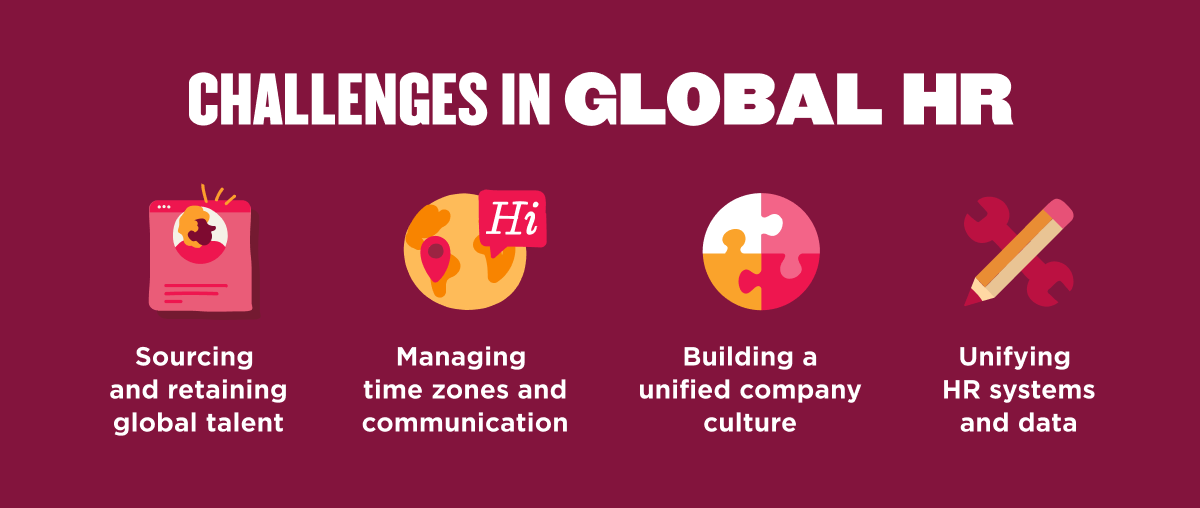
- Common challenges include building a unified culture across distributed teams, sourcing and retaining talent across borders, and keeping HR systems consistent across jurisdictions
- A connected global HR platform gives teams the visibility, consistency, and local adaptability they need to manage people effectively at scale
What is global HR?
Global HR is the practice of managing people operations across multiple countries and jurisdictions. It draws on the same core disciplines as domestic HR and adapts them to function across different legal environments, currencies, languages, and cultural norms. Here’s how they differ:
Global HR vs domestic HR
| Aspect | Domestic HR | Global HR |
| Compliance | HR teams usually work within one employment framework and one set of labor laws | HR teams need to manage different employment laws, leave rules, privacy requirements, and worker classifications across countries |
| Payroll | Payroll typically runs in one currency, one tax system, and one reporting structure | Payroll may involve multiple currencies, tax regimes, pay cycles, and local reporting requirements |
| Culture and communication | Teams often share similar workplace norms, communication styles, and expectations | HR needs to support different cultural expectations around feedback, management, communication, and ways of working |
| Time zones and coordination | Collaboration usually happens within one or closely aligned working schedule | HR processes and manager support need to work across regions with limited overlap in working hours |
| Language and localization | Policies, onboarding, and communication are usually created once for one main audience | HR teams often need to adapt communication, policies, and training for multiple languages and local contexts |
| Systems and data | Teams can often manage people data in one local process or platform setup | HR needs connected systems and consistent data across locations to keep reporting, planning, and decision-making aligned |
| Onboarding and employee experience | New joiners typically move through one standard process with limited local variation | HR needs to create a consistent experience while adapting onboarding, policies, and support to each country’s requirements |
| Talent acquisition | Hiring usually happens within one labor market, with one set of candidate expectations and compensation norms | Hiring may span multiple labor markets, where candidate expectations, employer branding, and role requirements vary by region |
| Compensation and benefits | Pay and benefits are usually managed within one market context and one set of statutory expectations | HR teams need to balance local competitiveness, global fairness, currency differences, and country-specific statutory benefits |
| Performance and people decisions | Performance reviews and people policies are usually shaped by one management culture | HR needs to balance consistent standards with local expectations around feedback, development, and performance conversations |
Common challenges in global HR management
The challenges below are common in multi-country organizations. Understanding them can help teams build a more consistent, scalable approach to global HR.
Sourcing and retaining global talent
International talent markets are competitive, and what helps organizations attract great people often varies by region. Compensation that feels competitive in one country may fall short in another, and benefits that are standard in some markets, such as certain leave policies, pension contributions, or health coverage structures, may be uncommon or legally required elsewhere.
Retention adds another layer of complexity. Organizations need to design career development, performance feedback, and progression pathways so they feel clear, fair, and relevant across different local contexts. Performance and development often make that challenge most visible. HiBob research found that 52 percent of HR leaders at multinational companies say aligning performance reviews across global teams and work cultures is highly complex, making it one of the most difficult parts of the employee lifecycle to standardize across regions.
Organizations usually get better results when they treat global talent management as a shared framework with local flexibility, not as a single template rolled out everywhere. That approach makes it easier to stay competitive across markets, support people more consistently, and reduce avoidable attrition as the business grows.
Managing time zones and communication
Managing across time zones requires more than finding meeting slots that work. Teams need communication habits that reduce delay, make decisions easier to follow, and help people stay included regardless of where they are based.
A few practices make the biggest difference:
- Document decisions clearly so people don’t need to be in the room to stay informed
- Rotate meeting times so the burden of early or late calls is shared more fairly across regions
- Set clear response-time expectations so teams know what needs an immediate reply and what can wait
- Plan handoffs carefully so work can move smoothly between regions without confusion or duplicated effort
- Use asynchronous updates where possible to keep projects moving without relying on everyone being online at the same time
- Make sure important conversations are not always concentrated in one region’s working hours so no team is consistently excluded from decisions or visibility
This is less about fixing calendars and more about building better operating habits. Teams that do it well treat time-zone collaboration as a core management skill, not an individual workaround.
Building a unified company culture
When teams are working across different time zones, languages, and workplace norms, organizations need clear ways to make culture visible and consistent in everyday experience.
That’s especially important in distributed environments, where technology often becomes the main channel through which people experience HR. In fact, 53 percent of HR professionals say HR tech has significantly affected company culture—especially in distributed and hybrid teams where technology is the primary touchpoint for HR interactions.
| Best practice | What this can look like across regions |
| Define the cultural principles that should stay consistent everywhere | Managers across the business are expected to give regular feedback, set clear goals, recognize strong work, and address performance issues early, instead of letting them build over time |
| Allow local flexibility in how those principles show up | One team may deliver feedback in a direct, fast-moving conversation, while another may give more context first, leave more room for discussion, or follow up in writing to make the message easier to absorb |
| Invest in cross-cultural awareness training for managers | Managers learn how differences in directness, hierarchy, meeting participation, and work-life expectations can affect one-on-ones, team discussions, and performance conversations |
| Use shared rituals and communication touchpoints that work across locations | The company keeps a consistent rhythm for check-ins, recognition, and updates, but uses asynchronous formats so teams in different time zones can still participate fully |
| Make HR technology part of the culture strategy | Teams use one platform for onboarding, feedback, recognition, and policy access, so people experience the organization more consistently, regardless of location |
| Give local managers the context and tools to interpret company values for their teams | Managers get guidance on how to turn values like openness, accountability, or flexibility into everyday team practices that feel relevant in their local setting |
Unifying HR systems and data
Fragmented data remains one of the most persistent operational challenges in global HR. When different countries rely on different HR systems, payroll platforms, or spreadsheets, it becomes much harder to maintain an accurate, current view of the global workforce. That makes people decisions slower, less consistent, and harder to defend.
The impact shows up quickly in both systems and decisions. HiBob’s recent report found that 62 percent of managers admit that when accessing the right data takes too much effort, they rely on an educated guess so they don’t miss a deadline. That kind of improvisation is difficult to sustain at any scale, and even harder to manage across countries.
It’s also one reason many global organizations outgrow their systems: HiBob research also found that only 26 percent of HR professionals at multinational companies say their current HCM (human capital management system) enables them to handle global HR complexity, and 88 percent say their company had to replace tech tools when it expanded internationally. Solving this kind of fragmentation usually requires more than better coordination. It requires a platform that can connect people data, workflows, and reporting across regions.
Recommended For Further Reading
- The future of work in 2026: 8 HR trends reshaping the global workforce
- 12+ Best global HRIS software [2026]
- The playbook for global AI regulations and generative AI compliance
- How TourRadar saves 40 hours per week by automating HR processes in Bob
- From spreadsheets to strategy: How Smartcat powers global growth with Bob
- Fast implementation, flexible, and global: Why Piab Group chose Bob
- How Geminor transformed people operations and strengthened cross-country collaboration with TheVIT and HiBob
How a global HR platform can support international teams
A global HR platform helps organizations manage international complexity with more consistency, visibility, and local flexibility. Here’s how:
- Centralized people data: One place to track headcount, compensation, performance, and reporting structures across regions
- Less operational overhead: Instead of spending time reconciling systems and chasing information across regions, HR teams can focus more on execution, manager support, and long-term planning
- Stronger HR and Finance alignment: Shared workforce data helps teams plan headcount, labor costs, and budgets more confidently across markets
- Clearer global reporting and planning: Leaders can compare workforce trends across regions and act faster without manual consolidation
- Localized compliance support: Global HR platforms can support country-specific workflows, required fields, and local policy variations so teams can manage compliance consistently
- A more consistent team member experience: When onboarding, performance, development, and people processes run through the same platform, team members get a more coherent experience regardless of location
- AI support in the flow of work: AI features built into the platform can help teams surface workforce insights faster, answer policy questions, reduce repetitive admin work, and support managers with more context when they need to act
Strengthen your global HR strategy
Managing people across borders requires more than local fixes and added tools. As organizations grow internationally, they need a more connected way to manage compliance, workforce visibility, and the team member experience across regions. The strongest global HR strategies give teams the structure to stay consistent where it matters, while still adapting to local realities.
HiBob helps global organizations manage HR with more consistency, visibility, and local flexibility. By connecting HR, payroll, benefits, performance, and workforce data in one platform, HiBob gives teams one place to manage people operations across countries, entities, and teams. Plus, with HiBob’s AI capabilities, HR teams and managers can also surface workforce insights faster, reduce repetitive admin work, and get support in the flow of work, giving them more time to focus on planning, manager support, and people decisions that need context and judgment.
Book a demo to see how HiBob supports international teams.