AI insights combined with human expertise help organizations plan for future workforce needs, strengthen internal mobility and retention, and respond more confidently to change.
Artificial intelligence is reshaping how organizations approach workforce planning. With 39 percent of workers’ skills expected to change by 2030, organizations need more agile, skills-focused approaches to prepare for the future. As a result, HR is shifting from traditional headcount and role-based planning toward capability and skills-based workforce strategies.
AI helps HR teams forecast talent needs, identify skill gaps, and align workforce planning strategy with business and people goals.
In this article, we’ll explore how AI-driven workforce planning can help your organization stay agile and prepared for what’s next.
Key insights
- AI workforce planning tools process large volumes of workforce data quickly, giving HR leaders a clearer basis for hiring, development, and retention decisions
- AI-driven processes can highlight and minimize biases in areas like hiring and promotions, helping organizations create fairer, more inclusive workplaces
- Through data analysis, AI identifies ways to allocate resources more effectively, improving operational efficiency and reducing unnecessary costs
- AI tools scale easily with organizational needs, making it easier to adapt workforce strategies as companies expand or shift focus
What is AI workforce planning?
AI workforce planning uses AI to help HR teams anticipate talent needs and model workforce scenarios aligned with business goals.
How AI improves traditional workforce planning
Traditional workforce planning often relies on historical data, manual reporting, and reactive decision-making. AI adds a more dynamic approach by helping HR teams identify patterns earlier, model future workforce needs faster, and align people strategies more closely with business priorities.
Here are a few ways AI can strengthen workforce planning:
- Address talent gaps more proactively: Some estimates show that 72 percent of employers today struggle to find the talent they need. AI can help HR teams evaluate whether they can meet future talent needs through hiring, workforce restructuring, or targeted development efforts.
- Improve agility through faster scenario planning: Growth in revenue per team member is nearly three times higher in industries more exposed to AI—and much of that edge comes down to workforce agility. For HR leaders, AI workforce planning supports faster scenario modeling, which helps teams adjust plans when business priorities shift.
- Support retention and career growth: 88 percent of organizations are concerned about retention today. AI workforce planning can help HR teams identify internal mobility opportunities, align development plans with future business needs, and create clearer career paths that support long-term retention.
The differences between traditional and AI-driven workforce planning become even clearer when comparing how each approach handles key planning activities, as shown in the chart below.
| Planning area | Traditional workforce planning | AI workforce planning |
| Data inputs | Relies on spreadsheets, static reports, and manual updates | Integrates data across HR, Finance, and the business |
| Forecasting | Leans on historical trends and periodic reviews | Uses predictive analysis to forecast talent demand and workforce changes |
| Scenario planning | Takes more time and manual effort | Models multiple workforce scenarios faster |
| Skills visibility | Offers a limited view that can become outdated quickly | Maps current skills, emerging gaps, and nearby skill matches more clearly |
| Decision-making | Often happens after change is already underway | Supports earlier action with forward-looking insights |
| Resource allocation | Focuses on current staffing needs | Uses future business priorities to plan staffing |
| Internal mobility | Can be harder to spot across teams and roles | Highlights mobility paths and reskilling opportunities more easily |
| HR impact | Keeps teams focused on admin-heavy planning work | Frees up more time for strategic planning and people-focused action |
AI doesn’t replace workforce planning strategy—it strengthens it and works best when paired with human oversight. Nicole Reineke, product manager of AI strategy at N-able, suggests that “AI should augment human decision-making, not replace it.” Combining predictive insights with human judgment helps HR leaders make faster, more informed choices about hiring, development, retention, and workforce growth.
How modern HR teams can use AI in workforce planning
AI workforce planning helps HR teams connect workforce data, business priorities, and future talent needs in a more agile way. Gartner found that only 15 percent of organizations conduct strategic workforce planning effectively. AI can help close that gap by giving HR leaders faster insights, stronger forecasting capabilities, and a clearer view of workforce trends before challenges escalate.
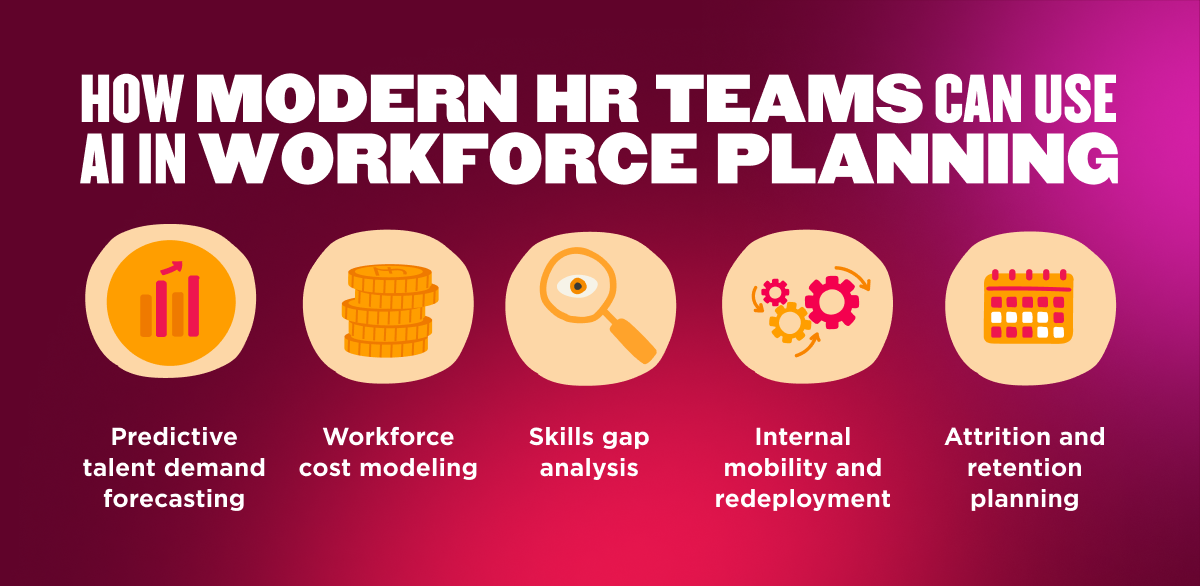
Predictive talent demand forecasting
Predictive talent demand forecasting helps HR teams anticipate workforce needs earlier. AI can analyze hiring trends, business growth goals, productivity patterns, and labor market data to estimate where demand is likely to increase.
This becomes especially important as hiring pressures continue to grow. Fiverr used HiBob to centralize people data and gain real-time visibility into headcount, growth, retention, attrition, and other workforce trends as the company scaled globally. It’s a strong example of how centralized workforce data helps organizations identify emerging talent needs and monitor growth patterns.
Workforce cost modeling
The need for stronger planning continues to grow as organizations face ongoing economic pressure. Workforce cost modeling helps HR and Finance teams evaluate staffing before making changes. AI can model different workforce scenarios and costs—such as hiring in new regions, expanding contingent support, or investing in reskilling—so leaders can compare tradeoffs with more clarity.
Skills gap analysis
Where traditional analysis might flag skill gaps like a shortage of data engineers, AI can go further. It can identify that several data analysts already on staff have adjacent skills that, with targeted upskilling, could fill that gap.
Rather than defaulting to an external hire, HR leaders can build a development plan around talent that already understands the business. This kind of connected skills mapping helps organizations move faster, reduce hiring costs, and create clearer growth paths for existing team members.
Internal mobility and redeployment
Organizations are focusing more heavily on internal growth opportunities. Learning and mobility opportunities are consistently among the top reasons people stay—or leave. AI-driven workforce planning helps organizations redeploy talent more effectively, create clearer career pathways, and retain institutional knowledge as business needs evolve.
Strong internal insight supports both agility and retention. With companies that have strong internal mobility programs seeing a two times increase in employee retention, it’s more important than ever for organizations to remain agile and keep people engaged. Mobility planning can help organizations move people toward emerging work needs while giving team members clearer career paths.
Attrition and retention planning
AI can surface patterns linked to departures before they become trends—stalled growth, workload imbalance, manager changes, lower engagement, or pay compression—giving HR teams time to act. HR teams can use that insight to guide better career conversations, manager support, development planning, and workload adjustments before a valued team member starts looking elsewhere.
Common challenges with AI workforce planning
AI workforce planning can bring sharper forecasts and clearer decisions, but strong results depend on strong foundations. HR leaders can get the best value when data, systems, governance, and adoption move forward together.
A thoughtful rollout keeps the process accurate, fair, and practical. Here are a few things to keep in mind as you build your plan.
Poor data quality
AI planning tools rely on clean, current workforce data. When job titles vary across teams, skills records go out of date, or headcount data exists in multiple formats, forecasts become less reliable.
A good starting point is a simple data cleanup plan. Standardize job architecture, create shared definitions for skills and roles, review records on a regular basis, and assign clear owners for core fields such as tenure, headcount, and cost centers.
Siloed HR and Finance systems
Workforce planning works better when people data and financial data tell the same story. When HR and Finance use separate systems, separate terms, or separate planning cycles, hiring plans and budget decisions can pull in different directions.
A shared planning rhythm can close the gap. Align definitions, connect systems where possible, and review workforce plans together so hiring demand, labor costs, and business priorities stay in sync.
Weak AI governance
Without clear governance, teams may use models inconsistently, trust outputs too quickly, or lose sight of where human review belongs.
Guardrails make AI more useful. Define who owns each model, document what each tool does, set review points for high-impact decisions, and keep HR, IT, legal, and leadership aligned on oversight.
Algorithmic bias and ethical concerns
AI can reflect patterns already present in historical data. If past actions included bias around hiring, promotion, pay, or mobility, AI may carry those patterns forward into future recommendations.
Regular review helps keep planning fair and credible. Audit models for uneven outcomes, involve diverse stakeholders in review, and use transparent criteria.
Lack of change readiness
Even strong AI tools can stall when managers and HR teams don’t feel confident using them. Adoption grows more steadily when people understand what AI support, where human judgment fits, and how planning workflows will change.
Start small and build trust through practice. Focus on one clear use case, train managers with real planning examples, explain the value in plain language, and share early results that help teams see how AI supports better decisions.
How HiBob supports AI workforce planning
Workforce planning works best when HR teams can trust their data, see changes clearly, and respond quickly, but that’s hard to do when people data lives in disconnected places.
Bob AI gives HR leaders a connected view of their workforce, bringing headcount, tenure, performance, compensation, and organizational data. That shared foundation means planning conversations can start with facts instead of guesswork, and AI tools get the clean, reliable inputs they need to surface meaningful insights.
From there, teams can track attrition, growth, mobility, and engagement in real time and adjust hiring plans, development efforts, and team structures as business priorities shift. HiBob’s reporting and analytics make those changes visible early. The platform also helps HR teams support internal mobility, map growth opportunities, and create clearer career paths, aligning business demand with the talent already in your organization.
And because workforce planning is never just about numbers, HiBob is built to support both sides of the work: the strategic decisions leaders need to make, and the team member experience those decisions shape.
Recommended For Further Reading
Achieve smarter staffing decisions with AI in workforce planning
AI workforce planning can help you make staffing decisions with more clarity and less guesswork. When you combine stronger data with human judgment, you can plan workforce growth more strategically, align staffing decisions with business priorities, and support teams through change with greater agility.
HiBob is built to support that foundation, helping HR leaders bring workforce data, planning, and people strategy together.
<< Explore HiBob and see how we help HR teams plan ahead with confidence >>
AI workforce planning FAQs
How is AI used in workforce planning?
AI helps HR teams plan ahead instead of reacting after the fact. It can process large volumes of workforce data quickly, giving HR leaders clearer insight for hiring, development, scheduling, and organizational design decisions.
What are the different types of AI?
A few types of AI support workforce planning in different ways. Machine learning spots patterns in workforce data and improves forecasts over time, natural language processing helps teams analyze written feedback and skills data, and generative AI can summarize findings, draft plans, and surface recommendations faster.
Predictive AI also plays a role. Predictive models can estimate future outcomes such as attrition risk, hiring demand, or likely skill gaps, giving HR leaders a stronger view of what may come next.
What are the different types of workforce planning?
Workforce planning usually includes a few main approaches. Strategic workforce planning focuses on long-term business goals and future talent demand, operational workforce planning focuses on near-term staffing and capacity, and scenario planning helps leaders prepare for different business outcomes.
Many organizations also include succession planning and skills-based planning. Together, those approaches help HR leaders balance immediate staffing priorities with long-term growth, capability building, and internal mobility.