Customer lifetime value (CLV) is the estimated total revenue a business can expect from a single customer throughout the entire relationship.
Customer lifetime value (CLV), also known as LTV (lifetime value), helps you understand how much revenue a customer may generate over the course of the relationship, and what that says about retention, customer value, and long-term growth. CLV is especially important for evaluating your return on acquisition costs and gaining a clearer picture of your long-term business health.
Every new customer represents the start of a valuable relationship. And like any relationship, it’s natural to ask: How well are we connecting? Will this be a short-term engagement or something that grows over time?
For SaaS companies, that question has a direct impact on growth. ChartMogul’s SaaS Retention Report found that the median company with 100 percent or higher net revenue retention grows 48 percent year over year—about twice as fast as SaaS companies in lower NRR ranges. The longer customers stay, adopt, and expand, the more valuable they become. CLV gives Finance, Sales, Marketing, and Customer Success teams a shared way to measure that value and decide where to invest.
Key insights
- Customer lifetime value (CLV or LTV) estimates the total revenue from a customer over the entire relationship
- LTV = (ARPU × gross margin) ÷ churn rate is the standard formula used in SaaS
- A strong LTV/CAC ratio (3:1 or higher) signals sustainable growth and efficient acquisition
- Improving LTV involves boosting retention, raising prices, and adding upsell opportunities
- Modern FP&A tools can make LTV tracking easier by connecting CRM, billing, revenue, and planning data
What’s the difference between CLV and LTV?
There’s no material difference between the terms CLV and LTV (or CLTV). These acronyms all refer to customer lifetime value, a financial metric that helps teams understand expected revenue from a customer relationship.
For many companies, usage of each term often comes down to an agreed-upon preference. Some companies will distinguish between CLV and LTV in terms of granularity. In those cases, LTV refers to the average customer lifetime value across the entire customer base, whereas CLV refers to lifetime value for an individual account.
In this article, we view them as the same metric and use LTV throughout.
Why is customer lifetime value important?
Customer lifetime value is an important SaaS metric because it tells you the total revenue you can expect a customer to generate over the course of your relationship together.
While Finance teams may not own the customer experience, their ability to accurately calculate LTV can help partners in the C-suite, product, sales, marketing, and customer support:
- Assess the long-term viability of the business model
- Justify investments in retention, automation, customer success, and product improvements
- Refine marketing and sales strategies by identifying high-value segments
- Forecast revenue more accurately by modeling retention, expansion, and customer lifespan assumptions
How do you calculate customer lifetime value?
Calculate customer lifetime value by multiplying average revenue per user (ARPU) by gross margin and dividing that number by churn rate. It focuses on three primary inputs:
- ARPU: The average revenue per user for your customer base over a given time period (e.g., one year, one month).
- Gross margin: Your net sales revenue minus cost of revenue shows your profit margins across the business.
- Churn or attrition rate: The percentage of customers who stopped using your product or service in the given period. This is the inverse of your retention rate.
The longer a customer continues to use your product or service, the higher their lifetime value grows.
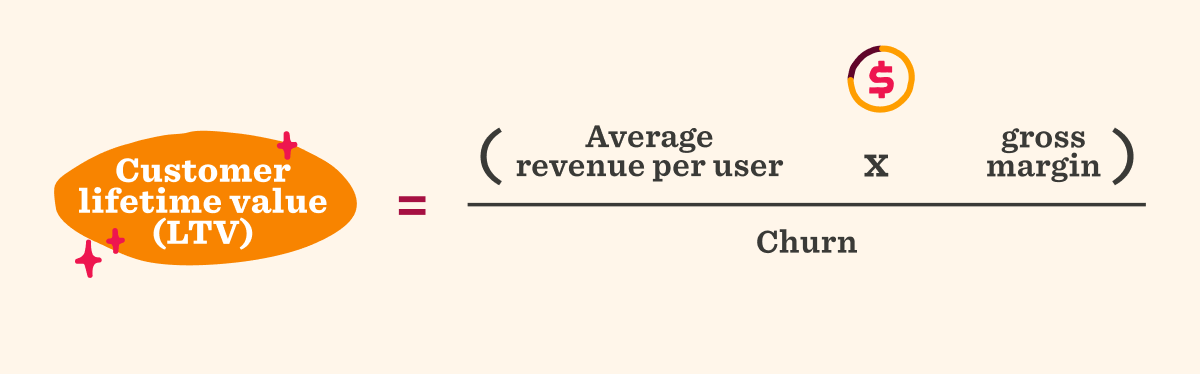
Customer lifetime value calculation examples
LTV looks different depending on your business model, pricing structure, and cost base. A SaaS company with high gross margins and low churn will land in a very different place than a subscription e-commerce brand with higher acquisition costs and seasonal churn. Here’s how that might play out:
LTV calculation example one: Monthly consumer subscription
A direct-to-consumer brand sells a monthly subscription box. Margins are tighter, and churn is higher, with customers canceling more freely.
Average monthly revenue per customer: $60
Gross margin: 40%
Monthly churn rate: 5%
LTV = $60 × .4 / .05
LTV = $24 / 0.05
LTV = $480
The $480 LTV means acquisition costs need to stay well below that figure for the unit economics to work. If monthly churn falls from 5 percent to 4 percent, LTV rises to $600, showing how retention improvements can quickly increase customer value.
LTV calculation example two: Annual services retainer
A boutique advisory firm charges annual retainers. Churn is low because relationships are sticky, and margins are strong because the primary cost is human time.
Average annual revenue per customer: $6,000
Gross margin: 65%
Annual churn rate: 10%
LTV = $6,000 × .65 / .1
LTV = $3,900 / 0.10
LTV = $39,000
For a retainer-based advisory firm, this creates room to invest more time in consultative sales, onboarding, and relationship-building. When client relationships are sticky and margins are strong, that upfront effort can translate into significant long-term value.
Factors that impact customer lifetime value
Many variables shape how much revenue a customer generates over their lifetime with your business. Understanding which levers move LTV most—and how to act on them—helps you make smarter decisions about where to invest in growth, retention, and pricing.
| Factor | What it means | Why it matters | How to improve |
| Purchase frequency | How often a customer buys, renews, or expands their contract. | Higher frequency increases revenue without adding new acquisition spend. | Use loyalty programs, usage-based prompts, and subscription models that encourage regular engagement. |
| Average order value | The average amount a customer spends per transaction or billing cycle. | Higher order values increase LTV directly, even when purchase frequency or customer lifespan stays the same. | Offer relevant upsells, cross-sells, tiered pricing, and value-add bundles. |
| Customer lifespan/retention rate | How long a customer continues doing business with you before churning. | Lifespan is the multiplier in the LTV equation. A longer relationship increases the impact of every other factor. | Strengthen onboarding, offer proactive customer success, run regular check-ins, and improve the product experience over time. |
| Customer satisfaction and experience | How well the product or service meets customer needs and expectations. | Satisfied customers are more likely to stay, spend more, and refer others, raising LTV without added acquisition spend. | Invest in support quality, act on feedback, and reduce friction across key moments in the customer journey. |
| Gross margin/profitability | Revenue retained after the cost of delivering the product or service. | LTV measures profitable revenue, not just top-line revenue. Thin margins can weaken LTV even when revenue looks strong. | Improve operational efficiency, optimize pricing, and reduce the cost of service delivery. |
| Customer acquisition cost | The total cost of winning a new customer. | CAC does not change LTV directly, but it determines whether customer lifetime value is high enough to generate a return. | Refine targeting, improve conversion rates, and invest in channels with stronger payback periods. |
| Discounting policies | How often and how deeply you discount to win or retain customers. | Discounts reduce gross margin and lower calculated LTV. A customer acquired at 30 percent off has a different economic profile than a full-price customer. | Price based on delivered value, limit discount frequency, and use usage-based incentives instead of price cuts. |
| Onboarding efficiency | How quickly new customers reach clear value from the product. | Slow time-to-value increases early churn, especially before customers fully adopt the product. | Streamline onboarding, provide dedicated success support in the first 90 days, and track key adoption milestones proactively. |
How to increase customer lifetime value
Customer lifetime value improves when teams retain customers longer, increase account value, and make better decisions with cleaner data. For SaaS companies, that means focusing on customer success, pricing strategy, expansion opportunities, and reliable Finance workflows that help teams track the metrics that matter.
1. Invest in customer success
One of the most effective ways to increase customer lifetime value is to improve retention. It’s usually more cost-effective to keep and grow existing customers than to replace them, so SaaS teams should treat customer success as a growth lever.
Start by identifying where customers lose momentum. Review onboarding completion, product adoption, support volume, renewal risk, and feedback from customer-facing teams. Focus on practical actions that help customers realize value faster, like:
- Make onboarding clearer, shorter, and easier to complete
- Share relevant feature updates based on customer needs and use cases
- Reduce support response times for high-impact issues
- Create proactive check-ins before renewal periods
- Track adoption signals so customer success teams can step in before usage drops
- Give account teams a shared view of customer health, risks, and expansion opportunities
Small improvements across the customer journey can build trust, strengthen loyalty, and help customers get more value over time.
2. Raise your prices
One direct way to increase LTV is to raise prices. Boosting average order value (in e-commerce) or annual contract value (in SaaS) gives you more revenue per customer, assuming all else remains equal.
However, there are diminishing returns. You always have to balance pricing with the value your product delivers to customers.
3. Build price escalations into your contracts
You can also increase LTV by building thoughtful expansion paths into your pricing strategy. Add-on features, usage-based tiers, and contract escalations can help revenue grow as customers get more value from the product.
The key is to connect price increases to clear value, so expansion feels earned rather than forced.
Recommended For Further Reading
Easily track customer lifetime value with FP&A software
The reality is that tracking LTV isn’t always easy. Measuring something as nuanced as customer sentiment takes a lot of data. You need to track when a customer first purchased, the terms of their contract, and any upsells, downgrades, and renewal rates over time. You’ll also want to break it down by cohort and product line to understand how different seasons, time periods, or offerings influence long-term value.
That means digging through a lot of customer data, which is often scattered across the customer lifecycle and tucked away in your CRM in hard-to-reach, hard-to-parse formats. It takes serious time and effort to pull, clean, and analyze that data. And to really optimize for sustainable growth, you’ll also want to layer in your customer acquisition cost (CAC).
FP&A platforms are changing how Finance teams manage SaaS metrics. Instead of pulling CRM, billing, and finance data into spreadsheets, modern tools can connect key business systems and bring customer, revenue, and planning data into one place. This gives Finance teams a clearer view of metrics like LTV, CAC, churn, and revenue performance, so they can track trends, test scenarios, and make faster decisions.
HiBob’s Finance Suite connects financial planning with HR, payroll, and people data, helping Finance and HR teams work from one trusted source of truth. For SaaS companies, that connected view makes it easier to understand how workforce plans, revenue goals, and customer growth strategies affect business performance.
Explore how HiBob’s Finance Suite brings planning, workforce, and business data together.
Customer lifetime value FAQs
What qualifies as a high CLV value?
A high customer lifetime value is three times your customer acquisition cost. If your LTV/CAC ratio is lower than that, it can mean your business is losing money in customer acquisition, while a ratio of more than 3:1 can indicate that you’re not putting enough money into growth opportunities.
What is the difference between CLV, NPS, and CSAT?
CLV, NPS, and CSAT each measure a different dimension of the customer relationship.
- CLV (or LTV) is a financial metric. It tells you how much total revenue—adjusted for margin—a customer is expected to generate over the course of your relationship. It’s a forward-looking number used in financial modeling, growth planning, and acquisition decisions.
- NPS (net promoter score) measures loyalty and advocacy. It asks customers how likely they are to recommend your product to a colleague and distills responses into a single score. A high NPS signals strong customer sentiment and correlates with organic growth through referrals.
- CSAT (customer satisfaction score) measures satisfaction with a specific interaction or experience. It’s a point-in-time signal, not a long-term relationship metric.
Customers who rate high on CSAT tend to score higher on NPS, and customers with strong NPS tend to stick around longer, which raises LTV. Used together, they give a more complete picture of customer health than any one metric alone.
Why is a 3x LTV to CAC ratio good?
The 3:1 LTV/CAC ratio has become a widely-used benchmark in SaaS because it reflects a sustainable balance between growth investment and long-term return. If your ratio falls below 3:1, it signals that you’re spending more to acquire customers than those customers generate in profit over their lifetime. Each new customer puts pressure on the business rather than supporting it, which becomes unsustainable at scale.
A ratio above 3:1 suggests healthy unit economics: you’re generating meaningful return on each dollar of acquisition spend. But the benchmark isn’t simply “higher is better.” A ratio of 8:1 or 10:1 often indicates underinvestment in growth. There may be untapped opportunity to put more into sales, marketing, or customer success.