
Employee engagement surveys do more than collect opinions. They help HR leaders see where their teams are thriving and where additional support can unlock stronger performance, clearer alignment, or better manager-team relationships. Whether it’s recognition, workload balance, career growth, or communication, engagement data shows you what’s influencing engagement across the organization and where small adjustments may have an outsized impact.
That visibility continues to grow in importance as U.S. employee engagement has fallen to its lowest level in a decade, with only 31 percent of people reporting they feel engaged. Another 17 percent self-report as actively disengaged.
The good news is that engagement isn’t fixed. With a well-designed survey, you can identify what’s working across high-performing teams, replicate successful practices, and address friction before it turns into turnover or burnout.
This guide walks you through practical question categories, scoring methods, and follow-up steps so your survey leads to meaningful improvements.
<< Download a free employee engagement survey template >>
Key insights
- Templates save HR teams hours of question development while ensuring comprehensive coverage of engagement drivers
- Effective surveys may include up to 12 core categories—from role satisfaction to career development—with both scaled and open-ended questions
- Scoring involves calculating category averages and tracking favorable response rates (percentage of “agree” and “strongly agree” responses)
- Success depends on setting clear objectives, protecting anonymity, and taking visible action on results
- Regular pulse surveys between annual comprehensive surveys help track progress and catch concerns early
What is an employee engagement survey?
An employee engagement survey is a structured tool that measures how connected, committed, and motivated people feel about their work, team, and organization. As Jim Harter, Ph.D., Chief Scientist of Workplace Management and Wellbeing at Gallup, explains, “Employee engagement trends matter for organizational leaders because declines signal potential vulnerabilities for businesses.”
These surveys go beyond basic job satisfaction surveys to assess whether people bring discretionary effort. Discretionary effort means people choose to go beyond the minimum requirements of their roles, such as proactively solving problems, supporting teammates, or taking ownership of outcomes that strengthen performance and retention.
Engagement surveys typically combine scaled statements and ratings (often using a five-point scale from “strongly disagree” to “strongly agree”) with a small number of open-ended prompts. This approach combines comparable data across periods with written feedback that explains what’s influencing the scores.
When done well—and followed by visible action—surveys signal that leadership is listening and willing to improve the company experience.
Benefits of using an employee engagement survey template
Engagement surveys work when people understand why each question matters. With 85% of team members most motivated by effective internal communication, clarity in survey design drives higher participation and more reliable results.
Templates create clarity and turn engagement surveys into a repeatable, data-driven process. They help HR teams:
- Keep consistency across time and teams, so results are comparable
- Save time by removing the need to build surveys from scratch
- Cover key drivers like communication, growth, recognition, and workload balance (with recognition alone motivating 37% of team members)
Strong templates are not one-size-fits-all. They give you a reliable starting point you can tailor to your organization’s needs.
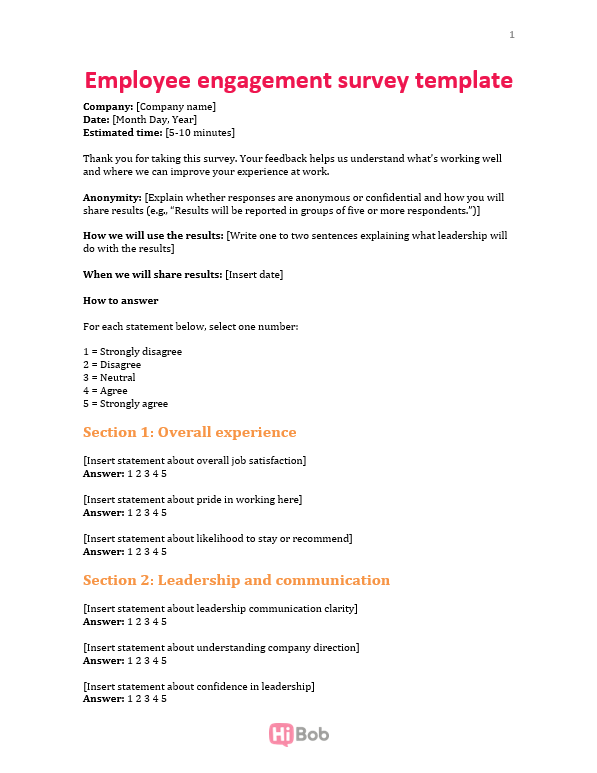
Employee engagement survey template
The template below gives you a ready-to-use survey you can copy into your HR platform or tool. It’s built around a simple 1 to 5 agreement scale and organized into core engagement categories so you can measure satisfaction, leadership trust, growth, workload, recognition, and team dynamics without overcomplicating the process.
Each section includes placeholders where you can insert statements tailored to your organization. Replace the bracketed prompts with clear, single-topic statements (for example, about career growth, communication clarity, or workload balance). Keep wording simple and neutral so responses stay consistent and comparable over time.
You can use the full template for an annual engagement survey or shorten it into a pulse survey by selecting only a few sections.
Company: [Company name]
Date: [Month Day, Year]
Estimated time: [5-10 minutes]
Thank you for taking this survey. Your feedback helps us understand what’s working well and where we can improve your experience at work.
Anonymity: [Explain whether responses are anonymous or confidential and how you will share results (e.g., “Results will be reported in groups of five or more respondents.”)]
How we will use the results: [Write one to two sentences explaining what leadership will do with the results]
When we will share results: [Insert date]
How to answer
For each statement below, select one number:
1 = Strongly disagree
2 = Disagree
3 = Neutral
4 = Agree
5 = Strongly agree
SECTION 1: Overall experience
[Insert statement about overall job satisfaction]
Answer: 1 2 3 4 5
[Insert statement about pride in working here]
Answer: 1 2 3 4 5
[Insert statement about likelihood to stay or recommend]
Answer: 1 2 3 4 5
SECTION 2: Leadership and communication
[Insert statement about leadership communication clarity]
Answer: 1 2 3 4 5
[Insert statement about understanding company direction]
Answer: 1 2 3 4 5
[Insert statement about confidence in leadership]
Answer: 1 2 3 4 5
SECTION 3: Manager support
[Insert statement about receiving helpful feedback from manager]
Answer: 1 2 3 4 5
[Insert statement about feeling supported by manager]
Answer: 1 2 3 4 5
[Insert statement about fair and consistent management practices]
Answer: 1 2 3 4 5
SECTION 4: Growth and development
[Insert statement about career growth opportunities]
Answer: 1 2 3 4 5
[Insert statement about access to learning resources]
Answer: 1 2 3 4 5
[Insert statement about clarity on advancement expectations]
Answer: 1 2 3 4 5
SECTION 5: Workload and resources
[Insert statement about having a manageable workload]
Answer: 1 2 3 4 5
[Insert statement about having the necessary tools and resources]
Answer: 1 2 3 4 5
[Insert statement about processes helping (not hindering) productivity]
Answer: 1 2 3 4 5
SECTION 6: Recognition and rewards
[Insert statement about feeling recognized for good work]
Answer: 1 2 3 4 5
[Insert statement about fairness of compensation and advancement]
Answer: 1 2 3 4 5
[Insert statement about satisfaction with total rewards (pay, benefits, perks)]
Answer: 1 2 3 4 5
SECTION 7: Teamwork and belonging
[Insert statement about collaboration within the team]
Answer: 1 2 3 4 5
[Insert statement about feeling respected and included]
Answer: 1 2 3 4 5
[Insert statement about being able to be authentic at work]
Answer: 1 2 3 4 5
SECTION 8: Open-ended questions
What’s one thing we should continue doing because it’s working well?
Answer:
What’s one change that would most improve your experience here?
Answer:
Is there anything else you’d like leadership to know?
Answer:
Thank you for sharing your feedback. We will review results and share next steps by [insert date].
Example employee engagement survey questions to ask
The categories below represent the core dimensions that drive engagement, satisfaction, and retention. You don’t need to include every category in every survey—many HR leaders rotate focus areas or prioritize categories based on recent feedback, organizational changes, or strategic initiatives.
The examples below are agreement-based statements that your team members can rate on a consistent scale. You can use something called a Likert scale—a structured rating system where respondents indicate how strongly they agree or disagree with a statement, typically on a five-point range from “strongly disagree” to “strongly agree.” This makes it easier to compare results across teams, track changes, and identify patterns in the data.
Each statement focuses on a single, specific aspect of the work experience using clear, jargon-free language that people at all levels can understand.
1. Satisfaction in role
Role satisfaction questions assess whether people find their work meaningful, appropriately challenging, and aligned with their skills and interests. This category helps identify whether people feel fulfilled by their daily responsibilities or are experiencing boredom, overwhelm, or misalignment.
Ask people to rate their agreement with statements like:
- I find my work meaningful and fulfilling
- My role makes good use of my skills and strengths
- I have the right amount of work to stay challenged without feeling overwhelmed
- I understand how my role contributes to our organization’s success
- I’m satisfied with the variety of tasks and responsibilities in my role
2. Communication with leadership
Leadership communication questions assess whether senior leaders share direction clearly, explain decisions transparently, and create space for two-way dialogue. This category helps you understand whether people trust leadership, feel informed about business priorities, and see how strategy connects to their day-to-day work.
Ask people to rate their agreement with statements like:
- Senior leadership communicates openly about our organization’s direction and performance
- I understand how leadership decisions affect my team and work
- Leaders explain the reasoning behind important changes
- I have confidence in our senior leadership team
- Leadership’s actions align with the values they communicate
3. Career development opportunities and encouragement
Career development questions measure whether people see a future at your organization. They help you identify whether growth paths feel clear, whether managers actively support team member development, and whether your team is using learning and development resources effectively.
Ask people to rate their agreement with statements like:
- I see opportunities for career growth within this organization
- My manager supports my professional development
- I have access to training and resources to build new skills
- I understand what I need to do to advance in my career
- This organization invests in helping people grow professionally
<< Download the professional development plan template to get started >>
4. Engagement levels
Engagement level questions capture how connected and motivated people feel in their work. They help you measure emotional commitment, discretionary effort, and long-term intent—signals that often predict retention and performance trends. Organizations can use this category as a consistent benchmark to track engagement over time.
Ask people to rate their agreement with statements like:
- I’m excited to come to work most days
- I feel personally driven to help this organization succeed
- I would recommend this organization as a great place to work
- I’m proud to work here
- I rarely think about looking for work elsewhere
5. Compensation and recognition
Compensation and recognition questions help you understand whether people feel valued for their contributions. While fair pay sets the baseline for helping your team feel recognized and compensated for their work, day-to-day acknowledgment and visible advancement opportunities can shape how appreciated people feel.
Ask people to rate their agreement with statements like:
- I’m satisfied with my compensation relative to similar roles in other organizations
- I receive recognition when I do good work
- Leadership distributes compensation and advancement opportunities fairly
- My manager and leadership value and acknowledge my contributions
- I’m satisfied with the total rewards (pay, benefits, and perks) I receive
6. Benefits and flexibility
Benefits and flexibility questions help you understand whether your total rewards and work arrangements support people’s day-to-day realities. This category measures satisfaction with benefits coverage, time-off policies, and flexibility around when and where work happens—all factors that can influence retention, wellbeing, and productivity.
Ask people to rate their agreement with statements like:
- I’m satisfied with the benefits package offered
- I have the flexibility I need to balance work and personal responsibilities
- Our paid time-off (PTO) policies support my wellbeing
- I can work in ways that help me be my most productive
- The organization supports different working styles and preferences
7. Company values and culture
Company values and culture questions assess whether your organization’s stated principles show up in everyday behavior. This category helps you evaluate alignment between messaging and experience, such as whether people feel respected, included, and able to contribute authentically.
Ask people to rate their agreement with statements like:
- This organization’s values align with my personal values
- We have a culture of respect and inclusion
- I can be myself at work
- Leadership demonstrates our values through their actions
- This organization prioritizes diversity, equity, inclusion, and belonging (DEI&B)
8. Growth and learning opportunities
Growth and learning questions help you assess whether people are building capabilities that matter for their careers and for the organization’s future needs. This category measures access to development opportunities, exposure to stretch work, and managers’ success in encouraging skill growth.
Ask people to rate their agreement with statements like:
- I have opportunities to learn and develop new skills
- My work includes challenging assignments that help me grow
- I can access training and development resources when I need them
- My manager encourages me to take on stretch assignments
- This organization values continuous learning
9. Teamwork
Teamwork questions measure how effectively people collaborate within and across teams. They help you evaluate trust, shared accountability, and whether team dynamics support strong performance.
Ask people to rate their agreement with statements like:
- My team works well together to achieve shared goals
- I trust my co-workers to deliver quality work
- People on my team support each other
- Collaboration across teams is effective
- I have positive relationships with my colleagues
10. Company processes and procedures
Company process questions assess whether systems, policies, and decision-making processes support effective work or create unnecessary friction. Even highly engaged teams can lose momentum if workflows are unclear, approvals stall, or tools don’t align. This category helps you identify structural barriers that affect productivity and morale.
Ask people to rate their agreement with statements like:
- Our processes and systems help me work efficiently
- Decision-making is clear and timely
- Leadership applies policies fairly and consistently
- I have the tools and resources I need to do my job well
- Internal communications are clear and helpful
11. Future outlook
Future outlook questions measure confidence in the organization’s direction and long-term stability. This category helps you understand whether people believe in the strategy, see a future for themselves within the company, and feel motivated by where the organization is heading.
Ask people to rate their agreement with statements like:
- I’m optimistic about this organization’s future
- I see myself working here in two years
- I believe this organization will be successful
- I’m excited about where we’re headed
- I have confidence in our strategy and direction
12. Open-ended questions
Open-ended questions help you understand the reasoning behind the scores. While scaled responses create the consistency you need to see clear patterns, written feedback highlights specific examples, recurring themes, and language you can bring directly into action planning. Including two to three open-ended prompts in each survey helps you uncover what’s driving high scores and what may be lowering them.
Consider prompts like:
- What do you value most about working here?
- What would you change to improve your experience?
- What resources or support would help you perform at your best?
- Is there anything else you’d like leadership to know?
How to score your employee engagement survey results
Most engagement surveys use a five-point Likert scale where responses receive numerical values: Strongly disagree = 1, Disagree = 2, Neutral = 3, Agree = 4, Strongly agree = 5. This consistent scoring system makes analysis and comparison straightforward.
Calculate scores using these methods:
- Category scores: Average all responses within each question category (like “Career development” or “Leadership communication”) to get a category score on a 1.0-5.0 scale
- Overall engagement index: Average all category scores to create a single engagement score that tracks overall organizational health
- Favorable response rate: Calculate the percentage of “Agree” and “Strongly agree” responses (4s and 5s) as an alternative metric that’s easier to communicate to leadership
Scores are most valuable when you compare them across categories, departments, time periods, or industry benchmarks.
How to create an effective employee engagement survey
While proven templates save significant time, you sometimes need to customize them to address specific organizational needs. These best practices ensure your surveys produce reliable, actionable insights that drive meaningful engagement strategies.
Set clear objectives and expectations
Effective surveys start with clarity about what you want to learn and what you’ll do with the results. Before launching any survey, define which aspects of engagement you’re measuring and why: Are you investigating recent turnover trends, preparing for organizational changes, or establishing baseline metrics for the first time?
Setting expectations with participants is equally important. Tell people upfront:
- Why you’re conducting the survey and how you use results
- How long the survey takes to complete (aim for 10-15 minutes)
- How you’ll protect anonymity and confidentiality
- When they can expect to see results and what actions might follow
Transparency builds trust and increases participation rates. People provide more honest feedback when they understand the purpose and see that leadership takes results seriously.
Use relevant questions
Every question must serve a clear purpose and align with what you can realistically address. Avoid including questions about topics outside your control or areas where you’re not prepared to take action—asking for feedback you can’t act on damages trust and credibility.
Write effective questions by following these guidelines:
- Focus on one topic per question: Avoid double-barreled questions like “My manager communicates clearly and supports my development”
- Use clear, simple language: Write at an eighth-grade reading level and avoid HR jargon or acronyms
- Stay neutral: Consider phrasing carefully so you don’t lead respondents toward particular answers
- Make questions specific: “I receive helpful feedback on my work” works better than “Communication is good”
- Align with your culture: Use terminology and examples that resonate with your organization
Combine quantitative and qualitative elements
The most effective surveys mix scaled questions with open-ended prompts. Quantitative data makes it easy to track trends, compare groups, and identify patterns, while qualitative data provides context, captures nuance, and surfaces specific examples that help you understand what’s driving the numbers.
Include two to four open-ended questions strategically placed throughout the survey or at the end. Keep prompts specific rather than generic—instead of “Any other comments?” ask “What’s one thing we could change to improve your experience?” or “What support would help you perform at your best?”
Open-ended responses require more analysis time, but they often contain the most actionable insights and help you understand the story behind the scores.
Test the survey
Pilot the survey with a representative sample (10-20 people across different roles and departments) to identify problems before full launch. Ask pilot participants to complete the survey and provide feedback on clarity, length, technical functionality, and relevance.
Testing provides a completion time estimate you can share with all participants. Use pilot feedback to refine questions, adjust survey flow, and fix technical problems before launch.
Develop a follow-up action plan
Collecting feedback means nothing without action—surveying without follow-through damages engagement more than not surveying at all. Before launching any survey, prepare leadership for what comes next and establish clear processes for acting on results.
Plan your follow-up process:
- Analyze results within two to three weeks: Share high-level findings with all participants and detailed data with leadership
- Identify two to three priority areas: Focus on categories with lowest scores or biggest gaps between current and desired states
- Create specific action plans: Define concrete steps, owners, and timelines for each priority area
- Communicate plans: Share what you learned and what you’ll do about it with all participants
- Track progress: Use pulse surveys or check-ins to measure whether actions improve scores
- Close the loop: Report back on progress and celebrate improvements
Visible follow-through builds trust and increases participation in future surveys. When people see their feedback leads to real changes, they provide more honest input next time.
<< Download the employee satisfaction survey template to get started >>
Recommended For Further Reading
Improve satisfaction with employee engagement surveys
Employee engagement surveys give you a clear view of what drives performance, retention, and manager effectiveness across your organization. This template helps you move faster, so you can focus on acting on what matters.
The real value comes from what you do next. Review results quickly, prioritize a few high-impact areas, and communicate clear actions. Small, targeted changes—like improving manager feedback, adjusting workloads, or clarifying growth paths—can drive measurable gains when you base them on real data.
Run regular pulse surveys to track progress and respond early. Turn engagement into something you manage continuously—not something you revisit once a year.
HiBob takes this further. HR and Finance work from the same real-time data, so engagement insights don’t sit in isolation—they connect directly to retention risk, workforce costs, and planning decisions. Teams can see which groups are at risk of attrition, understand the financial impact, and adjust hiring plans, compensation, or team structures before issues escalate.
Because everything lives in one system, ownership is clear. HR, Finance, and managers work from the same source of truth, align faster, and move from insight to action without chasing data across tools. The result is quicker decisions, tighter control over workforce spend, and more consistent execution across the business.
<<Download the employee engagement survey template to get started.>>
Employee engagement survey template FAQ
Why should organizations invest in employee engagement surveys?
Engagement surveys help you identify what drives satisfaction before people leave, making it possible to address concerns proactively. In fact, high engagement can reduce turnover by as much as 51 percent, reinforcing how connected and motivated teams help protect your talent pipeline.
For HR leaders, this makes engagement measurement a strategic priority, providing the insight needed to strengthen manager practices, recognition efforts, and everyday team experiences.
How do I increase employee engagement survey participation?
Start by communicating why you’re running the survey and what decisions it will influence. Be specific. Instead of saying “We want your feedback,” explain how the results will shape priorities like workload planning, manager training, or benefits adjustments.
Reinforce anonymity clearly and repeatedly. Explain how you protect responses, whether you aggregate results, and your minimum response threshold before sharing data with managers.
After the survey closes, share a summary of key findings, even if the results are mixed. Outline two or three concrete actions leadership will take and provide a timeline. When people see change tied directly to feedback, participation in future surveys increases naturally.
Finally, equip managers with talking points so they can encourage participation within their teams. Direct encouragement from managers often drives stronger response rates than company-wide reminders alone.
What are the 5 Cs of employee engagement?
The 5 Cs of employee engagement are a simple framework that highlights what drives strong engagement at work:
- Clarity: Team members understand their roles, goals, and how their work connects to business outcomes
- Connection: People feel a sense of belonging with their co-workers and alignment with company values
- Contribution: Team members see how their work makes an impact and feel that their efforts matter
- Credibility: Leadership builds trust through transparency, consistency, and follow-through
- Career: There are clear opportunities for growth, development, and progression
Together, these five elements help organizations build a more engaged, motivated, and high-performing workforce.