
An employee engagement action plan is a practical framework that translates feedback into specific, trackable initiatives. It helps organizations address engagement gaps with defined actions, ownership, and measurable outcomes.
Employee engagement surveys and action plans work hand in hand. Surveys gather valuable feedback, while action plans transform those insights into meaningful, visible change. Without a structured approach to turn survey data into concrete initiatives, even the most comprehensive engagement insights go unused while workplace challenges continue.
Disengagement isn’t just a morale issue, it has a measurable business impact as well. In 2024 alone, disengagement cost the global economy an estimated $438 billion in lost productivity. Organizations risk lower performance, higher turnover, and missed growth opportunities when feedback sits in dashboards without follow-through.
This guide shows you how to create and implement an employee engagement action plan that transforms feedback into lasting improvements, from analyzing survey results to measuring long-term impact.
<<Download our free employee action plan template.>>
Key insights
- An employee engagement action plan should move from survey results to concrete action within 30 days to maintain momentum and show people their feedback drives change
- Effective employee engagement action plans focus on two to three high-impact priorities rather than trying to address every challenge at once to prevent overwhelm and allow teams to see meaningful progress
- A successful employee engagement action plan requires collaboration from all departments, clear ownership, realistic timelines, and transparent progress tracking
- Strong employee engagement action plans balance quick wins that build credibility with longer-term initiatives that drive sustained cultural change
- Consistent communication is essential to any employee engagement action plan, reinforcing trust and demonstrating that leadership acts on feedback
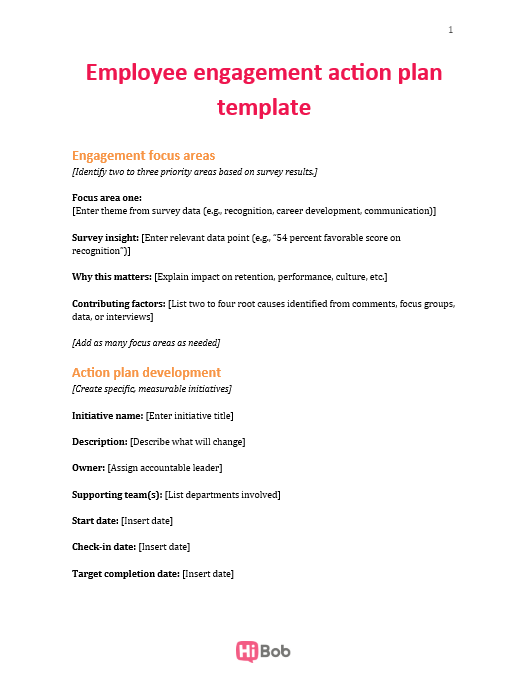
Employee engagement action plan template
Having a structured framework helps HR leaders move from analysis to action quickly and consistently. Start with this template, then customize it for your needs using our step-by-step process for creating an employee engagement action plan.
1. Engagement focus areas
[Identify two to three priority areas based on survey results.]
Focus area one:
[Enter theme from survey data (e.g., recognition, career development, communication)]
Survey insight: [Enter relevant data point (e.g., “54 percent favorable score on recognition”)]
Why this matters: [Explain impact on retention, performance, culture, etc.]
Contributing factors: [List two to four root causes identified from comments, focus groups, data, or interviews]
[Add as many focus areas as needed]
2. Action plan development
[Create specific, measurable initiatives]
Initiative name: [Enter initiative title]
Description: [Describe what will change]
Owner: [Assign accountable leader]
Supporting team(s): [List departments involved]
Start date: [Insert date]
Check-in date: [Insert date]
Target completion date: [Insert date]
3. Success indicators
[Define how you will measure progress]
Primary metric: [Example: Engagement score on X question]
Baseline: [Current score]
Target: [Desired improvement]
Review cadence: [Monthly/Quarterly]
4. 90-day implementation roadmap
Lay out a clear timeline for each step of your employee engagement action plan.
Days 1-30: [Communication plan and quick wins]
Days 31-60: [Launch initiatives and build routines]
Days 61-90: [Measure early results and adjust]
5. Communication plan
Answer the following questions to clarify how you’ll communicate the action plan and follow-up information with team members.
How will you share findings?
[Explain communication strategies (e.g., town hall, newsletter, or manager cascade)]
How often will you provide updates?
[Monthly/Quarterly]
How will you gather follow-up feedback?
[Clarify feedback channels (e.g., pulse surveys, focus groups, or open forums)]
How to make an employee action plan
Creating an effective action plan starts by stepping back to ensure you’re building the right plan—not just moving quickly. Because engagement surveys and action planning go hand in hand, the first step of this process returns to your survey data to ground decisions in what your people are actually experiencing.
From there, a systematic approach moves through analysis, prioritization, planning, and implementation. While the process may seem linear, it’s iterative—HR leaders refine their plans as they gather more input and learn what works.
The following four steps provide a proven framework HR teams use to turn engagement insights into meaningful change.
1. Send out an employee engagement survey and gather additional feedback
Results from the 2024 United Kingdom Civil Service People Survey highlight the value of consistent measurement in driving targeted improvements—that’s why effective action planning begins with gathering honest feedback through well-designed surveys. The quality of your action plan depends directly on the quality of insights you collect.
Effective engagement surveys include these elements:
- Timing and frequency: Conduct annual comprehensive surveys supplemented by quarterly pulse surveys to track progress and catch emerging patterns early
- Question design: Include a mix of quantitative rating scales and open-ended questions that explore key engagement drivers like growth opportunities, recognition, leadership trust, workload, and workplace culture
- Anonymity and trust: Ensure responses remain confidential to encourage honest feedback, especially on sensitive topics like management effectiveness or compensation fairness
- Participation rates: Aim for 70-80 percent response rates by communicating why feedback matters, how you will use it, and what changed from previous surveys
- Some organizations also incorporate stay interviews, exit interviews, and continuous feedback channels to supplement formal surveys. Large-scale efforts like the 2024 round of the European Working Conditions Survey also underscore the importance of collecting comparative data on employee experiences across different regions. Modern HR platforms can automate survey distribution, track participation in various channels in real time, and analyze results by department, region, or tenure to identify patterns.
2. Review the results with relevant stakeholders
Facilitate collaborative analysis sessions with executives, department heads, and team leaders to interpret findings and identify priority areas. This step transforms raw data into shared understanding and builds buy-in for the actions that follow.
The stakeholder review process involves:
- Assembling a cross-functional team: Include HR leaders who interpret engagement data and guide the process, senior executives who can allocate resources, department managers who will implement changes, and (optionally) people representatives who can provide frontline perspective
- Scheduling dedicated analysis time: Block two to three hours within two weeks of survey closure to review results while feedback is fresh and momentum is high
- Presenting data clearly: Share overall engagement scores, trends over time, comparisons to previous surveys or industry benchmarks, and breakdowns by department, location, or demographic group when sample sizes allow
Identifying patterns requires looking at both quantitative and qualitative data:
- Note positives and areas for improvement: Celebrate high-scoring areas like “I understand how my work contributes to company goals” while flagging concerning trends like declining scores in “I have opportunities to learn and grow”
- Look for themes across questions: Group related survey items to identify broader challenges
- Examine qualitative feedback: Review open-ended comments to understand the “why” behind scores and identify specific pain points people experience
- Compare across segments: Identify whether engagement gaps are company-wide or concentrated in specific teams, locations, or tenure groups
Prioritization discussions help stakeholders determine which areas most strongly impact engagement. They also help narrow down which are feasible to address with available resources, where quick wins are possible, and which align with current business priorities. Using an impact-versus-effort matrix—a decision-making tool that plots initiatives based on expected impact and required effort—helps teams evaluate options systematically.
This collaborative review builds shared ownership. When leaders participate in analysis, they’re more likely to champion solutions and hold themselves accountable for progress.
3. Use SMART goals and collaboration to strengthen your employee engagement action plan
With priorities identified, HR leaders work with stakeholders to design specific initiatives that address the root causes of engagement gaps. Effective action plans focus on two to three high-impact areas rather than trying to fix everything at once; this prevents overwhelm and allows teams to see meaningful progress.
Creating SMART goals for each focus area ensures clarity and accountability:
- Specific: Clearly define what will change—instead of “improve communication,” specify something like, “Implement monthly team meetings where managers share company updates and answer questions”
- Measurable: Identify quantitative metrics like “increase favorable responses to ‘I feel informed about company direction’ from 62 percent to 75 percent by year-end” or qualitative indicators like “positive feedback in pulse survey comments”
- Achievable: Ensure actions are realistic given available budget, time, and organizational capacity
- Relevant: Align initiatives with both survey findings and broader business objectives like retention, productivity, or culture goals
- Time-bound: Set clear deadlines for implementation milestones and final outcomes
Developing solutions through collaborative brainstorming yields the most practical results:
- Involve affected teams: Host focus groups or working sessions with people who experience the engagement gap firsthand—they often have the most practical ideas for improvement
- Research best practices: Look at what peer organizations or industry leaders do to address similar challenges, but customize approaches to fit your culture
- Consider multiple solutions: Develop three to five potential initiatives for each focus area, then evaluate which will have the greatest impact with reasonable effort
- Address root causes: If survey feedback indicates people don’t feel recognized, dig deeper to understand whether the challenge is a lack of manager training, absence of formal recognition programs, or unspoken cultural norms that discourage appreciation
Assigning clear task ownership is crucial. Each initiative needs a designated owner—typically a senior leader or department head who has authority to allocate resources, make decisions, and drive accountability. Owners may delegate execution to working groups or project teams, but ultimate responsibility sits with one person.
Resource planning prevents initiatives from stalling midway through implementation. Identify upfront what each initiative requires in terms of budget, technology, staff time, or external expertise.
4. Implement your plan and track results
Even the most thoughtful action plan creates no value until it’s executed. Implementation is the phase where HR leaders activate initiatives, communicate progress transparently, and monitor impact to ensure actions drive meaningful improvement.
The implementation timeline approach includes:
- Create a 90-day roadmap: Break the first quarter into three 30-day phases—days 1-30 focus on communicating findings and building awareness, days 31-60 emphasize launching quick wins and establishing routines, and days 61-90 concentrate on measuring early progress and adjusting course
- Sequence initiatives strategically: Start with quick wins that build credibility and momentum while simultaneously planning longer-term initiatives
- Build in checkpoints: Schedule monthly progress reviews with initiative owners to discuss what’s working, what barriers exist, and what support is needed
Tracking progress effectively requires:
- Monitoring leading behaviors: Tracking participation rates, adoption metrics, and observable changes that signal whether initiatives are taking hold
- Measuring engagement impact: Conducting pulse surveys every 60 to 90 days focused on the specific areas you’re addressing to determine whether scores improve
- Gathering qualitative feedback: Creating channels for people to share what they’re experiencing as changes roll out
- Reviewing business outcomes: Watching for shifts in retention rates, internal mobility, productivity trends, or other results linked to engagement efforts
Communication throughout implementation builds trust and maintains momentum:
- Share the action plan broadly: Within 30 days of survey completion, communicate survey findings, the two to three focus areas selected, specific initiatives planned, and how you’ll track progress
- Provide regular updates: Use monthly newsletters, town halls, team meetings, or internal communication platforms to share what you’ve launched, early wins, and upcoming milestones
- Celebrate progress: Recognize teams and leaders driving change, highlight positive feedback from people experiencing improvements, and acknowledge when initiatives achieve their goals
- Be transparent about challenges: If an initiative isn’t working as planned, explain what you’re learning and how you’re adjusting rather than going silent
Implementation isn’t a one-time event but an ongoing cycle. As you complete initiatives and measure impact, you’ll identify new opportunities and refine your approach based on what you learn. Successful organizations embed action planning into their regular rhythm, reviewing engagement data and progress quarterly rather than treating it as an annual exercise.
Employee engagement action plan examples
Concrete examples help HR leaders translate survey insights into focused, high-impact action. Below are common scenarios organizations face, with practical initiatives that drive measurable improvement.
These examples are a starting point—the most effective plans reflect your organization’s culture, priorities, and data.
Employee recognition
Focus area: Recognition
Survey insight: Favorable responses to “I feel recognized for my contributions” fall below target, with comments citing inconsistent manager appreciation.
Why this matters: Recognition is directly linked to engagement, retention, and discretionary effort. Organizations with recognition programs have 31 percent lower voluntary turnover and are 12 times more likely to have stronger business outcomes.
Root causes:
- Managers lack structured guidance on how and when to recognize team members
- Recognition happens informally but isn’t visible across teams
- Appreciation isn’t consistently tied to company values or strategic priorities
Evidence: Open-text survey comments referencing team members who “feel overlooked,” lower engagement scores in teams with limited manager check-ins, and exit interview feedback citing lack of acknowledgment.
Initiative: Launch a peer-to-peer recognition program, train managers to provide timely and specific recognition in one on ones and team meetings, and embed structured recognition moments into recurring meetings. Tie recognition explicitly to company values and introduce quarterly awards aligned with collaboration, performance, or innovation goals.
Owner: Head of HR (with department managers accountable for implementation)
Success metrics:
- Primary metric: Increase favorable responses to “I feel recognized for my contributions”
- Baseline: 58 percent favorable
- Target: Add 10 percentage point improvement within two survey cycles
- Secondary indicators: Participation rates in recognition program, retention in high-performing teams, internal mobility rates
90-day roadmap:
- Days 1-30: Announce initiative, train managers, launch pilot recognition tool or process
- Days 31-60: Roll out peer recognition company-wide and embed recognition moments into team meetings
- Days 61-90: Review participation data, gather qualitative feedback, and adjust program design as needed
Communication approach: Share survey findings and recognition focus area during an all-hands meeting, provide monthly updates on participation and early wins, and gather follow-up feedback through pulse surveys and manager check-ins.
Career development
Focus area: Growth and progression
Survey insight: Low scores on growth and future opportunity, with feedback pointing to unclear promotion paths.
Why this matters: 94% of people say they would stay longer at a company that invests in their development.
Root causes:
- No clear career frameworks or progression criteria
- Inconsistent development conversations
- Limited visibility into learning opportunities
Initiative: Define role-based career paths, introduce quarterly development conversations, allocate learning budgets, and launch mentorship programs supported by curated learning resources.
Owner: Chief People Officer (with department heads accountable)
Success metrics:
- Improve growth-related engagement scores (+8–12 points)
- Internal promotion rates
- Learning program participation
90-day roadmap:
- Days 1–30: Finalize and communicate career frameworks
- Days 31–60: Train managers and launch mentorship pilot
- Days 61–90: Roll out learning programs and gather feedback
Communication approach: Introduce the framework company-wide, equip managers with toolkits, and share progress through regular updates and pulse surveys.
Wellbeing and workload
Focus area: Wellbeing and burnout prevention
Survey insight: Low scores on work-life balance and workload, with comments about meeting overload and after-hours expectations.
Why this matters: Burnout reduces productivity and increases turnover risk. Sustainable performance depends on healthy workload practices.
Root causes:
- Excessive meetings limit focused work
- Unclear norms around after-hours communication
- Uneven workload distribution
Initiative: Introduce meeting-free focus time, define communication boundaries, expand wellbeing resources, and conduct workload reviews to rebalance priorities.
Owner: VP of People (with department leaders accountable)
Success metrics:
- Improve work-life balance scores (+10 points)
- Absenteeism and PTO usage trends
- Burnout-related survey feedback
90-day roadmap:
- Days 1–30: Set communication norms and introduce focus time
- Days 31–60: Review workloads and expand wellbeing support
- Days 61–90: Evaluate feedback and adjust practices
Communication approach: Reinforce expectations through leadership updates, provide manager guidance, and collect ongoing feedback through pulse surveys.
Communication and alignment
Focus area: Communication transparency and cross-team collaboration
Survey insight: Lower scores on items such as “I feel informed about company updates” and “Teams collaborate effectively across departments,” with comments highlighting siloed communication.
Why this matters: A recent survey revealed that 86 percent of respondents believe ineffective communication is the underlying reason for workplace failures. Clear communication and collaboration improve alignment, speed of execution, and team trust.
Root causes:
- No standardized communication cadence across teams
- Information scattered across multiple tools or platforms
- Managers lacking guidance on cascading updates effectively
- Limited structured opportunities for cross-department collaboration
Evidence: Engagement score gaps across departments, qualitative feedback about confusion on priorities, and inconsistent adoption of collaboration tools across remote and in-office teams.
Initiative: Set a consistent communication cadence, centralize information, train managers to cascade updates, and create structured cross-team collaboration.
Owner: Head of Internal Communications (with department leaders accountable for local implementation)
Success metrics:
- Primary metric: Improvement in favorable responses to “I feel informed about company updates”
- Baseline: 61 percent favorable
- Target: Add 8-10 percentage point improvement within two engagement cycles
- Secondary indicators: All-hands attendance rates, internal hub usage metrics, cross-department project participation, and collaboration tool adoption rates
90-Day roadmap:
- Days 1-30: Define communication cadence and audit existing tools
- Days 31-60: Launch centralized internal hub and manager cascade training
- Days 61-90: Introduce multi-department working groups and host first knowledge-sharing session
Communication approach: Announce the communication framework during an all-hands meeting, provide managers with clear messaging templates, and gather follow-up feedback through pulse surveys and cross-team retrospectives.
Recommended For Further Reading
Strengthen your team with an employee engagement action plan
Engagement action planning isn’t a one-time initiative. It’s a repeatable cycle of listening, prioritizing, acting, and measuring. The template in this guide gives you a structured starting point to move from survey data to defined next steps, then track whether those actions are actually improving the employee experience.
Modern HR platforms can support this process by centralizing feedback, organizing action items, tracking accountability, and giving managers visibility into their team’s engagement data. When the operational pieces run smoothly, HR leaders can spend less time chasing updates and more time partnering with managers on meaningful improvements.
Start with one focused priority, build early momentum, and expand from there. Download the free employee engagement action plan template to organize your next steps, and explore how HiBob helps HR teams turn engagement insights into measurable progress.
<<Download our free employee action plan template.>>
Employee engagement action plan FAQ
What is an employee engagement action plan?
An employee engagement action plan is a structured framework that transforms survey feedback and workforce insights into specific, measurable initiatives designed to improve the employee experience, strengthen company culture, and drive business outcomes. It serves as a roadmap for HR leaders to address engagement gaps systematically rather than reactively.
The core purpose centers on closing the loop between listening to people and taking meaningful action to demonstrate their feedback matters. Effective action plans translate broad themes like “improving communication effectiveness” or “expanding career growth opportunities” into concrete steps.
Action plans work best when they involve people at all levels. This includes senior leaders who champion initiatives and allocate resources, managers who implement changes with their teams, and individual contributors who help shape solutions. Successful plans balance quick wins that build momentum with longer-term HR initiatives that create lasting change.
What are the 7 steps of an action plan?
An effective action plan follows a clear, structured process:
- Define the goal based on survey insights
- Analyze data to identify root causes
- Prioritize focus areas based on impact and feasibility
- Define specific initiatives and actions
- Assign ownership and accountability
- Set success metrics to track progress
- Execute, monitor results, and refine as needed
While these steps create structure, the process is iterative—teams adjust their plans as they gather feedback and measure impact.
Why is employee engagement important?
Employee engagement matters because it turns insight into impact. It helps organizations identify what’s driving performance, where risks are building, and how to act with focus.
For HR and Finance leaders, engagement data supports better planning, clearer prioritization, and more confident decisions about where to invest time, budget, and resources.