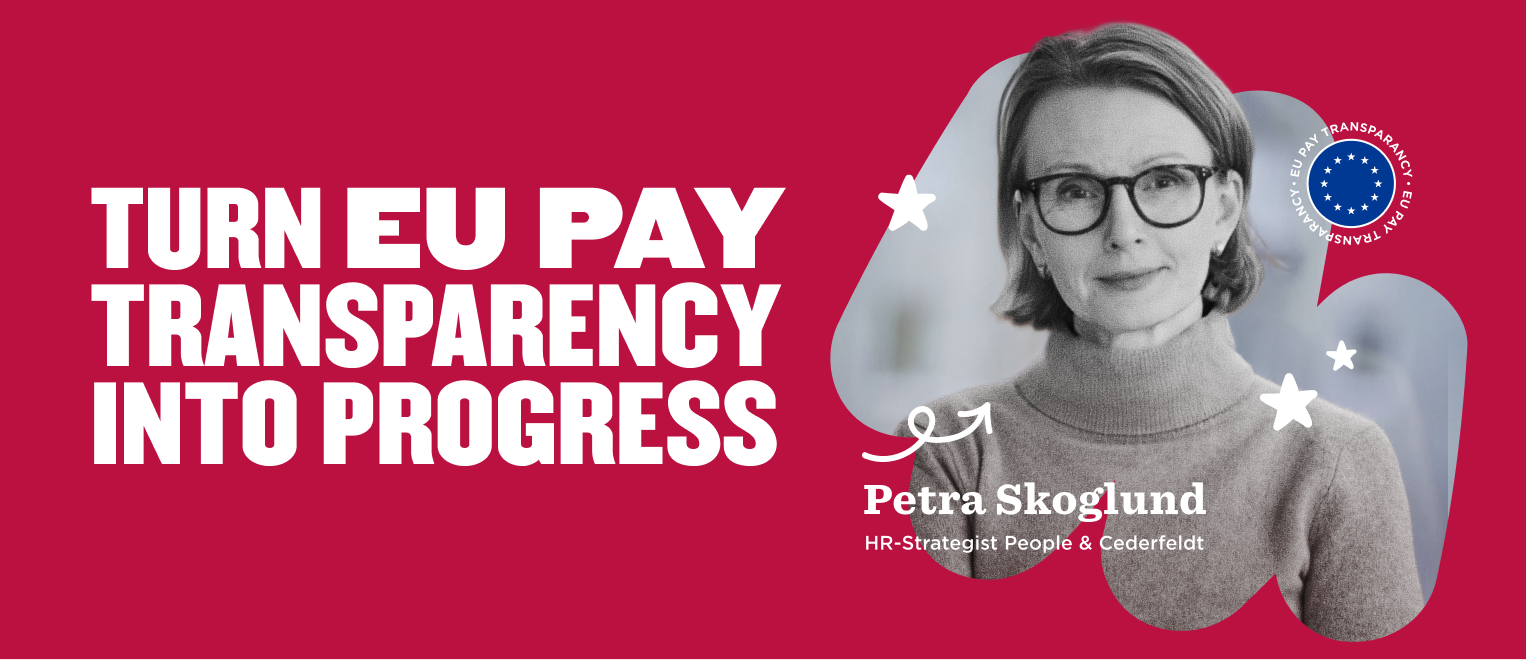
Using pay transparency to drive business growth
Most organisations preparing for the EU Pay Transparency Directive are asking the wrong question.
They are asking: How do we get ready for pay transparency?
The real question is: Can our pay strategy keep up with the market we are operating in?
Those are very different questions. And the gap between them is where most organisations are quietly losing money right now.
Across Europe, new regulations and rapid labor-market changes are forcing leaders to rethink how they define and reward work. The EU directive on pay transparency is part of that shift, but it is not the whole story.
For the past five years, I have worked as an interim CHRO specialising in turnaround assignments. Companies that are bleeding from people costs, not because they pay too much, but because people do not understand their context. Sickness absence. Staff turnover. Conflict. Disengaged employees spending their energy trying to figure out why a colleague earns more instead of doing their job.
That sounds soft. It is not. It is hard economics.
The real challenge isn’t transparency. Its complexity.
The reality check is that transparency is not the challenge. Complexity in organisational design that prevents clarity for employees is the real issue.
When people talk about pay transparency, they tend to focus on the directive. Deadlines. Reports. Compliance.
But there are three forces reshaping pay right now, and ‘the directive’ is only one of them.
- Uneven regulation across Europe: the directive
There is no single EU rollout. Countries are moving at different speeds: some are delaying, others are accelerating, or going further than the directive requires. For organisations operating across multiple markets, this is not a fixed deadline for preparation. It is a moving target that requires flexibility and structural thinking, not a one-time compliance exercise. - AI is reshaping the value of work
Certain skills are increasing in value rapidly. New roles are emerging faster than traditional frameworks can adapt to them. Pay differences are widening, not gradually, but sharply. The labour market is fragmenting, and the organisations that built their pay structures for a stable, predictable world are finding that those structures no longer hold. - Traditional pay models simply cannot keep up
Traditional pay models were built for annual cycles, internal consistency, and controlled decisions. What is needed now is real-time visibility, cross-market alignment, and the ability to explain every pay decision before it is challenged.
Transparency is not creating these problems. It is revealing that most organisations can no longer explain their pay decisions.
And when organisations cannot explain pay, the consequences do not stay theoretical. They show up quickly, and in ways that directly impact performance.
Why this is already costing you more than you think
When people cannot understand pay decisions, the impact shows up quickly, and not where most leaders expect.
A narrative review of 103 studies published in the Journal of Theoretical Social Psychology confirms what I saw: perceived unfairness around pay is one of the strongest psychosocial risk factors for sickness absence.
A Finnish longitudinal study of more than 31,000 employees found that low perceived fairness in decision-making was directly linked to longer periods of sickness absence, even after controlling for age, income, and health behaviours.
This is not a soft people issue. It is a financial one.
What this looks like in practice: a real turnaround story
In one of my interim CHRO assignments, we turned a result of minus 33 million Swedish kronor into plus 53 million Swedish kronor in two years. Without any meaningful increase in revenue.
What we did was not only a cost-cutting exercise in the traditional sense. We clarified the organisation. Reviewed roles and positions. Created a job architecture that helped everyone understand their part in the bigger picture and what it took to advance. We reduced headcount, but we did not lose revenue.
What we lost was the friction. Sickness absence fell. Staff turnover fell. And when those costs disappeared, engagement and profitability increased. We gained the capacity to invest in leadership, high-performing teams, and product development.
It was not about raising salaries. It was about people finally understanding why they were paid what they were paid, who did what, and what it actually took to progress.
What this case makes clear is that the issue was never pay levels; it was how pay decisions were made and understood.
The shift from reactive pay to strategic systems
What changed in that turnaround was not the pay levels. It was the pay system.
The old world of compensation relied on control, stability, and internal consistency. Leaders explained decisions after the fact, if they explained them at all. Organizations managed pay instead of leading it.
The new world demands something different. Organizations must treat pay as dynamic, market-influenced, and strategic.
Leaders need to explain decisions before anyone challenges them. Fairness is no longer about sameness. It is about having a system you can defend.
This is where many organisations struggle, not because they lack data, but because they lack a system that connects decisions to business outcomes.
What modern pay strategy requires: structure, visibility, control
If organisations are to keep up with a market that is constantly shifting, they need more than pay-level adjustments. They need a system that scales, adapts, and stands up to scrutiny.
That requires three things.
- Structure
A job architecture that defines work in a way that scales. Standardised roles, levels, and categories that create a consistent way to compare work of equal value and enable alignment across countries and functions. Without this, nothing else holds. - Visibility
The ability to understand your pay position in real time. Not through spreadsheets and disconnected systems, but through a unified view of people, role, and pay data that allows you to identify gaps early, not during reporting. You cannot defend what you cannot see. - Control
Control is clear workflows for salary reviews and requests, alignment across HR, Finance, and Legal, and managers who can explain decisions with confidence. Transparency without control does not create trust. It creates risk.
In practice, this is where many organisations begin to operationalize their strategy, bringing structure, data, and workflows together so pay decisions can scale across markets and withstand scrutiny.
It was in HiBob that we built that structure. Job architecture, pay bands, transparency module, all in one place, built to work across multiple countries and regulatory frameworks simultaneously.
From compliance pressure to business advantage
The organisations that will succeed in this environment will not be the ones that report best. They will be the ones who can operate total reward and talent as a system, not a series of decisions.
That distinction matters more than most leaders realise. Research from Harvard Business School economist Zoë Cullen shows that well-structured pay transparency reduces internal anxiety and creates more productive career conversations. Research published in Sage Journals shows that transparency without structure has the opposite effect: it increases envy and reduces collaboration.
The structure has to come first. And when it does, transparency becomes an advantage, not a liability.
And reporting becomes just an administrative task.
Pay transparency combined with AI-driven market shifts is not a temporary disruption. It is a permanent change in how organisations must define and reward value. The companies that act now will build trust, scale faster, and outperform those that treat this as a compliance exercise.
I have seen it with my own eyes, more than once. The question is no longer whether you are ready for pay transparency. The question is whether you can keep up with the market you are operating in. Because if you cannot explain your pay decisions, you cannot scale them.
Recommended For Further Reading
How to move forward with confidence
Moving from insight to action requires more than awareness. It requires a clear framework and the confidence to apply it in a fast-changing environment.
If you want to explore how leading organisations are turning pay transparency into a strategic advantage, watch my webinar, Pay transparency as a catalyst for business growth. You’ll learn how to build a compensation approach that is fair, defensible, and aligned to future business needs.
You can also download the EU pay transparency readiness checklist to assess your current readiness and identify the gaps in your structure, visibility, and control.
Key takeaways
- Pay transparency is not the core challenge. Complexity is. The EU directive is only one factor shaping compensation. AI-driven shifts and uneven regulation across Europe are creating a more dynamic and unpredictable pay landscape.
- Unclear pay decisions impact business performance. When people do not understand how compensation works, organizations see higher sickness absence, increased turnover, and reduced productivity. These outcomes carry real financial costs.
- Traditional compensation models are no longer sufficient. Static, annual-cycle pay structures cannot keep up with changing skill demand, cross-market differences, and growing expectations for transparency.
- High-performing organizations treat pay as a system. Moving from reactive decisions to a structured approach helps organizations scale, adapt, and confidently explain compensation decisions.
- Structure, visibility, and control form the foundation of modern pay strategy. Clear job architecture, real-time data, and aligned workflows help organizations manage compensation consistently across markets.
- Transparency becomes an advantage when supported by structure. Organizations that can clearly explain how and why people are paid build trust, improve engagement, and strengthen business outcomes.
- This shift is already underway. Pay transparency and AI-driven market changes are reshaping how organizations define and reward value. Acting now helps organizations stay competitive.