Growth rarely breaks human resource systems overnight. More often, the cracks show up slowly until the workarounds become the process. A mid-market company with 400 people rolls out a single HRM system to manage onboarding, payroll, performance, and time off. Three years later, the company has grown to 2,400 people across seven jurisdictions, completed two acquisitions, and built workarounds because teams no longer trust the data it exports. Nothing failed all at once. But the platform that once supported growth has become a constraint.
That is the HRM tipping point: The moment a system stops helping the business scale and starts slowing it down. In HiBob’s 2026 global survey of 4,700 people managers, 60 percent said they spend three or more hours assembling basic workforce data for a single decision, and only two percent said they have access to a unified HR and Finance dashboard. That kind of problem doesn’t stay contained in HR. It slows planning, weakens confidence in decisions, and pushes teams back into spreadsheets and manual work.
Key insights
- Legacy HRM systems rarely reach their limit all at once. More often, teams see the same warning signs build over time: manual workarounds, data inconsistencies, slower reporting, and growing reliance on shadow systems.
- The cost of an overstretched HRM system can affect payroll accuracy, increase compliance risk, weaken retention, and reduce confidence in strategic decisions.
- A modern HCM helps solve the underlying problem by connecting HR, payroll, benefits, and Finance in one source of truth.
- When both HR and Finance teams work from the same data, they can plan faster, manage risk more effectively, and make better decisions as complexity grows.
Why legacy HRM systems struggle to scale with enterprise growth
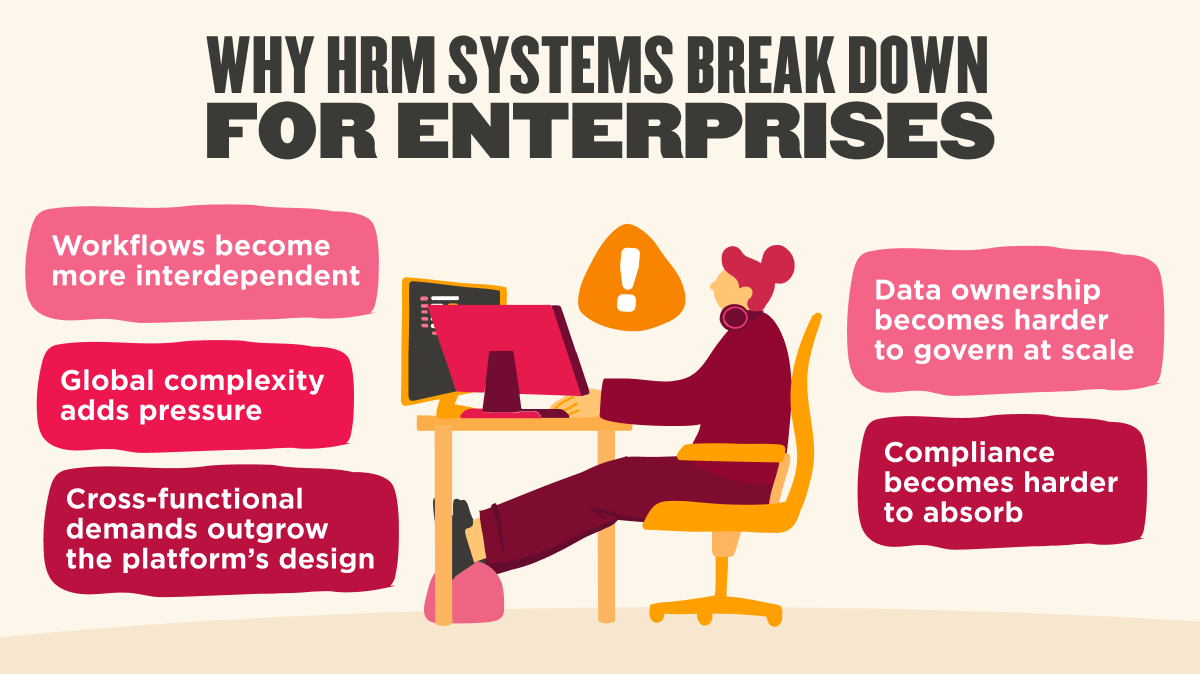
An HRM system can work well for a growing company for a long time. But over time, the system that once held everything together starts to create friction across the organization. A few patterns tend to drive that tipping point:
- Data ownership becomes harder to govern at scale. Workforce, payroll, and finance data often sit in separate systems with different owners, processes, and controls.
- Workflows become more interdependent. Changes to pay, structure, leave, or scheduling create downstream effects across HR, payroll, benefits, and reporting.
- Global complexity adds pressure. Different calendars, pay cycles, leave rules, and tax requirements expose the limits of systems built for narrower operating models.
- Compliance becomes harder to absorb. When every legal or policy update requires manual fixes or vendor support, risk starts to build.
- Cross-functional demands outgrow the platform’s design. Finance needs workforce data in real time. IT expects modern integrations and predictable security. Legacy HRM systems may struggle to meet both.
The result isn’t usually sudden failure. It’s a growing gap between what the business needs and what the platform was designed to support.
Early warning signs your current HRM system is reaching its limit
Most HR leaders recognize the signs before they define the problem. Reports take longer to pull. Payroll questions become more frequent. Managers stop relying on dashboards. These aren’t minor frustrations. They are signs that the system no longer supports the level of complexity the business needs it to handle.
Here are some of the most common signs that your current HRM system is starting to hold the business back:
| Signal | What it really means | How to test it |
| Manual workarounds are becoming standard | The system no longer supports key workflows cleanly, so teams are relying on spreadsheets, side systems, or email to keep work moving. | Count the spreadsheets, trackers, and side systems your HR team and managers actively maintain. |
| Data doesn’t match across systems | HR, payroll, and Finance are working from different numbers, which slows decisions and weakens trust. | Run the same headcount or labor cost report across systems and compare the results. |
| Reporting is slow or difficult to trust | The system cannot deliver timely, reliable answers without manual effort. | Track how long it takes to produce your most-used reports and how often they need correction. |
| Cross-functional workflows keep breaking down | Processes across HR, Finance, IT, benefits, or payroll depend on labor-intensive handoffs instead of connected workflows. | List your key integrations and flag the ones that require hands-on intervention or repeated fixes. |
| Admin effort rises faster than the business | Routine changes like hires, promotions, relocations, and exits still require too much manual work. | Compare HR operations workload or headcount growth with overall business growth. |
| Compliance changes create disproportionate effort | The system is not flexible enough to absorb new requirements at scale. | Review how many recent compliance updates required workarounds, vendor support, or custom fixes. |
When several of these signs appear at once, the issue isn’t usually process discipline alone. It’s a sign that the system is no longer keeping pace with the business. Running these checks helps turn a general sense of friction into evidence leaders can act on.
The real business cost of hitting your HRM tipping point
When an HRM system stops scaling with your business, the cost goes well beyond HR operations. It affects payroll accuracy, productivity, retention, and decision quality across the business:
Direct financial cost
Finance teams often feel the impact early because the cost shows up in payroll corrections, off-cycle runs, compliance remediation, and extra work. When an HRM system reaches its limit, routine tasks spill into spreadsheets, emails, and manual follow-up across HR, payroll, Finance, and managers.
Even small breakdowns become expensive at scale. One manual HR data entry without self-service technology carries an average estimated cost of $4.86. As those interventions multiply, so does the cost of running the business.
Productivity loss
A stretched HRM system creates drag across the organization. Reporting takes longer, approvals need follow-up, and managers spend more time validating data than acting on it. Gartner found that only 24 percent of HR functions say they are maximizing the business value of their HR technology, pointing to a wider gap between system investment and business impact.
When core systems stop delivering timely, usable data, the cost shows up in slower execution and lower-value work.
People and retention risk
Repeated delays, inconsistent data, and disconnected workflows do more than frustrate teams. They weaken trust in the systems and processes people rely on every day. That matters because everyday experiences, from onboarding to payroll and performance processes, shape whether people feel supported, productive, and likely to stay.
For example, in HiBob’s 2026 investment report, 90 percent of respondents said onboarding programs had a positive impact, and 40 percent said onboarding made a significant positive difference, more than any other initiative measured. The same report describes onboarding as a driver of stronger early engagement, smoother cultural alignment, and higher long-term retention.
These are the kinds of experiences HR systems should help teams deliver consistently. When the system adds friction instead, the business feels the cost in both trust and retention.
Decision-making limitations
When workforce data is incomplete, outdated, or spread across systems, departments can’t plan from the same foundation. In HiBob’s global survey, only two percent of managers said they have a unified HR and Finance dashboard, while 79 percent said one would help them manage more fairly and effectively.
When shared visibility is missing, headcount planning, compensation discussions, and budget decisions become harder to make with confidence. This slows planning, weakens confidence in workforce decisions, and leaves HR and Finance reacting to change instead of getting ahead of it.
How to avoid the HRM tipping point
The goal is not to keep patching around system limitations. It’s to give HR, Finance, and managers a stronger foundation for planning, execution, and growth. HiBob’s 2026 survey found that 79 percent of managers said a unified HR and Finance dashboard would help them manage more fairly and effectively, yet only 2 percent said they have one today.
Closing that gap is one of the clearest ways growing companies can improve decision quality and scale with more confidence. The most effective organizations do that by:
- Creating one source of truth for workforce data: When HR and Finance work from the same foundation, teams spend less time reconciling numbers and more time making decisions.
- Connecting planning, approval, pay, and reporting: Workforce decisions move faster when the systems behind them are aligned.
- Providing shared visibility: Real-time access to headcount, workforce costs, openings, attrition, and payroll variance helps both teams plan with more confidence.
- Building governance into the platform: Role-based access, audit logs, configurable controls, and strong security should scale with the business rather than rely on exceptions and workarounds.
- Using AI to reduce manual work and surface insight faster: AI is most useful when it is embedded in workflows, grounded in connected data, and designed to help teams act faster without giving up control.
This is where a modern, scalable HR software makes a difference. HiBob connects HR, payroll, benefits, and Finance in one platform so teams can plan, approve, pay, and report with better visibility and less friction. With shared data and built-in AI capabilities through Bob Companion, organizations can reduce manual work, surface workforce insights faster, and support better decisions across teams.
Recommended For Further Reading
Prevent enterprise-wide disruption with a scalable HRM system
The HRM tipping point rarely arrives as a single crisis. More often, it builds over time through confusing workarounds, disconnected systems, and growing gaps in trust. Eventually, those issues create more friction than the platform can absorb. Leaders who recognize the signs early, from data discrepancies and shadow systems to integration gaps and rising manual work, have more room to act. Those who wait usually face a higher price: first in operational inefficiency, then in the pressure of trying to replace a system while the business is still moving.
HiBob is built for the needs of modern, growing businesses. Bob brings HR, payroll, benefits, and Finance together in one connected platform, giving teams a shared source of truth for planning, approval, execution, and reporting. With the flexibility to adapt as the business grows, HiBob helps HR and Finance stay aligned, reduce friction, and make decisions with more confidence.
HiBob’s AI capabilities help teams get more value from that connected foundation. With Bob Companion, HR and Finance teams can surface workforce insights faster, reduce manual reporting, and get answers in the flow of work. Instead of spending hours assembling data, teams can focus on planning, identifying risks earlier, and making better decisions with the right context.
HRM tipping point FAQs
When is the right time to replace your HRM?
The clearest trigger is pattern recognition: When several warning signs appear at once—manual workarounds, data discrepancies, slow reporting, shadow systems, integration gaps—the platform has reached its ceiling. Other catalysts include a planned expansion into a new jurisdiction, an acquisition, a payroll provider change, or a Finance transformation initiative. Replacing the system during a calm period is far less disruptive than replacing it during a crisis.
Can one HR system support global growth?
Yes, when the platform is designed for international operation from the start. That means jurisdiction-aware data models, native multi-currency and multi-country payroll support, localized compliance updates handled by the vendor, and configurable workflows for regional policies.
Legacy systems often claim global coverage but deliver it through bolted-on modules that drift out of sync. A modern HCM treats global as the default, not an upgrade path.
What is the difference between HRM, HRMS, and HCM at scale?
HRM is the broadest term, HRMS adds core transactional capability, and HCM covers the full strategic picture. An HRM manages people processes. An HRMS adds payroll, benefits, and time tracking in one system. An HCM extends into talent, performance, workforce planning, compensation, and Finance integration. At enterprise scale, the distinction matters because the HCM layer is where strategic decisions live.