According to Forrester, over a quarter of global organizations they surveyed estimate annual losses of $5 million dollars or more due to poor data quality. Much of that risk starts with how HR data moves through large organizations. It rarely lives in one place, instead passing between systems designed for different functions, update cycles, and approval processes. Every handoff creates another opportunity for data to fragment or drift out of sync.
Minor inconsistencies don’t stay minor for long. A missing start date here, a mismatched salary there, and soon your HR data is incomplete and misaligned. The impact hits hardest where HR and Finance overlap: workforce planning, compensation, and FP&A all depend on a connected view of people and cost, and fragmented records throw each one off.
The challenge isn’t just that “bad” HR data exists. It’s understanding where it shows up, how it affects the business, and what it takes to prevent it from spreading. Here’s how to spot it at scale and reduce the impact of faulty data in your own organization.
Key insights
- Bad HR data is inconsistent or incomplete information that limits accurate, confident decision-making
- Data issues typically originate from disconnected systems, manual processes, and unclear ownership
- The impact of inconsistent or incomplete data shows up quickly, from payroll errors to compliance fines and operational inefficiencies
- Large organizations can reduce the cost of bad HR data by centralizing team member data, defining clear ownership, and improving data visibility
What bad HR data looks like at scale
What does “bad” HR data mean? It refers to unreliable, error-filled data that can’t be trusted to guide planning or decisions. At scale, it shows up in patterns like:
Non-standardized data
Enterprise teams develop layers of team member data across departments, regions, and historical systems. But if companies don’t have a shared way of recording core information, the structure and definitions start to diverge and impact workforce analysis and decisions.
“Data’s the substance behind every system promise,” says Matthew Brown, Human Capital Management Director at ISG Software Research. “When job titles, skills frameworks, performance metrics, or salary bands aren’t consistently defined and maintained, the system can’t serve leadership decisions. It can’t deliver meaningful analytics. And it certainly won’t sustain trust.”
Take job titles: “Manager,” “Mgr,” and “Team Lead” can all describe the same role, but the system sees them as different. So when HR pulls headcount by role, it returns three smaller groupings instead of a single total. That split feeds into planning, so hiring targets and budgets get set against the wrong baseline. Then leadership moves forward with numbers that don’t reflect how the organization actually operates. When the data doesn’t line up, your outputs won’t either, leading to distorted insights and misaligned planning.
Implausible outliers
Obvious data errors point to deeper validation gaps in your systems and processes, with 16 percent of organizations reporting significant operational drag. They typically surface in your team member records as:
- Nonsensical salary amounts: Values missing zeros or decimal places
- Invalid birth dates: Records in the future or outside realistic age ranges
- Inconsistent start dates: Entries before the company existed or after termination
- Unrealistic paid time off (PTO) balances: Totals below zero or far beyond policy limits
In complex organizations, these outliers don’t stay contained to individual records. They move downstream into other systems and calculations—impacting headcount, compensation analysis, and workforce planning models.
Lagging data changes
Even when records are standardized, updates don’t land everywhere on the same schedule. A role change gets approved in the HRIS today, payroll picks it up in the next cycle, and reporting tools refresh whenever they’re configured to—if they’re connected at all. The data isn’t wrong so much as out of date, and that lag alone is enough to throw decisions off.
The mismatches surface fast. The org chart shows a manager with eight direct reports, but performance systems list six. Finance pulls headcount for budgeting and reports 12 more team members than HR. Payroll removes a terminated team member, but HRIS still counts them, so benefit costs stay inflated.
Each delay leaves teams unsure which record reflects today’s reality—and the cost of catching up compounds. Manual corrections average $4.86 per fix, and at enterprise volume, that adds up quickly.
Distorted analysis
Bad HR data causes teams to draw incorrect conclusions and make decisions that don’t match up with reality. “Just because you have a metric doesn’t mean it’s the right one,” says Dr. Adena White, Market Intelligence Manager at HiBob. “Gaps in your data can lead to missing trends or skewed averages, especially if the gaps are systematic.”
Distorted analysis can happen because of gaps in:
- Attrition rates: Appearing artificially high or low when terminated people aren’t coded properly
- Diversity metrics: Misrepresenting actual demographics due to incomplete or incorrect data entry
- Performance trends: Contradicting manager observations because of system errors or missing information
Organizations end up making workforce investments based on flawed assumptions, misallocating resources, and missing strategic opportunities. Leaders believe they’re making data-driven decisions, but the underlying data tells an incomplete story.
Audit failures
Unreliable people data becomes a problem the moment records have to hold up under review. What goes unnoticed day-to-day doesn’t cut it once an audit pulls it all together.
Common signals include mismatched I-9 forms, incomplete pay equity data, and benefits enrollment records that don’t align with payroll deductions. These discrepancies make it harder to validate team member information and support compliance reporting—and they’re not rare. Over half of companies have incurred payroll penalties for non-compliance in the past five years, with I-9 paperwork violations ranging from $281 to $2,789 alone.
In regulated or multi-jurisdiction environments, gaps like these carry greater consequences. Incomplete or inaccurate records can trigger audit findings, require remediation, and expose organizations to financial and legal risk.
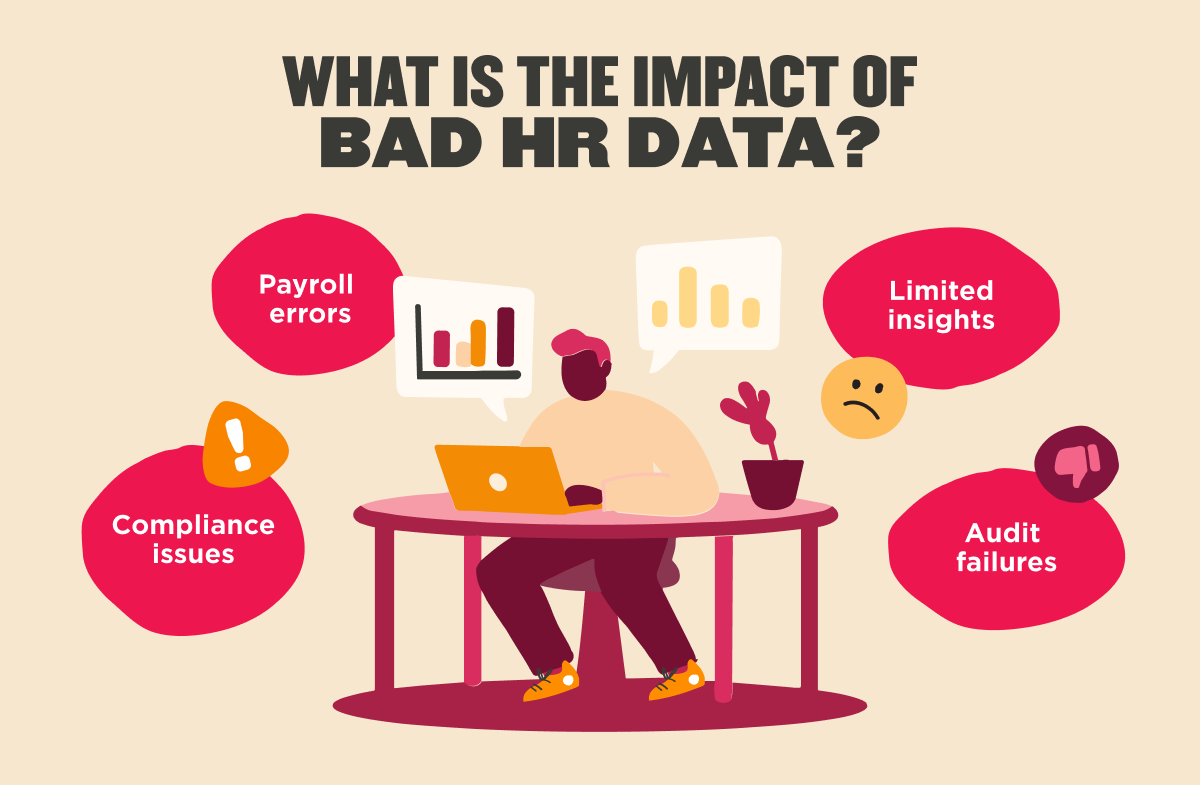
The real cost of bad HR data in large organizations
| Cost type | Example | Business impact | Real-world cost |
| Payroll errors | Incorrect compensation data | Overpayments, fines | ~15 corrections per pay period, each costing an average of $291 to resolve |
| Headcount misreporting | Inaccurate workforce data | Budget misallocation | 89 percent of CFOs knowingly make decisions based on unreliable records |
| Compliance gaps | Missing documentation | Legal exposure | Increased complexity negatively impacting profitability for 72 percent of organizations |
| Poor retention insights | Inaccurate attrition data | Weak workforce planning | 40 to 200 percent of salary to replace a single team member |
How to reduce the impact of bad HR data in large organizations
Addressing data issues takes more than fixing errors as they come up. Here’s how to prevent them from happening in the first place.
1. One shared source of truth
Fragmented systems create inconsistencies and endless reconciliation work that can consume up to 40 percent of a team’s time. “HR doesn’t need more data. We need better relationships between data points,” says Ken Matos, Director of Market Insights at HiBob. “That starts with breaking down the silos that separate you from your business outcomes.”
HR database software makes this possible by centralizing workforce data and getting rid of conflicting records. A role change, salary update, or termination is entered once, then reflected in reporting, payroll, and planning without relying on someone to update a second system later.
At Smartcat, moving to HiBob meant there was no need to check a second system. People data, onboarding, time off, and performance all lived in one place, so the team stopped reconciling records and guessing which version was right. That cut out the back-and-forth—reports didn’t need to be double-checked, discrepancies didn’t need to be chased—and the team could finally use their data without stopping to verify it first.
But even the best HR software doesn’t remove the need for discipline. Data quality still depends on how updates are made and whether teams treat the system as the place where records stay accurate, not just stored.
2. Clear ownership and accountability
Data quality breaks down when many people can make changes, but ownership of those changes isn’t clearly defined. “Good data governance requires cross-functional engagement where IT, finance, operations, and business leaders all share accountability for quality and clarity,” says Brown. “It’s not just about integrations or system logic; it’s about shared ownership of the truth.”
To support shared ownership without losing accountability:
- Define roles: Assign clear ownership for entering, validating, and maintaining data
- Document processes: Set expectations for how data gets updated during role changes, transfers, comp updates, and org shifts
- Run regular audits: Check key data on a set cadence to catch gaps and inconsistencies early
- Build data literacy: Help teams understand how their inputs affect reporting and downstream decisions
3. Real-time visibility and validation
Modern HR platforms provide real-time updates and automated validation to strengthen data integrity. When team member information changes, integrated systems update connected workflows right away through:
- Built-in checks: Validation rules flag issues such as negative salaries, future birth dates, or missing required fields at entry
- Standardized inputs: Replace free text with dropdowns and clear requirements to prevent errors at the source
- Workflow approvals: Route major changes through the right reviewers so errors get caught before they’re finalized
- Exception reporting: Surface patterns that signal problems, including spikes in terminations or compensation changes outside normal ranges
- Dashboards and alerts: Make inconsistencies visible early to address them before they escalate
- System synchronization: Establish automatic updates so data stays current everywhere
- Self-service accuracy: Give team members access to review their own information and flag discrepancies
“Clean data makes everything faster, easier, and more reliable,” says Dr. White. “It’s worth investing time upfront so that you’re not firefighting later.”
Recommended For Further Reading
Reduce costs and risk with a secure HR system
Fragmented people data means you can’t trust your own records. When updates happen inconsistently, incorrectly, or not at all, team member information starts to lag behind real-world changes. Multiply that by thousands of team members, and small inconsistencies spiral into costly problems.
A secure, all-in-one HR system removes data drift from the equation. When someone changes roles or teams, that change doesn’t create a mismatch somewhere else or show up differently in a report. Leaders don’t have to validate it or work around gaps before acting on it. Dr. White said it best: “High trust data leads to high trust insights, and that’s what powers high impact decisions.”
HiBob removes the fragmentation that causes “bad” HR data in the first place. Team member data lives in one system, so updates happen once and don’t rely on manual handoffs that introduce errors. Plus, HiBob’s AI-powered assistant, Bob Companion, surfaces anomalies in people data on demand, so teams catch drift before it spreads.
This shared foundation gives HR and Finance one source of truth for workforce costs, headcount plans, and pay decisions. When these departments share the same trusted data, workforce decisions move faster and business performance gets easier to steer.
See how HiBob can help you maintain reliable HR data at scale.
HR data FAQs
How do you measure HR data quality?
To measure HR data quality, build recurring checks into your workflows, such as comparing team member salaries in your HRIS and payroll before each pay run. Count how many don’t match, fix them, and track that number over time. If it’s not decreasing, something in your process is breaking.
Apply the same approach to other high-impact fields like start dates or job titles. Start with a small set of checks to quickly spot where data falls out of sync and whether your fixes work, then expand as your process matures.
What causes bad HR data?
“Bad” HR data is primarily caused by manual entry errors, disconnected systems, inconsistent processes, and missing validation rules. Updates made on one platform don’t always carry over, so multiple versions of the same records start to exist. These small gaps compound rapidly at scale, turning minor inconsistencies into widespread data problems that undermine reporting, compliance, and decision-making.
Who owns HR data in large organizations?
Large organizations don’t assign HR data to a single owner. HR maintains the central system of record and each team manages its own data: management updates roles, payroll handles compensation, and compliance oversees documentation. This makes it easier to keep HR data accurate and in sync as the company evolves.